Canada ending requirements for COVID-19 vaccines, ArriveCan app at border Sept. 30
Advertisement
Read this article for free:
or
Already have an account? Log in here »
To continue reading, please subscribe:
Digital Subscription
One year of digital access for only $1.44 a week*
- Enjoy unlimited reading on winnipegfreepress.com
- Read the E-Edition, our digital replica newspaper
- Access News Break, our award-winning app
- Play interactive puzzles
*Billed as $5.77 plus GST every four weeks. After 52 weeks, price increases to the regular rate of $19.95 plus GST every four weeks. Offer available to new and qualified returning subscribers only. Cancel any time.
To continue reading, please subscribe:
Add Free Press access to your Brandon Sun subscription for only an additional
$1 for the first 4 weeks*
- Enjoy unlimited reading on winnipegfreepress.com
- Read the E-Edition, our digital replica newspaper
- Access News Break, our award-winning app
- Play interactive puzzles
*Your next Brandon Sun subscription payment will increase by $1.00 and you will be charged $17.95 plus GST for four weeks. After four weeks, your payment will increase to $24.95 plus GST every four weeks.
Read unlimited articles for free today:
or
Already have an account? Log in here »
Hey there, time traveller!
This article was published 22/09/2022 (1498 days ago), so information in it may no longer be current.
OTTAWA – The last of Canada’s COVID-19 border restrictions will disappear at the end of this month with the expiry of a cabinet order affecting mandatory vaccinations, testing and quarantine of international travellers.
That expiry also spells the end of insisting travellers use the ArriveCan app to input their vaccine status and test results, though the app will live on as an optional tool for customs and immigration.
It doesn’t yet deal with whether passengers must wear masks on domestic and international trains and planes because that rule is contained in a separate order issued by the minister of transport.
Two senior government sources aware of the decision confirmed the cabinet order maintaining COVID-19 border measures will not be renewed when it expires on Sept. 30.
The sources spoke to The Canadian Press on the condition they not be named because they were not authorized to speak publicly. While the Liberal cabinet did meet Thursday afternoon, cabinet approval is not required to allow the order to expire.
One of the sources said Prime Minister Justin Trudeau, before the cabinet meeting took place, signed off on the decision not to renew the rules.
The change means international travellers will no longer have to prove they are fully vaccinated against COVID-19. Under the current rule, Canadians returning to the country who aren’t vaccinated must show a negative COVID-19 test result before arriving, and undergo further testing after arrival. They also must quarantine for 14 days.
Foreigners who aren’t vaccinated are simply banned from Canada unless they fall into specific categories, such as airline or boat crew members, those who need essential medical treatment, diplomats and temporary foreign workers.
The cabinet order also spells out that vaccinated travellers will be selected for random COVID-19 testing, and requires travellers to submit their vaccine proof and test results electronically.
The only way to do that is through the ArriveCan app.
All of that will end when the clock strikes midnight on Oct. 1.
Tourism Minister Randy Boissonnault would not confirm the decision Thursday afternoon, but he said if the order is allowed to expire, that would also eliminate the only mandatory component for the ArriveCan app.
“So the mandatory piece is the vaccine piece, and because that’s how people prove it through the ArriveCan, that’s how the order is written, from what I remember,” he said on his way into the cabinet meeting.
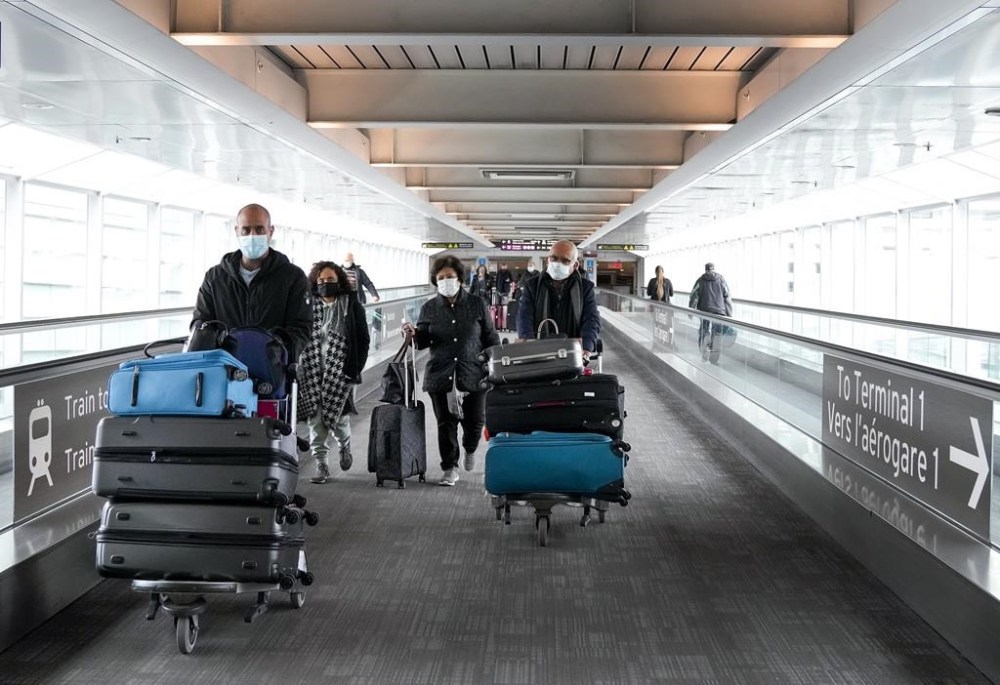
ArriveCan has morphed into a digitized border arrival tool, and now people flying into certain airports can use it to fill out their customs and immigration form instead of the paper version.
Boissonnault said that is in keeping with the digitization of border forms in a number of countries, including Europe, and long term will make for faster, smoother border experiences.
“If we’re going to want to go from 22 million visitors in 2019, to something closer to 30 million by 2030, we’re going to have to have a digital border,” he said.
The order’s expiration also means the minister of health will no longer be able to quickly bar citizens of specific countries facing COVID-19 outbreaks from coming to Canada. That measure was used to ban people from India and certain African countries at various points, moves criticized by some as racist.
Canada’s COVID-19 border measures have been evolving since the pandemic began in March 2020.
For more than a year, Canada invoked a mandatory 14-day quarantine for all returning Canadians, and for a time required quarantine to be fully or partially completed in specific hotels.
Between March 2020 and August 2021, foreign nationals couldn’t enter Canada period with some exemptions for critical workers including airline crew, health workers, and truck drivers.
In July 2021, once all Canadian adults and teenagers could access vaccines, the government stopped requiring quarantine for fully-vaccinated Canadian travellers.
In August 2021 they opened the border to fully vaccinated Americans, and in September 2021 the border was opened to fully vaccinated citizens from all countries.
Border measures have become heavily politicized, with the Conservatives demanding Trudeau lift them all, and Leader Pierre Poilievre made ending them a key policy in his recent leadership campaign.
Deputy Conservative leader Melissa Lantsman and the party’s Quebec lieutenant, Pierre Paul-Hus, said in a joint statement Wednesday that ending the measures within weeks of Poilievre winning the leadership was convenient.
“Ever since it was introduced, the ArriveCan app has killed jobs, suffocated economies all over the country, and told visitors they weren’t welcome in Canada,” they said. “Along with unscientific vaccine mandates and mandatory random testing, ArriveCan created the longest delays ever seen at Canada’s airports.”

Delays at airports were partially blamed on ArriveCan, as some travellers who struggled to get it to work, or couldn’t or wouldn’t use it, backed up lines. However, the delays have also been blamed on labour shortages affecting everything from airport workers to security and border guards.
Dr. Zain Chagla, an infectious disease specialist, has been arguing against mandatory vaccinations and testing at the border for months. In an interview Thursday he said testing asymptomatic travellers at the border is expensive and not as useful as testing symptomatic people in the community.
He said without testing everyone, the policy won’t prevent further spread of COVID-19.
The government had long pointed to the random testing as a way to screen for the arrival of new variants but Chagla said there are also better and more convenient ways to look for those as well.
This report by The Canadian Press was first published Sept. 22, 2022.
Related Articles
United in disdain for outdated ArriveCAN app
Advertisement Advertise With Us
Advertisement Advertise With Us