‘Deplorable evil’: Full text of the Pope’s residential school apology
Advertisement
Read this article for free:
or
Already have an account? Log in here »
To continue reading, please subscribe:
Digital Subscription
One year of digital access for only $1.44 a week*
- Enjoy unlimited reading on winnipegfreepress.com
- Read the E-Edition, our digital replica newspaper
- Access News Break, our award-winning app
- Play interactive puzzles
*Billed as $5.77 plus GST every four weeks. After 52 weeks, price increases to the regular rate of $19.95 plus GST every four weeks. Offer available to new and qualified returning subscribers only. Cancel any time.
To continue reading, please subscribe:
Add Free Press access to your Brandon Sun subscription for only an additional
$1 for the first 4 weeks*
- Enjoy unlimited reading on winnipegfreepress.com
- Read the E-Edition, our digital replica newspaper
- Access News Break, our award-winning app
- Play interactive puzzles
*Your next Brandon Sun subscription payment will increase by $1.00 and you will be charged $17.95 plus GST for four weeks. After four weeks, your payment will increase to $24.95 plus GST every four weeks.
Read unlimited articles for free today:
or
Already have an account? Log in here »
Hey there, time traveller!
This article was published 25/07/2022 (1558 days ago), so information in it may no longer be current.
MASKWACIS, ALTA. – Pope Francis delivered an apology to Indigenous residential school survivors in Maskwacis, Alta., after a visit to the former site of the Ermineskin Indian Residential School on Monday.
Here is the full text of his address:
Madam Governor General. Mr. Prime Minister. Dear Indigenous Peoples of Maskwacis and of this land of Canada. Dear brothers and sisters.
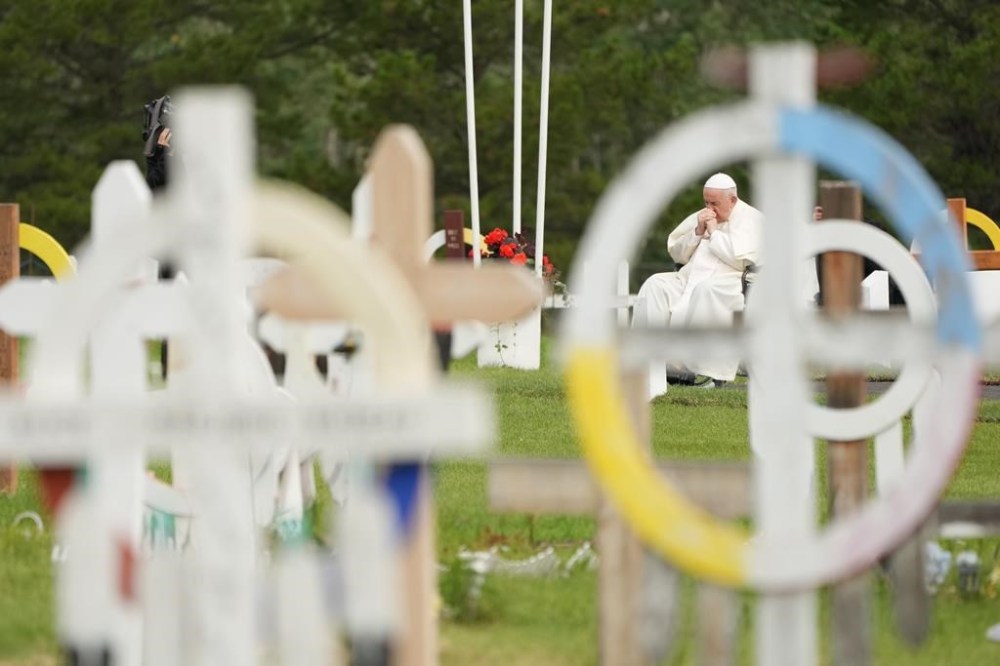
I have been waiting to come here and be with you. Here, from this place associated with painful memories, I would like to begin what I consider a penitential pilgrimage. I have come to your native lands to tell you in person of my sorrow, to implore God’s forgiveness, healing and reconciliation, to express my closeness and to pray with you and for you.
I recall the meetings we had in Rome four months ago. At that time, I was given two pairs of moccasins as a sign of the suffering endured by Indigenous children, particularly those who, unfortunately, never came back from the residential schools. I was asked to return the moccasins when I came to Canada, and I will do so at the end of these few words, in which I would like to reflect on this symbol, which over the past few months has kept alive my sense of sorrow, indignation and shame. The memory of those children is indeed painful; it urges us to work to ensure that every child is treated with love, honour and respect. At the same time, those moccasins also speak to us of a path to follow, a journey that we desire to make together. We want to walk together, to pray together and to work together, so that the sufferings of the past can lead to a future of justice, healing and reconciliation.
That is why the first part of my pilgrimage among you takes place in this region, which from time immemorial has seen the presence of Indigenous Peoples. These are lands that speak to us; they enable us to remember.
To remember, brothers and sisters, you have lived on these lands for thousands of years, following ways of life that respect the Earth, which you received as a legacy from past generations and are keeping for those yet to come. You have treated it as a gift of the Creator to be shared with others and to be cherished in harmony with all that exists, in profound fellowship with all living beings. In this way, you learned to foster a sense of family and community, and to build solid bonds between generations, honouring your elders and caring for your little ones. A treasury of sound customs and teachings, centred on concern for others, truthfulness, courage and respect, humility, honesty and practical wisdom.
Yet if those were the first steps taken in these lands, the path of remembrance leads us, sadly, to those that followed. The place where we are gathered renews within me the deep sense of pain and remorse that I have felt in these past months. I think back on the tragic situations that so many of you, your families and your communities have known; of what you shared with me about the suffering you endured in the residential schools. These are traumas that are in some way reawakened whenever the subject comes up; I realize too that our meeting today can bring back old memories and hurts, and that many of you may feel uncomfortable even as I speak. Yet, it is right to remember, because forgetfulness leads to indifference and, as has been said the opposite of love is not hatred, it’s indifference and the opposite of life is not death, it’s indifference. To remember the devastating experiences that took place in the residential schools hurts, angers, causes pain, and yet it is necessary.
It is necessary to remember how the policies of assimilation and enfranchisement, which also included the residential school system, were devastating for the people of these lands. When the European colonists first arrived here, there was a great opportunity to bring about a fruitful encounter between cultures, traditions and forms of spirituality. Yet, for the most part that did not happen. Again, I think back on the stories you told: how the policies of assimilation ended up systematically marginalizing the Indigenous Peoples; how also through the system of residential schools your languages and cultures were denigrated and suppressed; how children suffered physical, verbal, psychological and spiritual abuse; how they were taken away from their homes at a young age, and how that indelibly affected relationships between parents and children, grandparents and grandchildren.
I thank you for making me appreciate this, for telling me about the heavy burdens that you still bear, for sharing with me these bitter memories. Today I am here, in this land that, along with its ancient memories, preserves the scars of still open wounds. I am here because the first step of my penitential pilgrimage among you is that of again asking forgiveness, of telling you once more that I am deeply sorry. Sorry for the ways in which, regrettably, many Christians supported the colonizing mentality of the powers that oppressed the Indigenous Peoples. I am sorry. I ask forgiveness, in particular, for the ways in which many members of the church and of religious communities co-operated, not least through their indifference, in projects of cultural destruction and forced assimilation promoted by the governments of that time, which culminated in the system of residential schools.
Although Christian charity was not absent, and there were many outstanding instances of devotion and care for children, the overall effects of the policies linked to the residential schools were catastrophic. What our Christian faith tells us is that this was a disastrous error, incompatible with the Gospel of Jesus Christ. It is painful to think of how the firm soil of values, language and culture that made up the authentic identity of your peoples was eroded, and that you have continued to pay the price of this. In the face of this deplorable evil, the church kneels before God and implores his forgiveness for the sins of her children. I myself wish to reaffirm this, with shame and unambiguously. I humbly beg forgiveness for the evil committed by so many Christians against the Indigenous Peoples.

Dear brothers and sisters, many of you and your representatives have stated that begging pardon is not the end of the matter. I fully agree: that is only the first step, the starting point. I also recognize that, looking to the past, no effort to beg pardon and to seek to repair the harm done will ever be sufficient and that, looking ahead to the future, no effort must be spared to create a culture able to prevent such situations from happening. An important part of this process will be to conduct a serious investigation into the facts of what took place in the past and to assist the survivors of the residential schools to experience healing from the traumas they suffered.
I trust and pray that Christians and civil society in this land may grow in the ability to accept and respect the identity and the experience of the Indigenous Peoples. It is my hope that concrete ways can be found to make those peoples better known and esteemed, so that all may learn to walk together. For my part, I will continue to encourage the efforts of all Catholics to support the Indigenous Peoples. I have done so at various times and occasions, through meetings, appeals and also through the writing of an Apostolic Exhortation. I realize that all this will require time and patience. We are speaking of processes that must penetrate hearts. My presence here and the commitment of the Canadian Bishops are a testimony to our will to persevere on this path.
Dear friends, this pilgrimage is taking place over several days and in places far distant from one another; even so, it will not allow me to accept the many invitations I have received to visit centres like Kamloops, Winnipeg and various places in Saskatchewan, Yukon and the Northwest Territories. Nonetheless, please know that all of you are in my thoughts and in my prayer. Know that I am aware of the sufferings and traumas, the difficulties and challenges, experienced by the Indigenous Peoples in every region of this country. The words that I speak throughout this penitential journey are meant for every Native community and person. I embrace all of you with affection.
On this first step of my journey, I have wanted to make space for memory. Here, today, I am with you to recall the past, to grieve with you, to bow our heads together in silence and to pray before the graves. Let us allow these moments of silence to help us interiorize our pain. Silence. And prayer. In the face of evil, we pray to the Lord of goodness; in the face of death, we pray to the God of life. Our Lord Jesus Christ took a grave, which seemed the burial place of every hope and dream, leaving behind only sorrow, pain and resignation, and made it a place of rebirth and resurrection, the beginning of a history of new life and universal reconciliation. Our own efforts are not enough to achieve healing and reconciliation: we need God’s grace. We need the quiet and powerful wisdom of the Spirit, the tender love of the Comforter. May he bring to fulfilment the deepest expectations of our hearts. May he guide our steps and enable us to advance together on our journey.
This report by The Canadian Press was first published July 25, 2022.

Advertisement Advertise With Us
Advertisement Advertise With Us
The Free Press acknowledges the financial support it receives from members of the city’s faith community, which makes our coverage of religion possible.