WEATHER ALERT

Pope sorry for forced assimilation of Indigenous people at residential schools

Advertisement

Advertise with us

MASKWACIS - Tears streamed down the faces of Indigenous elders and survivors of residential schools as Pope Francis stood before them and begged forgiveness for the "deplorable evil" committed by members the Roman Catholic Church.

Read this article for free:


By clicking the button above, an account will be created and you will begin to receive some of our recommended newsletters. You may opt out of any newsletter by visiting your Email and Communication Preferences page or by clicking "unsubscribe" at the bottom of any email.

or

Already have an account? Log in here »

To continue reading, please subscribe:

Digital Subscription

One year of digital access for only $1.44 a week*

  • Enjoy unlimited reading on winnipegfreepress.com
  • Read the E-Edition, our digital replica newspaper
  • Access News Break, our award-winning app
  • Play interactive puzzles

*Billed as $5.77 plus GST every four weeks. After 52 weeks, price increases to the regular rate of $19.95 plus GST every four weeks. Offer available to new and qualified returning subscribers only. Cancel any time.

To continue reading, please subscribe:

Add Free Press access to your Brandon Sun subscription for only an additional

$1 for the first 4 weeks*

  • Enjoy unlimited reading on winnipegfreepress.com
  • Read the E-Edition, our digital replica newspaper
  • Access News Break, our award-winning app
  • Play interactive puzzles
Start now

*Your next Brandon Sun subscription payment will increase by $1.00 and you will be charged $17.95 plus GST for four weeks. After four weeks, your payment will increase to $24.95 plus GST every four weeks.

Hey there, time traveller!
This article was published 25/07/2022 (1561 days ago), so information in it may no longer be current.

MASKWACIS – Tears streamed down the faces of Indigenous elders and survivors of residential schools as Pope Francis stood before them and begged forgiveness for the “deplorable evil” committed by members the Roman Catholic Church.

Francis, at his first public appearance in Canada in Maskwacis, Alta., said he was sorry the church took part in the cultural destruction and forced assimilation of Indigenous people.

“In the face of this deplorable evil, the church kneels before God and implores his forgiveness for the sins of her children … I humbly beg forgiveness for the evil committed by so many Christians against the Indigenous Peoples,” Francis said Monday through a translator at the community’s powwow grounds.
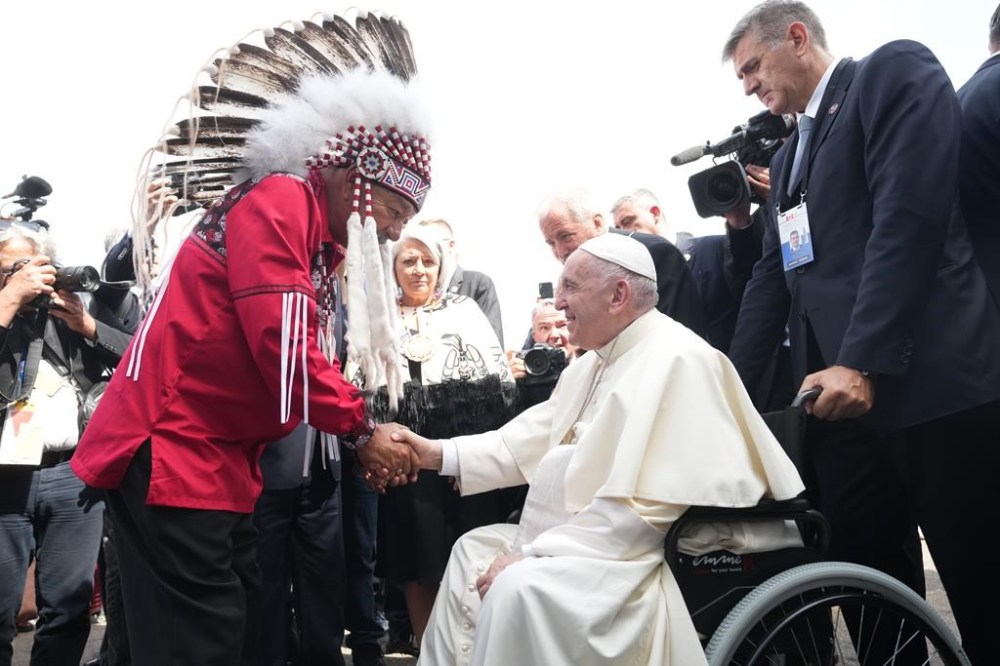
Pope Francis is greeted by George Arcand, Grand Chief of the Confederacy of Treaty Six First Nations, as he arrives in Edmonton on Sunday, July 24, 2022. His visit to Canada is aimed at reconciliation with Indigenous people for the Catholic Church's role in residential schools.THE CANADIAN PRESS/Nathan Denette

It was an apology that Evelyn Korkmaz, a survivor of the St. Anne’s Indian Residential School in Ontario, had waited 50 years to hear,but she was left wanting more.

“Part of me is rejoiced. Part of me sad. Part of me is numb,” she said.

“I am glad I lived long enough to have witnessed this apology.”

Francis also received applause and cheers from many in the crowd of thousands as he said he felt sorrow, indignation and shame. Others sat in contemplation with their eyes closed when the pontiff said the actions of the church were a “disastrous error incompatible with the gospel of Jesus Christ.”

Francis asked for forgiveness, in particular, for “the ways in which many members of the church and of religious communities co-operated, not least through their indifference, in projects of cultural destruction and forced assimilation promoted by the governments of that time, which culminated in the system of residential schools.”

The Pope spoke in Spanish, his first language, and it was translated into English by a priest. Translations were also available in several Indigenous languages.

He said begging forgiveness is the first step and there must be a serious investigation into what took place. He also called the overall effects of the policies linked to residential schools “catastrophic.”

Following his apology, Francis returned a pair of moccasins to Marie-Anne Day Walker-Pelletier, a retired chief of Okanese First Nation in Saskatchewan.

She had given the children’s moccasins to the Pope when an Indigenous delegation visited Rome earlier this year. They were meant to represent children who never came home from residential schools and she had told the pontiff she expected him to return them when he came to apologize on Canadian soil.

An estimated 150,000 Indigenous children were forced to attend residential schools in Canada, where neglect and physical and sexual abuse were rampant. More than 60 per cent of the schools were run by the Catholic Church.

Eileen Clearsky from Waywayseecappo First Nation in Manitoba held photos of her mother and father during the Pope’s address. She said she wanted to honour her parents, who were both survivors, and to find healing for her family.

“It’s been a long journey to find out who we are because of the legacy that residential school has left behind for us to deal with,” Clearsky said.

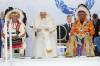
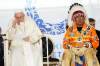
Chief Wilton Littlechild gave Francis a headdress. The former member of the Truth and Reconciliation Commission attended residential schools for 14 years as a child in Alberta.

He said he hopes the Pope’s visit furthers a pathway of justice, healing, reconciliation and hope.

Jon Crier, a residential school survivor, questioned whether the Pope’s apology is enough. He said the church must now respond by laying out a plan to repair its relationship with Indigenous people.

Treaty 6 Grand Chief George Arcand Jr. said the Pope’s apology felt genuine but action around his words is needed.

Pope Francis is greeted by George Arcand, Grand Chief of the Confederacy of Treaty Six First Nations, as he arrives in Edmonton on Sunday, July 24, 2022. His visit to Canada is aimed at reconciliation with Indigenous people for the Catholic Church's role in residential schools.THE CANADIAN PRESS/Nathan Denette

Minister of Crown-Indigenous Relations Marc Miller said the apology must be “the beginning and not the end.” He said more work must be done, including getting documents from the Catholic Church.

Earlier in the day, Francis held his own face as he was brought in a wheelchair to a graveyard in Maskwacis. Organizers said there are likely remains of residential school students among the graves.

The Ermineskin Indian Residential School was one of the largest residential schools in the country. Five teepees were set up at the location for the Pope’s visit — four representing the nations of the land and the fifth as a symbol of the entrance to the former school.

Later Monday, Francis echoed his comments of sorrow to members of the Church of Sacred Heart in Edmonton’s inner city.

“May this never happen again in the Church,” the Pope said. “May Jesus be preached as he desires, in freedom and charity.”

The century-old church blends Catholic and Indigenous rituals. The pontiff sat in a chair placed at the front of the church under wooden teepee poles.

Francis also blessed a statue of Kateri Tekakwitha, the first Indigenous person to be canonized as a saint. He held the hands of elders, touching some on the head, as he was wheeled out.

Later in the week, the Pope is scheduled to host a large outdoor mass at the city’s football stadium and take part in a pilgrimage in nearby Lac Ste. Anne, before travelling to Quebec City and Iqaluit.

The Indian Residential Schools Resolution Health Support Program has a hotline to help residential school survivors and their relatives suffering trauma invoked by the recall of past abuse. The number is 1-866-925-4419.

This report by The Canadian Press was first published July 25, 2022.

— With files from Kelly Geraldine Malone in Winnipeg

—

This story was produced with the financial assistance of the Meta and Canadian Press News Fellowship.

Report Error Submit a Tip

The Free Press acknowledges the financial support it receives from members of the city’s faith community, which makes our coverage of religion possible.
More Stories

Ottawa announces $500 million for North End sewage plant upgrade

Joyanne Pursaga 5 minute read Preview

Ottawa announces $500 million for North End sewage plant upgrade

Joyanne Pursaga 5 minute read Friday, Oct. 30, 2026

The federal government will provide $500 million to help complete the major upgrade to Winnipeg’s North End sewage treatment plant.

Winnipeg South MP Terry Duguid confirmed the total funding at a news conference at the plant Friday, calling the work critical to Winnipeg’s future.

“The stakes could not be higher. Without expanded wastewater treatment, Winnipeg would run out of capacity to build new homes and accommodate new industries within six years,” said Duguid.

The commitment offers the final funding needed to cover the $1.57-billion third and final phase of the upgrade. The city and province will also pay $500 million each for the work.

Read
Friday, Oct. 30, 2026

Third fire hits troubled Manitoba Housing apartment block

Malak Abas 4 minute read Preview

Third fire hits troubled Manitoba Housing apartment block

Malak Abas 4 minute read 3:19 PM EST

Residents of a North End Manitoba Housing apartment block with a long history of trouble say they’re shaken after the building was hit with its third fire in eight months Friday night.

An apartment complex at 145 Powers St. was evacuated by firefighters after a fire broke out at around 7:45 p.m.

When longtime resident Sharon Markwell heard the fire alarm go off, she chalked it up to a false alarm — kids will get into the building and pull the fire alarm around once or twice a month, she said — until smoke began billowing into the hallway of her fifth-floor apartment.

“Once I realized that I could smell smoke very, very strongly, and the smoke was seeping into my room, into my apartment, I said to myself, ‘This is no false alarm. This is the real thing,’” Markwell, 64, told the Free Press Sunday.

Read
3:19 PM EST

RRC Polytech program cuts take bite out of hospitality, tourism sector

Maggie Macintosh 4 minute read Preview

RRC Polytech program cuts take bite out of hospitality, tourism sector

Maggie Macintosh 4 minute read Saturday, May. 2, 2026

Manitoba’s tourism industry is bracing for the disappearance of hospitality training programs — once-popular courses among international students.

Citing budgetary challenges related to a shift in federal immigration policy, Red River College Polytechnic is scrapping 11 programs and scaling back three others in 2026-27. Its hospitality business management diploma is one of seven permanent casualties.

The announcement, while unsurprising, is but the latest blow to a sector trying to “build back the workforce” in the wake of the COVID-19 pandemic, said Michael Juce, president of the Manitoba Hotel Association.

“Are people going to go outside of Manitoba for training? And if they leave, are they going to come back?” Juce said, adding that rural hotels in particular are already grappling with staffing shortages.

Read
Saturday, May. 2, 2026

Canada tops Dominican Republic in pre-qualifier

Jason Hills, The Canadian Press 4 minute read Preview

Canada tops Dominican Republic in pre-qualifier

Jason Hills, The Canadian Press 4 minute read Sunday, Nov. 17, 2019

EDMONTON - Canada's women's basketball team put its depth on display Sunday in a dominant 110-60 victory over the Dominican Republic in the final game of the FIBA Olympic pre-qualifying tournament.

All 12 players hit the scoresheet, including six in double digits, to help the Canadians finish 3-0 at the tournament and advance to the next Olympic qualifier in February.

Sami Hill led the way with 16 points, three rebounds, two assists and three steals, while 20-year-old Shaina Pellington recorded 14 points. Bridget Carleton and Jamie Scott had 13 points each and Ruth Hamblin had 11 points and five rebounds.

"We got to roll our whole lineups through, and it was fun when we got going," said Canada's coach Lisa Thomaidis. "It was nice to see different lineup contributing and building chemistry.

Read
Sunday, Nov. 17, 2019

Brandon manufacturer says Canadian steel in demand, but high costs, long delivery times hit hard

Gabrielle Piché 6 minute read Preview

Brandon manufacturer says Canadian steel in demand, but high costs, long delivery times hit hard

Gabrielle Piché 6 minute read Yesterday at 2:01 AM CDT

Something’s different in a Brandon plant.

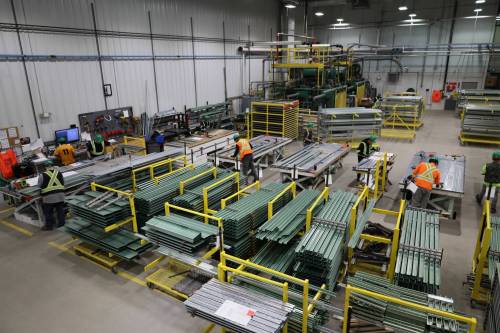
Building envelope panels — or shells for homes and commercial buildings — keep being produced at Greenstone Building Products.

But the galvanized steel used by workers has been arriving later and the price is constantly increasing, according to company leadership.

“It’s just a little bit nerve-wracking for us to hear the opposite narrative,” said Tilda Fortier, Greenstone Building Products’ business manager.

Read
Yesterday at 2:01 AM CDT

Imperialist crusades: 21st-century style

John R. Wiens 5 minute read Preview

Imperialist crusades: 21st-century style

John R. Wiens 5 minute read Wednesday, Jul. 8, 2026

In the 11th century and lasting into the 13th, the papacy launched a series of at least eight military campaigns we now refer to as the Crusades, or Holy Wars. They were an imperialistic call to arms for Christians to retake Jerusalem, which was at the time under Muslim rule.

Spiritual rewards for participation were implied, and other incentives offered, to dull the extra taxation demanded to fund the campaigns. Over time, the “crusades” morphed to become massacres of not only Muslims but also Jews and Christian dissidents — in other words, any enemies of the papacy. If today’s news sounds like déjà vu all over again, it probably should.

The stories keep repeating themselves in many forms. We now know that two 20th century world wars, global in scope, were caused by imperialistic ambitions, changes in the balance of international powers and corresponding arms races. The first was attributed to the assassination of the heir to the Austro-Hungarian throne by a Bosnian Serb, a kind of “regime change” initiative. The second resulted from rising tensions between Allied and Axis powers, triggered by the rise of European fascism and Japanese militarism. The human toll of both was unimaginable.

In the First World War, 15 to 22 million people, including soldiers and civilians, were killed and another 23 million were wounded. These numbers do not account for those otherwise affected — victims of chemical warfare whose compromised health shortened their lives; of the subsequent Spanish flu epidemic amplified by the displacement of peoples; others who died from other diseases caused by war conditions; and those who were malnourished or starved. Nor do they account for the ongoing trauma and resentments passed on intergenerationally to this day.

Read
Wednesday, Jul. 8, 2026