G-7 aims to create club of nations to boost climate action

Advertisement

Advertise with us

BERLIN (AP) — Members of the Group of Seven major economies pledged Tuesday to create a new " climate club " for nations that want to take more ambitious action to tackle global warming, putting them on a possible collision course with China.

Read this article for free:


or

Already have an account? Log in here »

To continue reading, please subscribe:

Subscribe and receive a limited-edition Free Press branded hat or tote.

Digital Subscription

One year of digital access for only $205*

  • Enjoy unlimited reading on winnipegfreepress.com
  • Read the E-Edition, our digital replica newspaper
  • Access News Break, our award-winning app
  • Play interactive puzzles

*First annual payment billed as $205.00 + GST for one year. This annual subscription will automatically renew at $233.00 + GST every 52 weeks (10% off the regular annual price of $259.35). Offer available to new and qualified returning subscribers only. Cancel any time.

To continue reading, please subscribe:

Add Free Press access to your Brandon Sun subscription for only an additional

$1 for the first 4 weeks*

  • Enjoy unlimited reading on winnipegfreepress.com
  • Read the E-Edition, our digital replica newspaper
  • Access News Break, our award-winning app
  • Play interactive puzzles
Start now

*Your next Brandon Sun subscription payment will increase by $1.00 and you will be charged $17.95 plus GST for four weeks. After four weeks, your payment will increase to $24.95 plus GST every four weeks.

Hey there, time traveller!
This article was published 28/06/2022 (1539 days ago), so information in it may no longer be current.

BERLIN (AP) — Members of the Group of Seven major economies pledged Tuesday to create a new ” climate club ” for nations that want to take more ambitious action to tackle global warming, putting them on a possible collision course with China.

The idea, championed by G-7 summit host German Chancellor Olaf Scholz, will see countries that join the club agree on tougher measures to reduce greenhouse gas emissions.

Countries that are part of the club will try to ensure their national measures are transparent and comparable, avoiding the need for members to impose climate-related tariffs on each others’ imports. The European Union in particular has touted such tariffs as a way to prevent companies which reduce emissions from being undercut by foreign rivals that don’t have to abide by strict environmental rules.
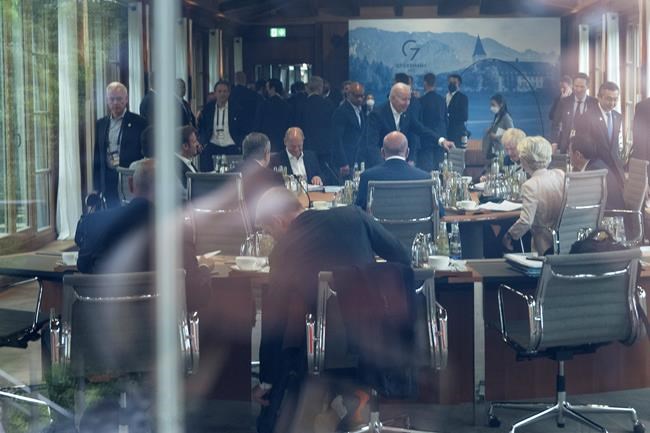
Leaders attend a working session pictured through a window glass, during the G7 leaders summit, at Bavaria's Schloss Elmau castle, in Kruen, near Garmisch-Partenkirchen, Tuesday, June 28, 2022 on the last day of the G7 Summit. (Brendan Smialowski/Pool Photo via AP)

Speaking at the end of the three-day summit, Scholz said the aim was to “ensure that protecting the climate is a competitive advantage, not a disadvantage.”

The G-7 say that the new club will be “will be inclusive in nature and open” to countries that are committed to fully implementing the 2015 Paris climate accord, but the idea is likely to find little favor particularly with China, the world’s biggest emitter. Beijing has made clear that it strongly opposes climate-related tariffs and has tried to rally support against the idea from other emerging and developing countries.

Scholz said details of the planned climate club would be finalized this year.

The G-7 also made clear their continued support for efforts to cap global warming at 1.5 Celsius (2.7 Fahrenheit) this century compared to preindustrial times, outlining numerous measures they will take to curb their own emissions and help poorer nations do the same.

Environmental campaigners expressed relief that existing pledges to phase out coal use and boost the uptake of electric cars hadn’t been rolled back, though the G-7 did soften their commitments on ending public support for fossil fuel investments.

In their final statement following three days of talks in Elmau, the G-7 leaders said that because of the exceptional circumstances arising from the war in Ukraine, “publicly supported investment in the gas sector can be appropriate as a temporary response.”

Environmental campaigners, scientists and U.N. Secretary-General Antonio Guterres have urged rich, developed nations to end all public finance for fossil fuel projects, warning that these could lock in increased carbon emissions or become obsolete in just a few years.

Scholz, whose country has scrambled to find replacements for Russian natural gas supplies cut due to the war in Ukraine, defended the decision.

“Gas will be needed temporarily and that is why there may be investments that make sense, in this transition phase, and that therefore may need to be supported,” he told reporters after the summit.

One of the arguments made by German officials in favor of supporting new natural gas development projects is that this could prevent them having to resort to burning more polluting coal to meet their energy needs.

But experts said it is unclear whether investments in natural gas projects — such as one that Germany is considering supporting in Senegal — even make financial sense when countries have committed not to release any additional emissions into the atmosphere by mid-century.

“The simple truth is gas, oil and coal have got much more expensive while clean alternatives like wind and solar look an even better, and far cheaper bet,” said Gareth Redmond-King of the environmental think tank Energy and Climate Intelligence Unit. “It will be critical not to risk fossil fuel stranded assets that, by the time they come online, find the world has moved on towards net zero.”

___

Follow AP’s coverage of the G-7 summit at https://apnews.com/hub/g-7-summit and climate issues at https://apnews.com/hub/climate

Report Error Submit a Tip

More Stories

Max Parrot lands bronze but actor-turned-snowboarder Su Yiming takes big air spotlight

Rosie DiManno - Star Columnist, Toronto Star 7 minute read Preview

Max Parrot lands bronze but actor-turned-snowboarder Su Yiming takes big air spotlight

Rosie DiManno - Star Columnist, Toronto Star 7 minute read Tuesday, Feb. 15, 2022

Su Yiming, a precocious Chinese teenager, truly exploded with supernova brilliance on Tuesday, writes Rosie DiManno.

Read
Tuesday, Feb. 15, 2022

Canada overlooks scores of workers

Krista Carr and Jonathan Lai 4 minute read Wednesday, Jul. 22, 2026

Canada has a labour shortage and a labour surplus at the same time. Canada’s labour force shortages are no longer a temporary challenge. Across the country, “help wanted” signs are everywhere.

A report this spring by RBC Economics said the situation will be exacerbated by retirements and changes in immigration policy.

Employers across the country say they can’t find enough workers. There is a solution, however, that continues to be overlooked. Roughly three-quarters of working-age Canadians with an intellectual disability or autism remain unemployed or underemployed despite being ready, willing and able to work. These two realities should not exist side by side.

For decades, many employers have overlooked this talented and motivated group of workers, often due to misconceptions about workplace accommodations or assumptions about productivity. The result is a labour market that is leaving approximately 500,000 capable individuals on the sidelines while businesses simultaneously report difficulty finding reliable employees.

Bond yields are rising, reflecting fear, loathing about state of world

Joel Schlesinger 6 minute read Preview

Bond yields are rising, reflecting fear, loathing about state of world

Joel Schlesinger 6 minute read Saturday, Sep. 12, 2026

It can seem counter-intuitive, but rising bond yields reflect investor worry. (After all, aren’t higher yields attractive?)

At the same time, investors’ bagful of anxieties is running headlong into greater demand for borrowing than at any time in human history.

It’s a full-course meal of mayhem: trade wars, unending real wars, accelerating government budgets and big tech companies borrowing as much as they can to achieve artificial intelligence supremacy.

Don’t forget the orange zest of economic unrest: an unpredictable, often incomprehensible president of the United States.

Read
Saturday, Sep. 12, 2026

Mayoral candidate denounced for online comments

Morgan Modjeski 3 minute read Preview

Mayoral candidate denounced for online comments

Morgan Modjeski 3 minute read Updated: Yesterday at 2:34 PM CDT

A Winnipeg mayoral candidate is facing criticism after he posted derogatory comments about immigrants and used the word “gay” as an insult online.

Sydney Adams said the response she got from Zac Uminski, who is seeking the city’s top office alongside 12 other individuals, left her baffled. She recently criticized Uminski over his use of artificial intelligence to produce campaign material, to which he replied he can’t afford to hire people to make art or “do whatever gay s—- you think is better than AI.”

“What was going through my head was that this is just unacceptable,” she said.

Adams said Uminski also posted other disparaging remarks about newcomers.

Read
Updated: Yesterday at 2:34 PM CDT

Letters, Sept. 14

7 minute read 2:00 AM CDT

Transit troubles and passes

Re: Growing pains? Maybe, but it’s worth it, Think Tank, Sept. 10.

Worth it for who? Our transit system has been undergoing growing pains for the past year, ever since city staff completely messed up the system with their redesign.

The net result of those changes is reduced ridership, leading to a projected deficit of $18 million in revenues this year (not including the capital costs of those changes). Add that to the annual $126-million subsidy to operate Winnipeg Transit and that’s $144 million being paid annually by Winnipeg taxpayers.

Don’t deny kids a bedtime bond with Gran

Maureen Scurfield 5 minute read 2:00 AM CDT

DEAR MISS LONELYHEARTS: My mother is coming to visit and our little kids want her to sleep in their bedroom, where there’s a double bed and a single. My husband thinks this idea is ridiculous and says grandma needs her sleep, but I disagree.

I remember sleeping with my grandma — who’s now with the angels — and she told us grandkids (two girls) some wonderful bedtime stories she made up herself. She even put our names into them, making us the stars of the stories.

The best part was getting into our pyjamas with our grandmother, who showed us the magic cord from the little thing that ran from her near-deaf ear down to the secret battery pocket hidden in the bra of her slip. It made her hear us better in the daytime. We thought, “Wow!”

Not surprisingly my own mother has inherited her mom’s fantastic storytelling talent and who knows what else she has to teach the kids when she’s alone with them? I want them to be close.