‘About the survivors’: Pope’s visit important to understand residential schools

Advertisement

Advertise with us

MASKWACIS - Leaders from four First Nations in central Alberta say the Pope's upcoming visit could help the world understand the trauma the residential school system caused to Indigenous people.

Read this article for free:


By clicking the button above, an account will be created and you will begin to receive some of our recommended newsletters. You may opt out of any newsletter by visiting your Email and Communication Preferences page or by clicking "unsubscribe" at the bottom of any email.

or

Already have an account? Log in here »

To continue reading, please subscribe:

Digital Subscription

One year of digital access for only $1.44 a week*

  • Enjoy unlimited reading on winnipegfreepress.com
  • Read the E-Edition, our digital replica newspaper
  • Access News Break, our award-winning app
  • Play interactive puzzles

*Billed as $5.77 plus GST every four weeks. After 52 weeks, price increases to the regular rate of $19.95 plus GST every four weeks. Offer available to new and qualified returning subscribers only. Cancel any time.

To continue reading, please subscribe:

Add Free Press access to your Brandon Sun subscription for only an additional

$1 for the first 4 weeks*

  • Enjoy unlimited reading on winnipegfreepress.com
  • Read the E-Edition, our digital replica newspaper
  • Access News Break, our award-winning app
  • Play interactive puzzles
Start now

*Your next Brandon Sun subscription payment will increase by $1.00 and you will be charged $17.95 plus GST for four weeks. After four weeks, your payment will increase to $24.95 plus GST every four weeks.

Hey there, time traveller!
This article was published 27/06/2022 (1586 days ago), so information in it may no longer be current.

MASKWACIS – Leaders from four First Nations in central Alberta say the Pope’s upcoming visit could help the world understand the trauma the residential school system caused to Indigenous people.

Pope Francis is scheduled to visit the Maskwacis area, south of Edmonton, as part of his Canadian tour from July 24 to 29.

The community, which has four member nations, says it has been working around the clock in preparation for the thousands of people who are anticipated to come to the area to watch as the Pope is expected to apologize to survivors of residential schools and hear their stories.
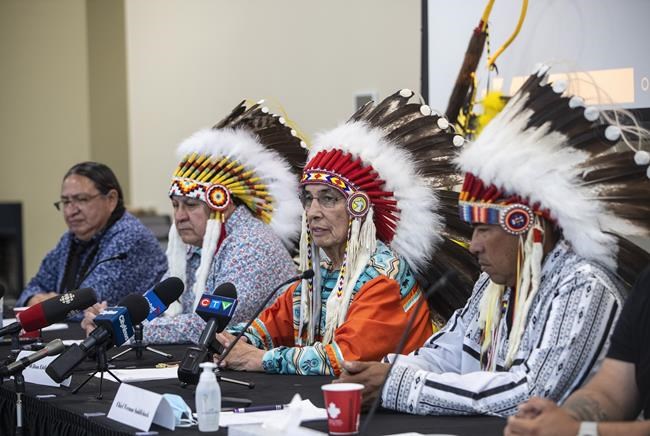
From left, Chief Desmond Bull, Chief Randy Ermineskin, Chief Wilton Littlechild and Chief Vernon Saddleback, speak about the announcement from the Vatican of the Papal visit, in Maskwacis Alta, on Monday, June 27, 2022. Leaders from four First Nations in central Alberta say the Pope's upcoming visit could help the world understand the impacts and intergenerational trauma that the residential school system inflicted on Indigenous people. THE CANADIAN PRESS/Jason Franson

The approximately one-hour visit to Maskwacis is the first scheduled stop during the pontiff’s trip.

Along with visiting a local church and cemetery, the Pope is also to visit the former site of a residential school in the community.

It signals his desire to highlight the voices of survivors, said Chief Wilton Littlechild, a lawyer and former Truth and Reconciliation Commission member who spent 14 years of his youth in a residential school.

“It’s about peaceful coexistence. It’s about the survivors and it’s about truth and about reconciliation,” Littlechild said at a news conference in Maskwacis on Monday.

“We ask everyone to join us on our walk together to the path of peace, justice and reconciliation.”

Littlechild said he hopes the Pope personalizes his apology and allows survivors some time to forgive when he is in Maskwacis.

Littlechild was among the Indigenous delegates who went to the Vatican in the spring to speak with Francis. The trip ended with the pontiff apologizing for the Roman Catholic Church’s role in residential schools and committing to visit Canada to make another apology.

Ermineskin Cree Nation Chief Randy Ermineskin said the planned visit is triggering a lot of emotions for survivors.

“After he leaves, we’re left holding the baggage.”

Ermineskin said the community has already been engaging local mental health practitioners to support survivors and it has reached out to the federal government to request more workers.

The Vatican has said the Pope’s daily appearances will be short due to the 85-year-old’s mobility and health issues.

The Maskwacis First Nations want to make sure the visit is meaningful despite the time constraints.

“I know many people are going to be disappointed at the time that they’re given, because this is years and years of trauma. Is that enough time? So, we want to make sure we use this time wisely,” Ermineskin said.

The Ermineskin Indian Residential School operated from 1895 to 1975 and was one of the largest residential schools in Canada.

The National Centre for Truth and Reconciliation has recorded the deaths of 15 students during its operation. In 1903, three children died of tuberculosis, while a government survey in the 1920s concluded half of the students were infected.

Survivors from the school told the Truth and Reconciliation Commission they were physically abused for speaking their first language and for practising their traditional ceremonies.

The residence closed in the early 1970s and the educational facilities were transferred to the Ermineskin Cree Nation.

Maskwacis created its own independent school system in 2016 to serve its member nations: Ermineskin Cree Nation, Louis Bull Tribe, Montana First Nation and Samson Cree Nation.

The fact that the Pope plans to visit an area that now has complete control over education represents a full-circle moment, said Crystal Fraser, an assistant professor in the faculty of native studies at the University of Alberta.

“It is really an example, a paradigm, of what Indigenous communities can do in order to educate their own children according to their own ways,” she said.

Maskwacis chiefs are welcoming survivors from across Canada to come during the Pope’s visit.

“Maybe for the first time and last time, someone will come here and put closure to some of the things that they have gone through in the residential schools,” Ermineskin said.

George Littlechild, an artist in Comox, B.C., sees the Pope’s visit as a time to heal.

The intergenerational residential school and Sixties Scoop survivor had family members who attended the Ermineskin school, including two uncles who died there.

He said it’s important for Francis to acknowledge that atrocities occurred.

“For those survivors and the pain that they lived through daily, I don’t think that pain ever goes away, but at least they’re being acknowledged.”

The Indian Residential Schools Resolution Health Support Program has a hotline to help residential school survivors and their relatives suffering trauma invoked by the recall of past abuse. The number is 1-866-925-4419.

This report by The Canadian Press was first published July 27, 2022.

— With files from Brittany Hobson in Winnipeg

Report Error Submit a Tip

The Free Press acknowledges the financial support it receives from members of the city’s faith community, which makes our coverage of religion possible.


More Stories

Is Canada headed for time chaos this weekend?

Michelle Bastian 5 minute read 2:00 AM CDT

When Manitoba Premier Wab Kinew declared Sept. 17 that the province would remain on permanent daylight time, he suggested it was a historical moment people would share with their “great-great-grandkids.” But, while Sunday, Nov. 1 has been heralded as the date many Canadians will stop changing their clocks, there are rumblings behind the scenes suggesting this will actually cause more trouble than ever before.

There are, of course, the warnings from chrono-biologists and sleep scientists about the damage permanent daylight time will do. The lighter evenings will mean many more dark mornings. But there is another set of problems in the offing in the critical infrastructure that underpins our digital lives.

While it used to be common to spend the Sunday morning after a time change going around our homes updating the clocks, we now wake up to devices that have already adjusted to the new time. These automatic updates occur regularly for daylight time, as well as when we travel to new time zones.

Our clocks are able to change by themselves owing to the hard work of a group of volunteers who were recently named in a list of the people who hold up the internet. This group, led by Paul Eggert, a computer scientist at UCLA, maintains a little-known tool called the Time Zone Database. Since the 1980s, it has kept track of regional, national and international debates about clock time and provided an up-to-date table of what time it should be on our walls.

Building healthier Canadians

Jason M. Sutherland 4 minute read 2:00 AM CDT

Ottawa is betting that billions of taxpayer dollars spent on steel, asphalt and concrete will secure Canada’s economic future and prosperity. Through the $51 billion Build Communities Strong fund, the federal government is paying for roads, bridges, water systems and transit to boost productivity and attract capital from Europe and Asia.

As the shovels hit the ground from Halifax to Vancouver, Canadians should be asking themselves: What good does it do to build a stronger country if we are not building healthier Canadians?

The fund’s $5 billion allocation for health infrastructure is welcome news, as many of our hospitals and long-term care homes across the country are showing severe signs of aging, and modern care centres are much needed. But pouring concrete for new facilities is not the same as building a healthy population.

A ribbon-cutting at a modern hospital does not guarantee you see a family doctor when you need one, keep a rural emergency department open overnight, or shorten the wait for a knee replacement keeping someone off the job or robbing a retiree of independence.

The volatile U.S. midterms

Allan Levine 5 minute read Preview

The volatile U.S. midterms

Allan Levine 5 minute read 2:00 AM CDT

The last time the Democratic Party had 218 or more seats — the number required to control the U.S. House of Representatives — was from 2021 to 2023, following the election of Democrat Joe Biden as president. During that same period, the Democrats also had the edge in the Senate. Despite a 50-50 split with the Republicans, Democrats were able to control the Senate with the help of Vice-President Kamala Harris, who cast the key vote in a tie. From 2023 to 2025, the Democrats had a slim 51 to 49 Senate majority.

If history repeats itself and the latest polls are fairly accurate, on Tuesday, Nov. 3, the Democratic Party will take back the House and (probably) the Senate from the Republicans, who have controlled both legislative bodies since the 2024 election. In the House, the Democrats have to gain at least three more seats. In the Senate, they have to win four more, which is entirely doable, though they almost certainly have to win a seat in Texas, Ohio, Kansas or Alaska, each of which currently has two Republican senators.

The prospect of a Democratic victory has President Donald Trump in a tizzy. For the past two years, he has abused his executive power to impose illegal tariffs on Canada and other countries; started a war with Iran; cozied up to Russian president Vladimir Putin and turned his back on Ukrainian president Volodymyr Zelenskyy; and increased the national debt through questionable tax cuts — to list only a few of his more egregious actions. He has been able to get away with this mainly because Republicans in the Senate and the House refuse to even question his decisions.

With the Democrats in charge, Trump’s brazen actions won’t be completely halted, but he will face significant legislative challenges and obstacles not easily dismissed. His controversial appointees, such as Attorney General Todd Blanche, who perceives himself as Trump’s private lawyer rather than the legal representative of the people, won’t get a free pass in committee hearings.

Read
2:00 AM CDT

Submit a news tip

1 minute read Monday, Mar. 16, 2026

Submit a news tip

Shocking development

Kelly Taylor 6 minute read Preview

Shocking development

Kelly Taylor 6 minute read 2:00 AM CDT

HOCKLEY VALLEY, Ont. — It’s not too often you get into a new vehicle, look at the interior, and say to yourself, “Wow, this is different… in a good way.”

Automakers tend to stick pretty close to defined norms, and when they differ, it’s not always successful. I’m looking at you, Toyota Yaris and Nissan X-Trail.

So, stepping into the 2027 BMW iX3 was refreshing. A bright parallelogram of a main touchscreen is closer to the driver than most, aided in no small part by pushing the instrument cluster to a narrow band just under the windscreen.

The effect is to clean up the look of the dash but without moving to a centre-mount instrument panel like the Yaris and X-Trail. The most valuable information (speed, battery charge, range) is right in front of the driver, visible above the top rim of the steering wheel.

Read
2:00 AM CDT

Waiting for Cormier verdict the ‘calm before the storm’

Katie May 6 minute read Preview

Waiting for Cormier verdict the ‘calm before the storm’

Katie May 6 minute read Thursday, Feb. 22, 2018

As the jury room door closed behind the seven women and four men who are now deliberating on the evidence against Tina Fontaine’s accused killer, Thelma Favel rose from the chair she’s occupied for most of Raymond Cormier’s second-degree murder trial.

Almost every day over the past three weeks, Favel, the woman who raised 15-year-old Tina, has sat right up front, directly across from the jury box, listening, sobbing and soaking in disturbing details of the teen’s last days that have come to light over the course of Cormier’s second-degree murder trial.

On Wednesday afternoon, after Court of Queen’s Bench Chief Justice Glenn Joyal instructed the jury and sent them off to be sequestered until they decide whether 56-year-old Raymond Cormier is guilty of killing Tina, Favel got up and hugged Crown prosecutor Breta Passler. It was one of many moments, this one shielded from jurors, that have long since proven the emotional impact of the case and the lasting power of Tina’s legacy.

Tina’s death sparked a public outcry that renewed calls for a national inquiry into disproportionately high rates of missing and murdered Indigenous women and girls across Canada, and the criminal trial for the man accused of killing her hasn’t happened in a vacuum.

Read
Thursday, Feb. 22, 2018