Federal COVID-19 vaccine mandates to be suspended for domestic, outbound travellers
Advertisement
Read this article for free:
or
Already have an account? Log in here »
To continue reading, please subscribe:

Digital Subscription
One year of digital access for only $205*
- Enjoy unlimited reading on winnipegfreepress.com
- Read the E-Edition, our digital replica newspaper
- Access News Break, our award-winning app
- Play interactive puzzles
*First annual payment billed as $205.00 + GST for one year. This annual subscription will automatically renew at $233.00 + GST every 52 weeks (10% off the regular annual price of $259.35). Offer available to new and qualified returning subscribers only. Cancel any time.
To continue reading, please subscribe:
Add Free Press access to your Brandon Sun subscription for only an additional
$1 for the first 4 weeks*
- Enjoy unlimited reading on winnipegfreepress.com
- Read the E-Edition, our digital replica newspaper
- Access News Break, our award-winning app
- Play interactive puzzles
*Your next Brandon Sun subscription payment will increase by $1.00 and you will be charged $17.95 plus GST for four weeks. After four weeks, your payment will increase to $24.95 plus GST every four weeks.
Read unlimited articles for free today:
or
Already have an account? Log in here »
Hey there, time traveller!
This article was published 14/06/2022 (1575 days ago), so information in it may no longer be current.
OTTAWA – The Canadian government will “suspend” COVID-19 vaccine mandates for domestic and outbound international travellers and federally regulated workers, ministers announced Tuesday.
The new rules will come into effect on June 20, though the requirements for foreign nationals coming to Canada will not change.
Several ministers lauded Canada’s high vaccination rate at a news conference to announce the changes, but Intergovernmental affairs Minister Dominic LeBlanc warned the government is prepared to “bring back” necessary policies if there’s a resurgence of the virus in the fall.
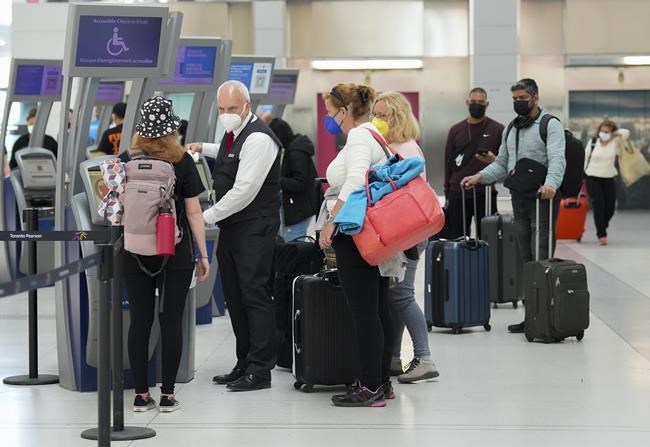
Travel industry groups have blamed federal public health measures and mandates for slowdowns at airport customs that have contributed to long waits for passengers and forced flight delays and cancellations.
They have put increasing pressure on the government to do away with them.
The decision to drop the federal mandate is not a response to the situation at Canada’s airports but rather is “based on science,” LeBlanc said.
“We don’t regret at all being cautious when it comes to a virus that has tragically killed tens of thousands of Canadians and millions of people around the world,” he said.
“Acting prudently has saved lives.”
Public health experts have known for six months that a two-dose series of the COVID-19 vaccine does not do a very good job guarding against transmission of the virus.
Health Minister Jean-Yves Duclos said the reason the government is changing course now is that there are encouraging epidemiological trends anticipated for the next few months.
“The number of hospitalizations, cases and deaths has fallen and experts tell us that we should expect the next few weeks in the summertime … to be relatively good in terms of COVID-19,” Duclos said.
The Public Health Agency of Canada has reported a steadily declining number of COVID-19 cases, though provinces are no longer providing COVID-19 molecular tests for the general public and federal reporting has become less regimented.
NDP transport critic Taylor Bachrach said the government hasn’t been transparent about the criteria cabinet is using to make public health decisions.
“For over a month we’ve been calling on the government to be more transparent with Canadians — they haven’t been. Now this leaves Canadians asking what’s changed?” he said in a statement.
Travellers will still need to fill out health questions through the ArriveCan app when travelling to Canada, even though the Canadian Airports Council pointed to the added verification as one of the issues causing snarls at customs.
“We’re working on efficiencies to ensure that ArriveCan is less of a source of complaint, however it continues to be a meaningful tool to verify the vaccination status of travellers who are arriving into our borders,” Transport Minister Omar Alghabra said.
He said foreign nationals must still be vaccinated when they come to Canada to protect the country’s health systems. Travellers on federally regulated planes and trains will also still need to wear masks.
The vaccine mandate will be lifted for federal workers who have been put on unpaid leave because of their vaccination status.
The mandates applied to all members of the core federal public service, including members of the RCMP. Federally regulated workplaces like Crown corporations and banks were also required to have a COVID-19 vaccine mandate policy for employees.
The government has not revealed how many employees have been put on leave, but reports 98.5 per cent of public servants are fully vaccinated with two doses of a COVID-19 vaccine.
Those who have been on leave will be contacted by their managers to resume their regular duties with pay, Treasury Board President Mona Fortier said.
Fortier said she expects government agencies and Crown corporations to remove vaccine mandates for their workers as well, at least for now.
The Public Service Alliance of Canada filed a policy grievance against the government earlier this year on behalf of those put on leave, as well as public servants who work from home but still needed to be vaccinated or risk losing their pay. Several other public sector unions have made similar challenges.
Those grievances are expected to remain in effect until unions have more details, said the Professional Institute of the Public Service of Canada.
The union’s president Jennifer Carr said they have been trying to get an update from the government for weeks about the plan for vaccine mandates, but found out about the change from the media rather than the employer.
Conservative transport critic Melissa Lantsman’s response to the policy change Tuesday was simply: “Finally.” She and other MPs in her party have been calling for an end to the mandates for months.
She noted though on Twitter that “suspending” mandates is not the same as eliminating them and there will still be some federal mandates in place. For example, cross-border truck drivers will still be required to be vaccinated.
Prime Minister Justin Trudeau first pitched vaccine mandates for federal workers and domestic travellers during the summer election, before the Omicron wave hit Canada in full force.
The government made no secret that it hoped the mandates would pressure Canadians to get their shots, saying the move was necessary to protect the public from severe illness and transmission of the virus.
After the Omicron variant overwhelmed the country, opposition members and some experts began to question the effectiveness of the mandate, since Omicron was still transmissible among people considered fully inoculated.
However, some public health experts have called on the government to add a third dose to the vaccine mandate to protect against severe illness.

“Two doses is not enough to provide vaccine effectiveness against Omicron infection,” chief public health officer Dr. Theresa Tam said at a briefing Friday.
While more than 89 per cent of Canadians over the age of 12 have at least two doses of an approved COVID-19 vaccine, only about 55 per cent of them have received a booster shot.
Duclos said Tuesday the government will move away from encouraging people to be “fully vaccinated” and instead move toward making sure Canadians are “up-to-date” on their COVID-19 vaccinations.
He said not enough Canadians are up to date, and the government will work with provinces and territories to try to boost those numbers before a potential resurgence in the fall.
This report by The Canadian Press was first published June 14, 2022.
Related Articles
End of vaccine mandates may open travel floodgates


Advertisement Advertise With Us
Advertisement Advertise With Us