Why? Because it’s sort of there
Remnants of original Red River Trail still exist, but long stretches lost to progress and time
Advertisement
Read this article for free:
or
Already have an account? Log in here »
To continue reading, please subscribe:
Digital Subscription
One year of digital access for only $1.44 a week*
- Enjoy unlimited reading on winnipegfreepress.com
- Read the E-Edition, our digital replica newspaper
- Access News Break, our award-winning app
- Play interactive puzzles
*Billed as $5.77 plus GST every four weeks. After 52 weeks, price increases to the regular rate of $19.95 plus GST every four weeks. Offer available to new and qualified returning subscribers only. Cancel any time.
To continue reading, please subscribe:
Add Free Press access to your Brandon Sun subscription for only an additional
$1 for the first 4 weeks*
- Enjoy unlimited reading on winnipegfreepress.com
- Read the E-Edition, our digital replica newspaper
- Access News Break, our award-winning app
- Play interactive puzzles
*Your next Brandon Sun subscription payment will increase by $1.00 and you will be charged $17.95 plus GST for four weeks. After four weeks, your payment will increase to $24.95 plus GST every four weeks.
Read unlimited articles for free today:
or
Already have an account? Log in here »
Hey there, time traveller!
This article was published 04/06/2022 (1599 days ago), so information in it may no longer be current.
Sometimes, when I’m asked why we would attempt an eight-week-long, slow-motion journey down a long forgotten trail, I’m tempted to be a smart ox and quote legendary climber George Mallory: “Because it’s there.”
The problem is, unlike Mount Everest, the Red River Trail isn’t there anymore. At least not exactly.
VIEW FROM THE OX CART
Winnipegger Terry Doerksen and his wife Patty are retracing the traditional trade route.
He is providing periodic updates for Free Press readers.
Read Doerksen’s first letter from the road: Big wheels start turning.
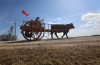
Long stretches of the Red River Trail have disappeared to development and to the plow. In these sections, my wife, Patty, and I use existing roads to follow the original route as closely as possible. Squaring off at mile roads makes our total route 54 miles longer than the original 469 miles. I use miles instead of kilometres, much like the Métis cart drivers who charted the trail.
About a third of the original trail got built up into roads that are still being used. The first 18-mile stretch leaving Upper Fort Garry down St. Mary’s Road past St. Adolphe is the longest section of original route in Manitoba. The last 50-mile stretch approaching the Mississippi River in St. Paul is the longest section in Minnesota.
The third thing that happened to small sections of the old Red River Trail is… nothing. They’re still there, in obscure places, with the wheel ruts visible. I’m hoping local people will point them out to me. The first place I was able to drive my cart on the actual trail was when we crossed the border into the U.S. It’s still clearly visible from Google Earth. I’ve talked to the farmers on either side of the border who confirmed what I saw. It was pretty crazy touching the past, and I’ll have more on the experience in my next dispatch.
But let’s get back to the real answer to the question of “Why?”
Why? To Touch Lagimodiere’s Box
I’m not the type of person who is welcomed in a museum. I’m tempted to touch artifacts when no one is looking. Whenever I read history, I have this desire to see what they saw, smell what they smelled, feel what they felt. What was it like to munch on pemmican and listen to fiddle music while leaning on your ox by the fire at the end of a day on the Red River Trail? Once in a while, a hyperactive curiosity can only be satisfied by an epic journey.
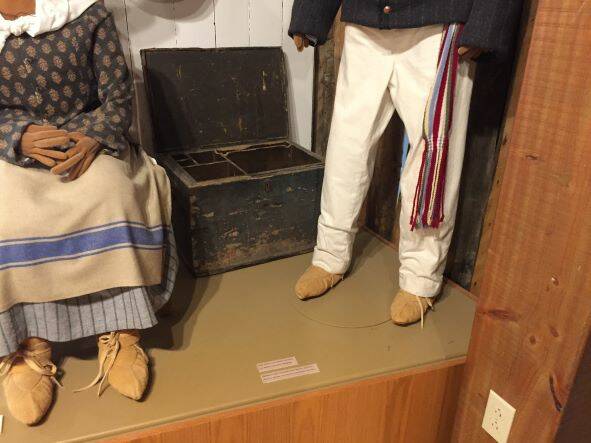
I had managed to slip my way into the St. Boniface Museum — the vetting questionnaire only asked about exposure to COVID and nothing about my compulsion relating to artifacts. I noticed a label that described a suitcase-sized wooden box made up of compartments: Jean Baptiste Lagimodiere’s Red River Cart Box.
What I knew about Lagimodiere got my imagination going. Musket balls for the buffalo hunt would go in one little section. Extra flints and wadding in another. And then (and here’s where it started getting dangerous) the thought occurred to me that this box should once again ride on a Red River cart.
Lagimodiere would have been honoured. I quickly suppressed the next idea to surface: nonchalantly walking out the door with the compartment. Instead, I talked to Tatianna at the counter who had unwittingly let me in. I explained my plans to retread the Red River Trail. And that it would be really, really cool to, once again, use Lagimodiere’s box for what it was made for. She was interested and would mention it to the new director who had just taken over that day. I went home, assuming there were more important things for a new museum director to deal with than a plan to temporarily rid her museum of a prized display. But by that evening I had an e-mail from Emilie Bordeleau-Laroche: “I am very excited to be able to help make this happen.”
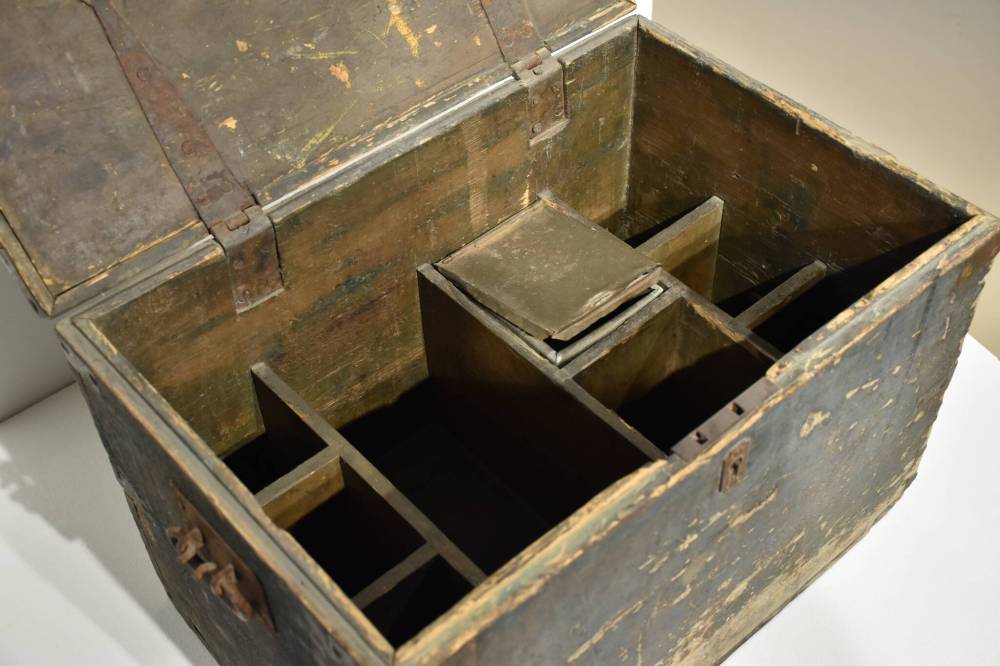
I have to admit I touched Lagimodiere’s cart box before it was carefully placed on the back of my cart on May 17 before departing from Upper Fort Garry. And with that rickety old box cushioned on a buffalo robe behind me, I was Jean-Baptiste Lagimodiere — off on another Red River Trail adventure.
Keeping it real
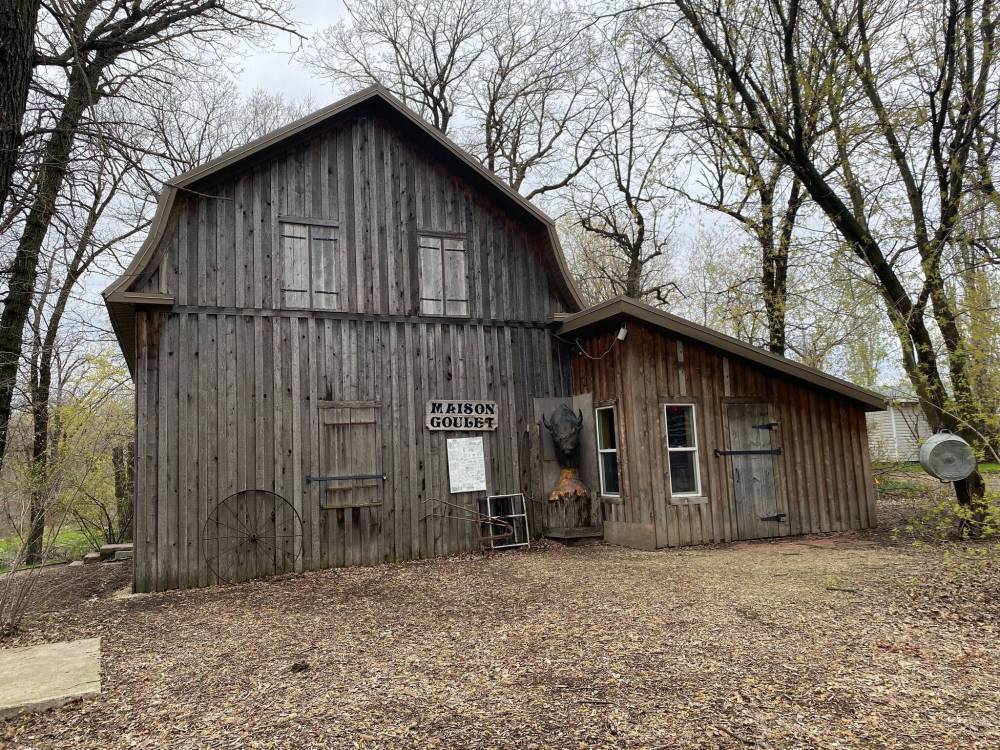
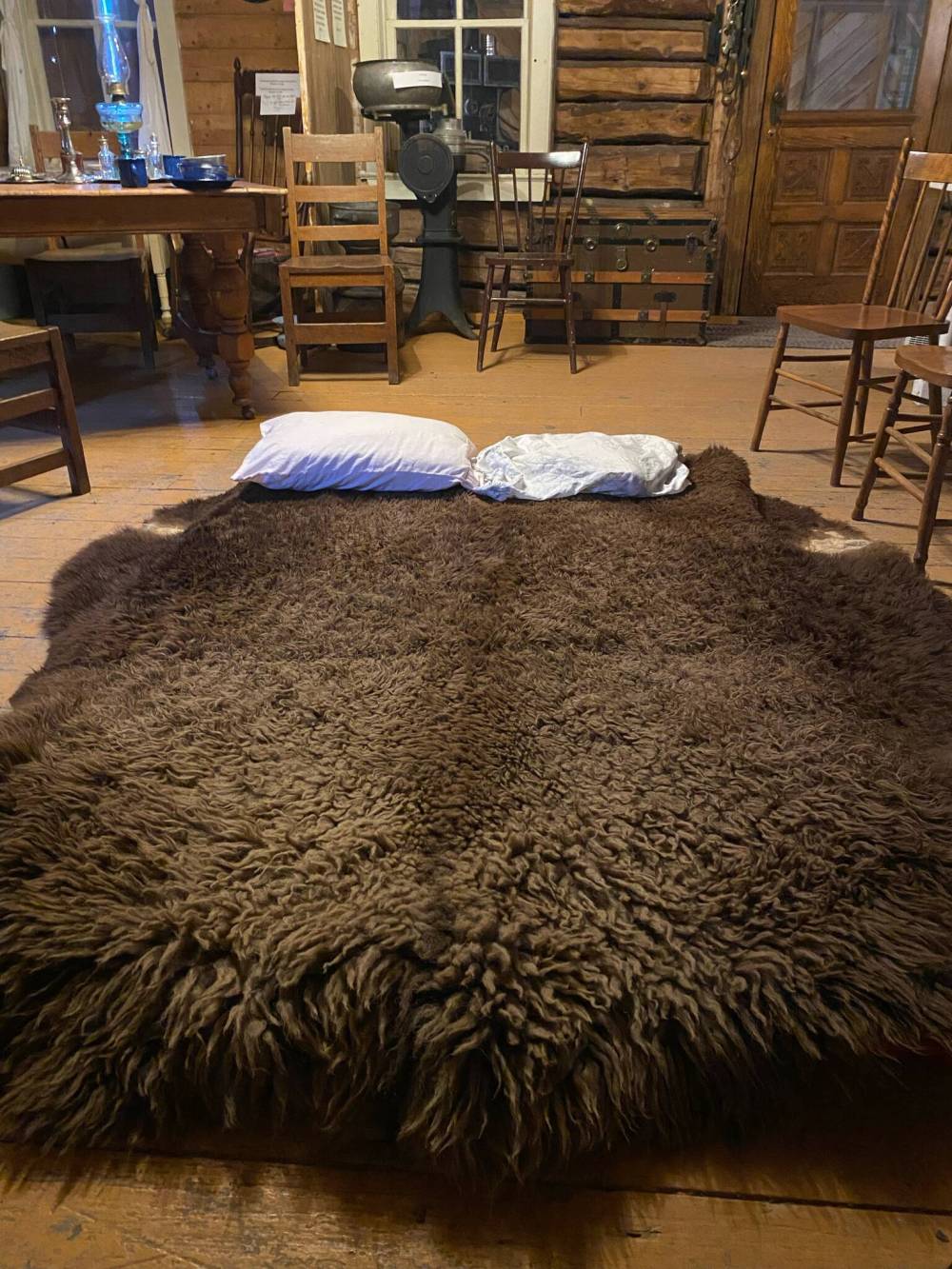
I wanted to do as many ‘real’ things as possible on our journey. With actual stuff from the old Red River Trail, such as Lagimodiere’s box. The next ‘real’ experience involved Maison Goulet, an original rest house on the trail that is now part of the St. Pierre Museum. The amazing thing is that Rollie Gagnon, the then-director of the museum, agreed to let us sleep in Maison Goulet for the night.
We approached St. Pierre on Rat River Road. It was the first stretch of original trail routing since St. Mary’s Road in Winnipeg. It had a feel of authenticity about it. Its curves followed the river and all the houses and farms were on the river side of the road — a relic of the early strip lots along the trail. The French accent of people who stopped to say ‘Bonjour’ added to the affect. But I was so focused on my tangible definition of ‘real’ that I almost missed savouring what might turn out to be a genuinely real embrace of our journey.
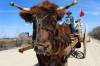
First, there was Al who stopped to see if our ox, Zik, needed any grain. He’d drop some oats off at the museum. Then when a piece of my harness broke, John came out from his house and asked if he could help. He welcomed us onto his yard for a midday stop. After making sure we had grazing for Zik, he brought us some muffins and eggs. John mentioned that Guy Gosselin is his best friend. Guy is a descendant of Jean-Baptiste Lagimodiere and the one who placed his ancestor’s box on our cart before we embarked on our journey. And then, on cue, Guy showed up and joined our conversation.
After our break I continued down the road, now leading Zik. We passed by Murielle’s place who came out to meet us and jumped on the cart for a ride into town. Murielle spearheaded the development of the Crow Wing Trail and has helped me a lot in my planning. Our old friend Cindy saw the cart from her workplace and ran out to join us. She also climbed aboard.
When we got to the museum, the new director said she hadn’t heard about our coming. That didn’t keep her from welcoming us with open arms and giving us the run of the place. As I lay awake on my buffalo robe on the floor of Maison Goulet — the floor that had felt the feet of many a jigging cart driver in years past — I thought about the day. I realized I had experienced something pretty special. It was the real, unchanged spirit of a close-knit, sharing community along the Red River Trail. And they had embraced me as part of it.
Metis-Mennonite Fusion
There was no question that we would visit Le Routier restaurant in St-Pierre-Jolys in quest of their deadly poutine. Poutine made with Bothwell cheese — a fusion of French-Canadian and Mennonite elements. The marble cheese is like a map of this part of Manitoba, where French-Canadian/Métis villages alternate with Mennonite settlements.
That’s kind of like our cart — a Métis vehicle with a Mennonite church pew for a seat, complete with hymn-book rack on the back. The ‘cartiste’ was Phil Doerksen, who poured in more than 200 hours of dedication and skill to craft this thing of beauty. The design and guidance came from Armand Jerome — together with his wife, Kelly, the foremost Red River Cart makers in the known universe.
Of course Armand wasn’t the first Métis to help a Mennonite with a cart. The area of St-Pierre-Jolys and the Rat River was a regular wintering spot for the Métis. It had a lot of hay for their animals and a lot of wood for building carts. And when the first Mennonite immigrants to Canada landed at the mouth of the Rat in 1874, they were met by their new Manitoba neighbours. A handful of Métis cart drivers would spend the next three days transporting the grateful newcomers — my ancestors — to immigration shelters.
Now, 150 years later, it’s my chance to pay tribute to the Métis — the best neighbours a Mennonite could have.
Related Articles
Grass for grazing and swamp for water redefine meaning of ‘perfect campsite’
Advertisement Advertise With Us
Advertisement Advertise With Us