Big wheels start turning Epic adventure years in the making begins with sendoff from Upper Fort Garry
Read this article for free:
or
Already have an account? Log in here »
To continue reading, please subscribe:
Digital Subscription
One year of digital access for only $1.44 a week*
- Enjoy unlimited reading on winnipegfreepress.com
- Read the E-Edition, our digital replica newspaper
- Access News Break, our award-winning app
- Play interactive puzzles
*Billed as $5.77 plus GST every four weeks. After 52 weeks, price increases to the regular rate of $19.95 plus GST every four weeks. Offer available to new and qualified returning subscribers only. Cancel any time.
To continue reading, please subscribe:
Add Free Press access to your Brandon Sun subscription for only an additional
$1 for the first 4 weeks*
- Enjoy unlimited reading on winnipegfreepress.com
- Read the E-Edition, our digital replica newspaper
- Access News Break, our award-winning app
- Play interactive puzzles
*Your next Brandon Sun subscription payment will increase by $1.00 and you will be charged $17.95 plus GST for four weeks. After four weeks, your payment will increase to $24.95 plus GST every four weeks.
Read unlimited articles for free today:
or
Already have an account? Log in here »
Hey there, time traveller!
This article was published 21/05/2022 (1613 days ago), so information in it may no longer be current.
I hate a sad ending. The book I had taken out of the Winnipeg Public Library, The Legend of Pierre Bottineau and the Red River Trail, had these for its final words:
The great wilderness of the plains turned to settlement and civilization. The trails they knew disappeared, and nobody ever went down them again.
Tales from the Red River Trail
Winnipegger Terry Doerksen and his wife Patty are retracing the traditional Métis trade route. He will be providing periodical updates for Free Press readers.
I had to talk to the author, Ted Stone. Was he still alive? I had to tell him the good news. The magical song of the ox cart would again be sung on the trail! I found his number and learned he was living in southern Manitoba, within earshot of the trail he had written about. He knew by proximity that it had gone silent.
Ted listened politely as I told him the wheels were already turning (so to squeak). That in a couple of years, I hoped to do something that hadn’t been done since the 1870s. Together with my wife, Patty, I planned to take an ox cart down the Red River Trail, 800-odd kilometres from Winnipeg to St. Paul, Minn.
Oh, I still needed an ox and a cart and I didn’t know anything about driving an animal, but those were just details …. Knowing what I’ve learned since that conversation, about the obstacles to travelling internationally by ox, maybe I shouldn’t have been surprised that Ted was a little hesitant to jump on board.
● ● ●
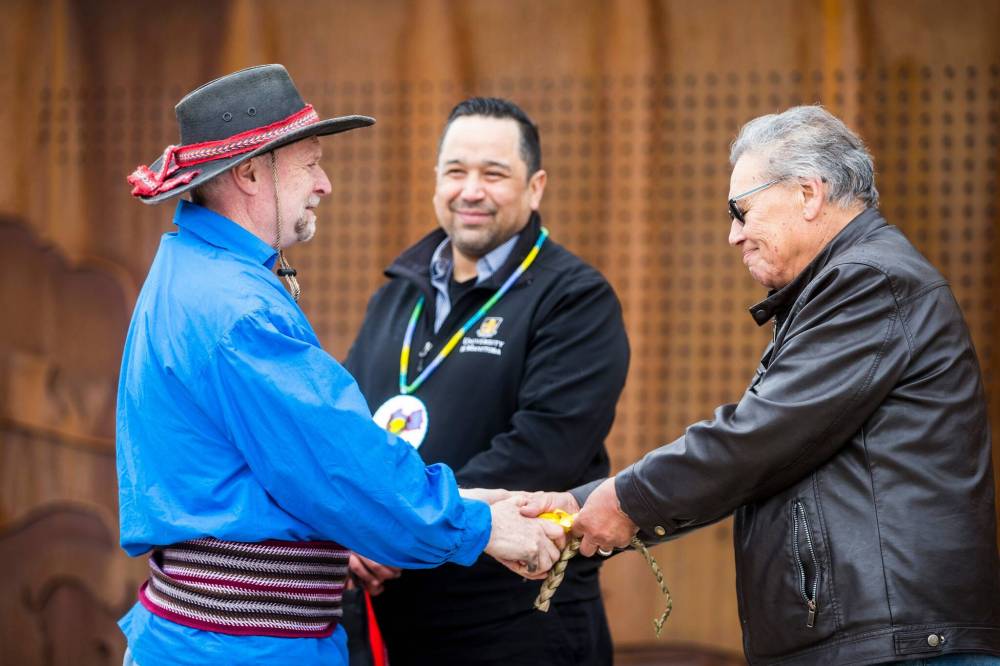
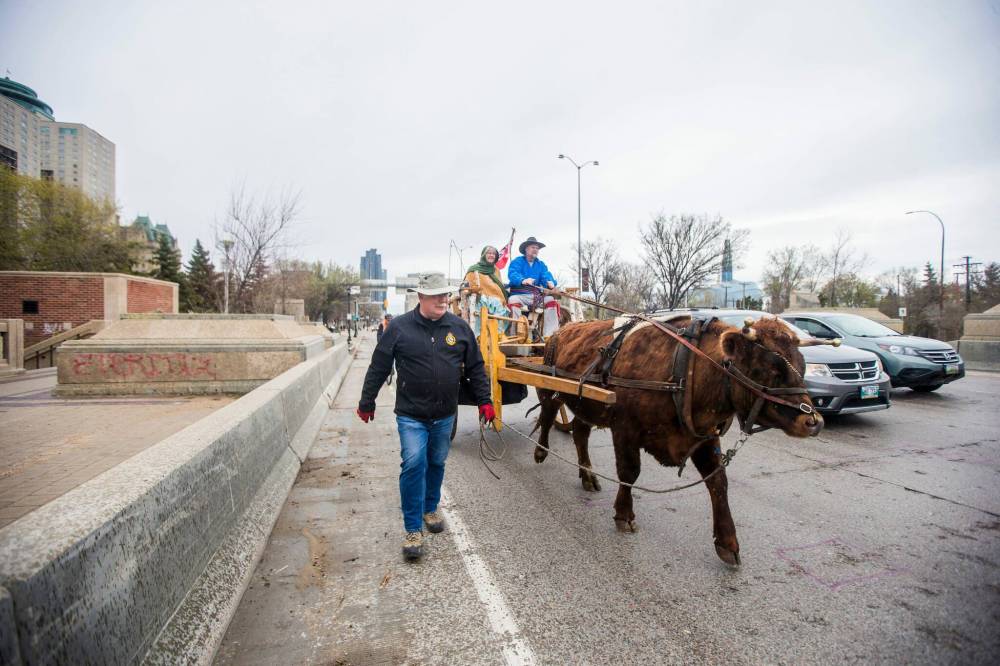
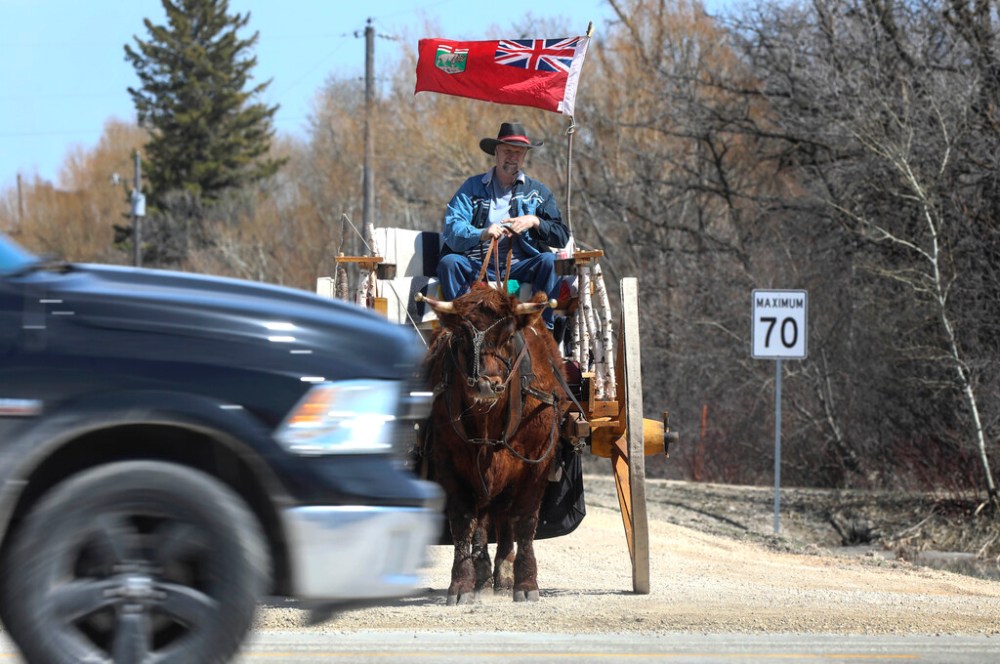
Like the tandem humps of a Mongolian camel, the road from Upper Fort Garry crosses the Assiniboine and the Red in quick succession. Much water has flowed under those bridges since my conversation with Ted. When we trundled across the bridges Tuesday, I was fully cognizant of the fact our predecessors didn’t have that luxury.
Previous carts to start down the Red River Trail were, unfortunately, dependent on the ferryman — one Duncan Macdougall. Mac Doug, as he was known to French speakers, was “inclined to conviviality,” which often meant a neglect of his naval duties. Many a frustrated carter would grow hoarse screaming for an AWOL Mac Doug from the far side of the river.
Should the ferry scow respond to the distant pleas, the adventure wasn’t over. Here’s how the scene was described in J.J. Hargrave’s Red River:
A slow trek through history
Posted:
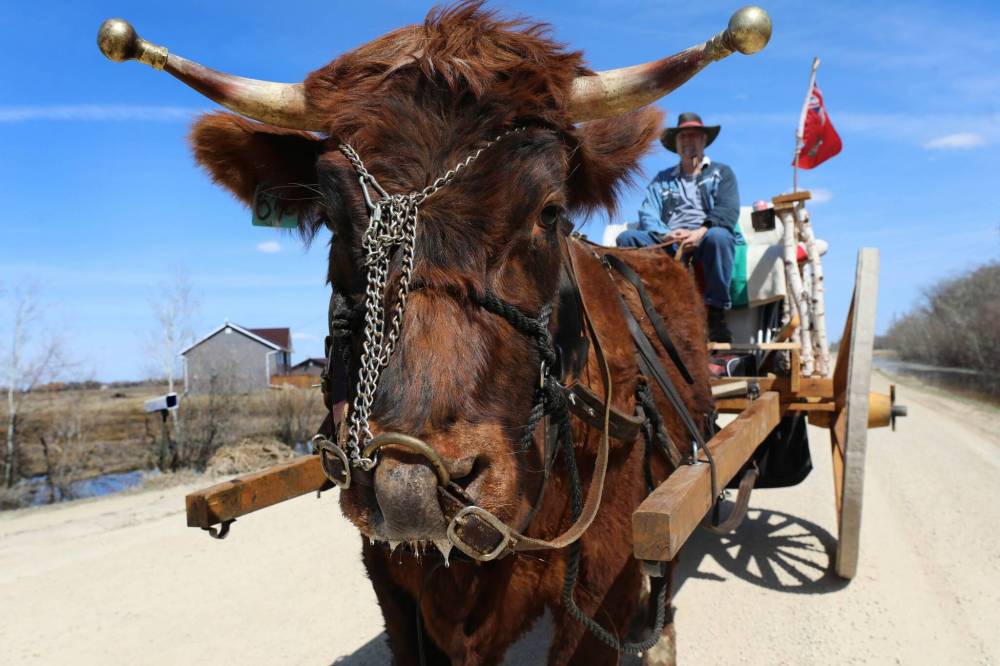
One Friday afternoon in May, a man named Terry Doerksen crossed Highway 8.
“The flooring of the scow had been reduced to such a state of disrepair that every step of the horses, or motion of the carts, deranged the boarding, sometimes to such an extent that, owing to the intervention of a tolerably central fulcrum underneath, one end of the board went down under pressure of a foot, while the other flew up with a certain degree of violence against the face of some neighbouring beast of burden. While the animal whose leg had sunk through the flooring was on his knees trying to recover himself, the other, who had received the stroke on his proboscis, might be on his haunches, the passengers shouting for mercy and assistance, the boatmen contemplating a leap into the water, and the scow floating in mid-channel of the river.”
As the first few carts in those former spring caravans to St. Paul slowly screeched their way down what is now St. Mary’s Road, more and more carts joined in behind. That didn’t happen to us, but we would have been ready. We were in possession of a City of Winnipeg parade permit.
Can you imagine having to wait for a 20-mile long, 2,500-cart-strong, undulating, dusty, squealing snake to pass by? And people complained about getting stuck in the Freedom Convoy passing Winnipeg this January! C.W. McCall’s trucking anthem could easily be adapted to the scene as an early cart train started gaining force:
By the time we hit the American line,
We had a thousand screamin’ carts,
And a couple long-robed friends of Jesus,
Heading out from St. Boniface.
Our own journey will see a few added variations to McCall’s version. Instead of “crashin’ the gate doin’ 98,” we’ll really have the hammer down if we hit 98 miles per week. I’m hoping to average two miles-per-hour and 15 miles-per-day, five days a week.
The only highway trouble we’re likely to have is if we get pulled over for not displaying a slow-poke triangle. The Smokies of Winnipeg were actually on our side, stopping traffic for us as we lumbered through town to the far side of the perimeter — our first night’s camp.
For all of you who patiently waited for us to pass by, I’d like to say thanks, and I hope you follow us on our journey the rest of the way.
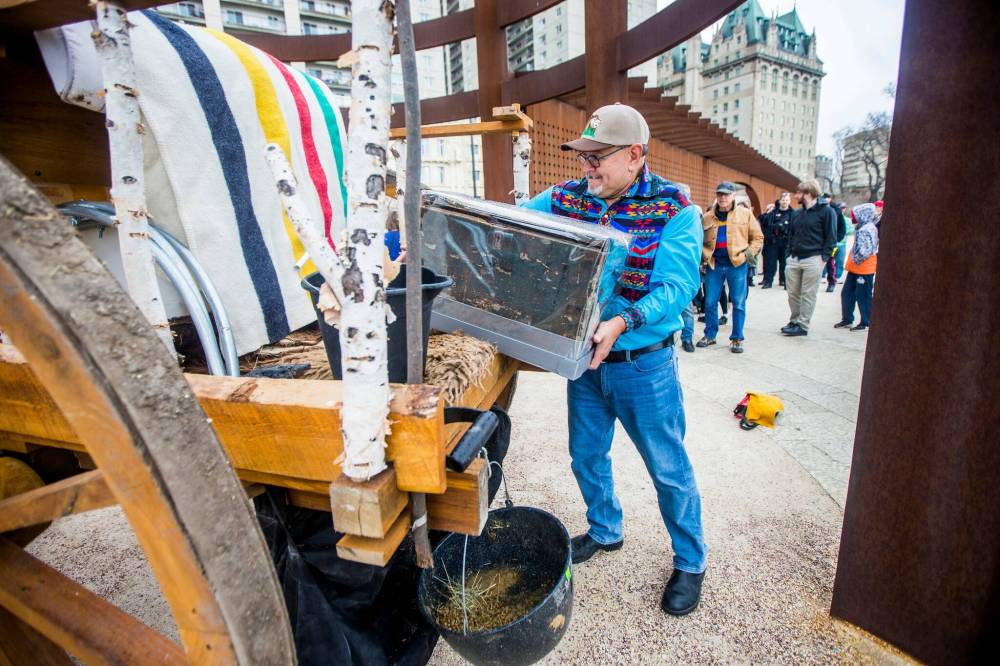
The ‘long-robed friends of Jesus’ in my Convoy parody refer to two Grey Nuns.
A brief history of my time
1961-1965: Born of pure Mennonite stock in Steinbach on Oct. 31, 1961.
That was 444 years to the day after Martin Luther nailed his theses to the door, 44 years to the day that Lawrence brought the Arabs into Damascus, and four years less four days after the dog, Laika, was launched into space. Are these facts significant? Maybe.
They show I like history and that my brain notices patterns like that. I lived the first four years of my life in my ancestral hometown of Blumenort.
1961-1965: Born of pure Mennonite stock in Steinbach on Oct. 31, 1961.
That was 444 years to the day after Martin Luther nailed his theses to the door, 44 years to the day that Lawrence brought the Arabs into Damascus, and four years less four days after the dog, Laika, was launched into space. Are these facts significant? Maybe.
They show I like history and that my brain notices patterns like that. I lived the first four years of my life in my ancestral hometown of Blumenort.
1965-79: Migrated west to Alberta with a three-year layover in Gouldtown, Sask. (No, you haven’t heard of it.) I grew up near the badlands where I loved to hunt for dinosaur bones.
1979-82: Studied at Winnipeg Bible College in Otterburne. Decided that if I ever lived in a city, I hoped it was Winnipeg. Met Patty Wiens. One of us fell deeply in love; the other said she just wanted to be friends.
1982-85: Adventured my way from Tuktoyaktuk to Titicaca. Caught an infection with the symptom of wanting to see around just one more bend of the trail. It was never fully cured.
1985-94: Became an electrician with Jorey Electric in … Winnipeg. Guess who finally married me in 1987? Leif was born in ’92.
1994-06: Taught English in Mongolia. Drank lots of fermented horse milk. Sim was born in ’95. Mischa in ’97.
2006-today: Back to work with Jorey Electric. Read lots of Manitoba history. Began thinking about an epic adventure.
Today, I did 15 miles in a Red River cart with the woman of my dreams. A guy could do a lot worse.
Long before the sadness of the residential schools, these Sisters of Charity were the hands and feet of Jesus to the Indigenous and Métis peoples of Red River and anyone who needed their selfless care.
One of the favourites was Sister Ste. Thérèse, who earned the nickname of Our Sister Doctor. She travelled great distances by foot, ox cart and canoe in all kinds of weather to visit the sick in a hut or a teepee. Apparently her presence healed as many as her herbal remedies.
It was another sister, Sister Valade, who founded the Grey Nun community in Red River in 1844, the year Louis Riel Jr. was born. In 1858, returning east for a meeting, this sister escorted 14-year-old Louis, the future father of Manitoba, by ox cart down the Red River Trail and on to Montreal where he would continue his education.
As we follow that pair down the same trail 164 years later, I think about the deep conversations that must have taken place between this woman of God and her devout young charge as they bounced along in their cart.
One year after Sister’s Valade’s trip, Sister Ste. Thérèse was told by her superior in Ottawa that she must leave Red River and move back east.
But the tearful onlookers who were there to see her off had no idea there was a seditious plot under way. A few Métis, led by Louis Riel Sr., sneaked ahead with an extra ox cart to the place on the Red River Trail where they knew the travellers would be camped the first night.
As Sister Ste. Thérèse wearily descended from her cart, she was surprised by a group of men who surrounded her and pointed to another, hidden, ox cart. “Sister, we will do you no harm but you are our prisoner.”
What could she do, but climb aboard and begin the trip back to where she had just come from? Presumably she saw her kidnapping as the will of God because Sister Ste. Thérèse stayed to serve the people of Red River for the rest of her life. Her medical work sowed the seeds that would grow into today’s St. Boniface Hospital and a blessing for our family. It was at St. B. where our two sons were born.
You may have noticed a random reference to Mongolia. It won’t be the last one. But to make sense of that, you might want to read on …


History
Updated on Saturday, May 21, 2022 11:46 AM CDT: Cutline updated.
Updated on Tuesday, May 24, 2022 10:05 AM CDT: Adds fact box