Elon Musk’s successful bid for Twitter explained, analyzed

Advertisement

Advertise with us

TORONTO - Twitter's board accepted Elon Musk's US$44-billion bid to take over the social media platform on Monday.

Read this article for free:


By clicking the button above, an account will be created and you will begin to receive some of our recommended newsletters. You may opt out of any newsletter by visiting your Email and Communication Preferences page or by clicking "unsubscribe" at the bottom of any email.

or

Already have an account? Log in here »

To continue reading, please subscribe:

Digital Subscription

One year of digital access for only $1.44 a week*

  • Enjoy unlimited reading on winnipegfreepress.com
  • Read the E-Edition, our digital replica newspaper
  • Access News Break, our award-winning app
  • Play interactive puzzles

*Billed as $5.77 plus GST every four weeks. After 52 weeks, price increases to the regular rate of $19.95 plus GST every four weeks. Offer available to new and qualified returning subscribers only. Cancel any time.

To continue reading, please subscribe:

Add Free Press access to your Brandon Sun subscription for only an additional

$1 for the first 4 weeks*

  • Enjoy unlimited reading on winnipegfreepress.com
  • Read the E-Edition, our digital replica newspaper
  • Access News Break, our award-winning app
  • Play interactive puzzles
Start now

*Your next Brandon Sun subscription payment will increase by $1.00 and you will be charged $17.95 plus GST for four weeks. After four weeks, your payment will increase to $24.95 plus GST every four weeks.

Hey there, time traveller!
This article was published 26/04/2022 (1649 days ago), so information in it may no longer be current.

TORONTO – Twitter’s board accepted Elon Musk’s US$44-billion bid to take over the social media platform on Monday.

The blockbuster offer made by the controversial Tesla and SpaceX leader, who has Canadian citizenship, will see Musk pay US$54.20 per share, a 38 per cent premium to the closing price of Twitter’s stock on April 1.

Musk has vowed to transform the company by taking it private, reducing content moderation and launching a long-requested edit button on Twitter.
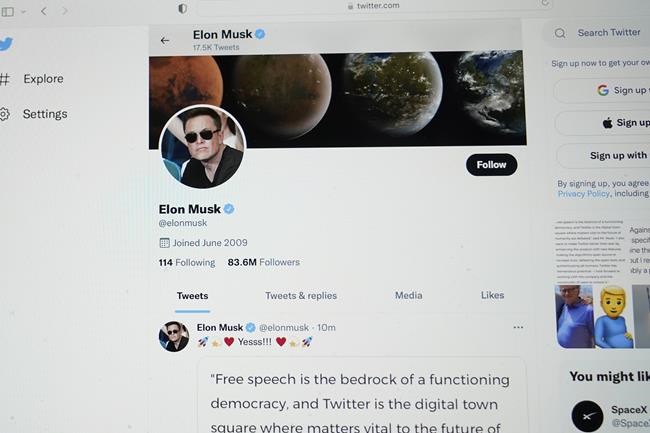
The Twitter page of Elon Musk is seen on the screen of a computer in Sausalito, Calif., on Monday, April 25, 2022. On Monday, Musk reached an agreement to buy Twitter for about $44 billion. THE CANADIAN PRESS/AP-Eric Risberg

How did the deal materialize?

In January, Musk began buying significant shares in Twitter, racking up a five per cent stake in the company in March and just shy of 10 per cent in April.

The more than 73.4 million shares he owned made him the company’s largest shareholder, though he failed to notify the Securities and Exchange Commission that his stake in the company surpassed five per cent within the required time, violating U.S. laws. Some Twitter investors have sued him for failing to disclose the size of his stake promptly.

Musk was due to join Twitter’s board on April 9, though the arrangement prevented him from owning more than 14.9 per cent of Twitter’s outstanding stock.

By April 10, Twitter CEO Parag Agrawal had tweeted Musk had decided not to join the board and “this is for the best.”

But Twitter had not seen the last of Musk. On April 13, he filed his bid to buy the company.

How does Canada figure into the bid?

Royal Bank of Canada and Canadian Imperial Bank of Commerce are two of the 12 banks offering Musk financing for the bid, shows a commitment letter filed by Musk’s X Holdings III LLC. RBC offered US$750 million and CIBC has pledged US$400 million.

How did the board arrive at its decision to accept the offer?

Approving bids like the one Musk made largely comes down to money, said Dave Valliere, a professor at Ryerson University’s Ted Rogers School of Management.

“The job of Twitter’s board of directors is to do whatever is in the best interest of shareholders, and so when somebody comes along and offers a big premium over the existing value of the shares, it’s pretty hard to turn that down,” he said.

What will Musk do with the company?

Musk has mused about making several changes to Twitter.

At an April 14 TED Talk, he said the company should be reluctant to delete tweets and mentioned that it should be “an inclusive arena for free speech.”

Musk has also suggested the company should offer users who pay for the company’s premium subscription product Twitter Blue a verified mark, allow longer tweets and depend more on subscriptions than advertising for revenue.

Perhaps his most popular recommendation has been an edit button, which he polled users on earlier this month. Twitter has long been working on the feature but has never rolled it out.

While these ideas have generated Musk plenty of attention, Valliere said, “it’s not automatically clear to me that he’s got any great business strategy that does well for Twitter, the company.’

How will Musk’s ownership affect Twitter users?

Just after Musk’s bid was accepted, Musk tweeted that he plans to “make Twitter better than ever” by making the algorithms open source to increase trust, defeating the spam bots and authenticating all humans.

Valliere believes the deal is really about Musk being “a rich guy that wants to control the megaphone.”

“He wants a platform that he has some control over and so that people aren’t going to hold him accountable in certain ways that maybe exists now,” the professor said.

“I don’t see that there’s a huge benefit to the other users of Twitter. I don’t see the huge benefits for the existing shareholders of Twitter, other than you’ve already paid them a lot of money.”

Musk has a reputation for being a volatile leader known for Twitter rants and rash business decisions. What will this mean for Twitter staff?

Some who see Musk as successful will stick with the company or try to join, said Valliere.

But others may leave because they doubt he has shareholders’ best interests at heart and Valliere expects “turmoil at the top.”

“Certainly some of the upper management can be expected to depart because if this goes through, this is a vote of non-confidence in the existing team.”

How will Musk handle running a company that is being circled by regulators and international governments looking to restrict harmful materials from being posted online?

Valliere believes Musk won’t help Twitter weather such conditions better because he is known for picking fights with his critics.

“He’s going to try and stick a stake in the ground and so it’s going to be an interesting thing because the legislative agenda is pointing towards greater accountability, but he’s got lots of money, so which one would you want to bet on?”

This report by The Canadian Press was first published April 26, 2022.

Report Error Submit a Tip

More Stories

SNC planned U.S. move if no deal: documents

Jordan Press and Christopher Reynolds, The Canadian Press 5 minute read Preview

SNC planned U.S. move if no deal: documents

Jordan Press and Christopher Reynolds, The Canadian Press 5 minute read Thursday, Mar. 28, 2019

OTTAWA - SNC-Lavalin warned federal prosecutors last fall about a possible plan to split the company in two, move its offices to the United States and eliminate its Canadian workforce if it didn't get a deal to avoid criminal prosecution, newly obtained documents show.

The documents, part of a PowerPoint presentation obtained by The Canadian Press, describe something called "Plan B" — what Montreal-based SNC might have to do if it can't convince the government to grant a so-called remediation agreement to avoid criminal proceedings in a fraud and corruption case related to projects in Libya.

Under that plan, SNC would move its Montreal headquarters and corporate offices in Ontario and Quebec to the U.S. within a year, cutting its workforce to just 3,500 from 8,717, before eventually winding up its Canadian operations.

“The government of Canada needs to weigh the public interest impact of the prosecution of SNC-Lavalin," the presentation reads.

Read
Thursday, Mar. 28, 2019

Walkout creates chaos at St. James Smitty’s

Morgan Modjeski 3 minute read Preview

Walkout creates chaos at St. James Smitty’s

Morgan Modjeski 3 minute read 2:01 AM CDT

Gordon Sharpe wanted to eat a meal at the St. James Smitty’s Wednesday, but he got a helping of bad news instead.

He saw several workers walk out of the restaurant, at 1017 St. James St.

“(The waiter) came back about 10 minutes later and stood over the table, looking a little distraught and said, ‘I’m quitting right now and so is everybody else,’” Sharpe said. “He said, ‘This is my last time serving you,’ and he was quite choked up.”

“I’ve never seen anything like it,” he said, adding that the managers scrambled to serve patrons.

Read
2:01 AM CDT

Newspaper websites display fewer stories, more curation

5 minute read Tuesday, Feb. 10, 2026

A city subcommittee was provided with a routine update on the status of an ongoing administrative process Thursday, in accordance with standard reporting procedures.

Court ruling concludes Canadian Wheat Board saga

Laura Rance-Unger 4 minute read Preview

Court ruling concludes Canadian Wheat Board saga

Laura Rance-Unger 4 minute read 2:01 AM CDT

It remains to be seen whether the recent court ruling in a lawsuit filed after Canadian Wheat Board’s dissolution in 2012 puts the whole debate to rest, as some no doubt hope.

But either way, the dust has settled on the post-CWB world. The sun still rises and a new generation of farmers on the land only knows by name an institution that for generations influenced every aspect of Prairie grain farming.

The first Rural Revival column I wrote for this newspaper more than 30 years ago was about a thousand farmers from Western Canada demonstrating in support of the Wheat Board. It was in the aftermath of the Western Grain Marketing Panel report, one of several efforts that eventually included a plebiscite to help the federal government decide what to do about a vocal minority of farmers who wanted marketing “freedom.”

The polls at the time suggested about two-thirds of farmers were comfortable enough with the single-desk system for food wheat and barley to keep it around. It served as a counterbalance to canola, which they sold on the open market. They essentially had a dual market.

Read
2:01 AM CDT

Province’s first female dentist took skill, insight wherever needed

David Sanderson    25 minute read Preview

Province’s first female dentist took skill, insight wherever needed

David Sanderson    25 minute read Saturday, Apr. 3, 2021

Some stories take longer to get around to than others.

In the fall of 2011 I hooked up with Fiona Odlum at an Academy Road Starbucks for a lighthearted feature about people who report on traffic for a living. Odlum, currently a contributor at CBC Saskatchewan, was working for 680 CJOB at the time, clueing rush-hour commuters in on stalls, lane closures and fender-benders they’d be wise to avoid.

Odlum turned the tables at one point by asking a few questions of her own including, “So, what’s your main beat?”

I don’t really have one, I told her, but if pressed, I would probably go with human-interest pieces.

Read
Saturday, Apr. 3, 2021

Nobel laureate Toni Morrison dead at 88

Hillel Italie, The Associated Press 18 minute read Preview

Nobel laureate Toni Morrison dead at 88

Hillel Italie, The Associated Press 18 minute read Tuesday, Aug. 6, 2019

NEW YORK - Nobel laureate Toni Morrison, a pioneer and reigning giant of modern literature whose imaginative power in "Beloved," ''Song of Solomon" and other works transformed American letters by dramatizing the pursuit of freedom within the boundaries of race, has died at age 88.

Publisher Alfred A. Knopf announced that Morrison died Monday night at Montefiore Medical Center in New York. Morrison's family issued a statement through Knopf saying she died after a brief illness.

"Toni Morrison passed away peacefully last night surrounded by family and friends," the family announced. "The consummate writer who treasured the written word, whether her own, her students or others, she read voraciously and was most at home when writing."

Few authors rose in such rapid, spectacular style. She was nearly 40 when her first novel, "The Bluest Eye," was published. By her early 60s, after just six novels, she had become the first black woman to receive the Nobel literature prize, praised in 1993 by the Swedish academy for her "visionary force" and for her delving into "language itself, a language she wants to liberate" from categories of black and white. In 2012, Barack Obama awarded her a Presidential Medal of Freedom.

Read
Tuesday, Aug. 6, 2019