Ukrainian student finds support at Winnipeg school

Advertisement
Read this article for free:
or
Already have an account? Log in here »
To continue reading, please subscribe:

Digital Subscription
One year of digital access for only $205*
- Enjoy unlimited reading on winnipegfreepress.com
- Read the E-Edition, our digital replica newspaper
- Access News Break, our award-winning app
- Play interactive puzzles
*First annual payment billed as $205.00 + GST for one year. This annual subscription will automatically renew at $233.00 + GST every 52 weeks (10% off the regular annual price of $259.35). Offer available to new and qualified returning subscribers only. Cancel any time.
To continue reading, please subscribe:
Add Free Press access to your Brandon Sun subscription for only an additional
$1 for the first 4 weeks*
- Enjoy unlimited reading on winnipegfreepress.com
- Read the E-Edition, our digital replica newspaper
- Access News Break, our award-winning app
- Play interactive puzzles
*Your next Brandon Sun subscription payment will increase by $1.00 and you will be charged $17.95 plus GST for four weeks. After four weeks, your payment will increase to $24.95 plus GST every four weeks.
Read unlimited articles for free today:
or
Already have an account? Log in here »
Hey there, time traveller!
This article was published 01/04/2022 (1627 days ago), so information in it may no longer be current.
Being a full-time university student is hard enough, with classes, assignments, exams and late-night studies.
Anastasiia Seleznova has the added anxiety of fearing for the safety of her family who are in Ukraine as a Russian invasion force wages battle for control of the eastern European country.
Seleznova, 25, is in her third year of media and communication studies at Canadian Mennonite University in Winnipeg.
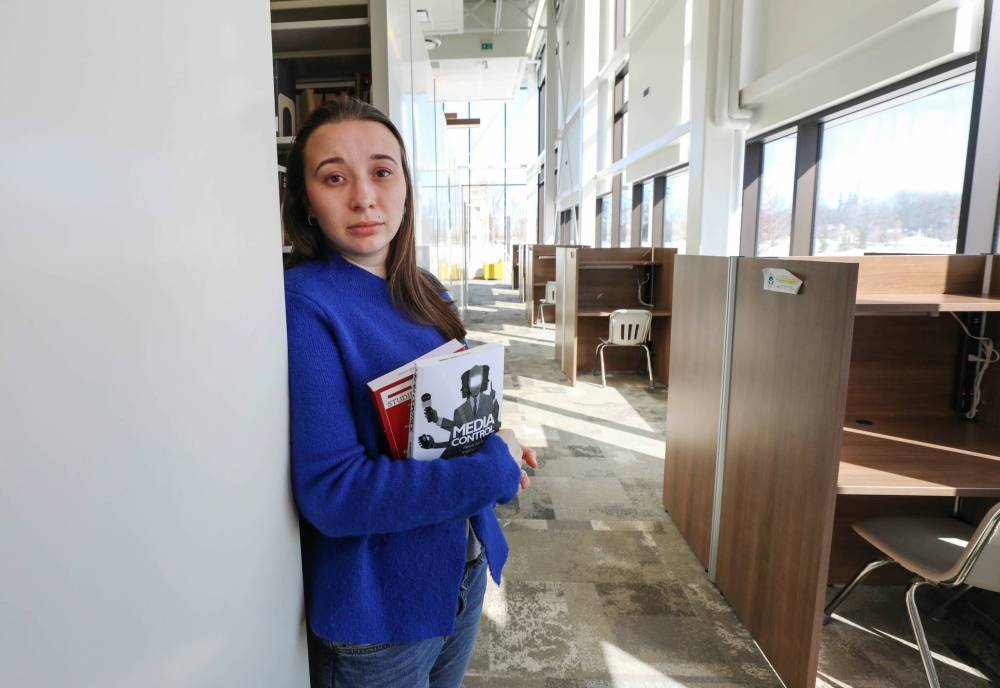
“It’s hard to keep my mind on my studies,” because of the war, she said, noting it is a special challenge for her as a “super perfectionist.”
“I might not be able to do my maximum this semester. I will have to do just the best I can now.”
Losing a week of classes last month exacerbated the problem: Seleznova went to Poland to help her nine-year-old sister, Manko, escape the war in Ukraine.
Manko is now in Winnipeg, along with the siblings’ mother, who came for a visit before the war and is unable to return to Ukraine.
Seleznova’s father, stepfather, grandparents and other relatives and friends are still in the country, living in Kharkiv, just 30 kilometres from the border with Russia — “One of the hotter spots in the war zone,” she said.
What helps keep her going is the support she is getting from CMU staff and faculty.
“Everybody has been so helpful,” Seleznova said, adding her professors have granted extensions for assignments and been considerate of the stress she is feeling.
“We’ve received lots of help with information and practical advice,” she said. “They have also provided me with a lot of emotional support. My mother and sister are feeling at home already.”
One of the people offering assistance is Sandra Loeppky, co-ordinator of CMU international student and accessibility programs.
As an advocate and friend, Loeppky has been helping Seleznova find food, clothing, documentation and health insurance for her sister, along with other practical assistance.
“We all appreciate how hard it is for Anastasiia to focus on her studies now,” Loeppky said, adding she is working with two other Ukrainian students at the university.
“The key thing is always: what is the best way forward for them.”
Loeppky recounted conversations with Seleznova where she talked about waking at night with her heart racing from worry about family in Ukraine.
“It’s hard to be a student under those conditions,” Loeppky said.
For staff and faculty, this is a “growing edge” for supporting students.
“We have to do more trauma counselling,” Loeppky said, noting there are students from other countries who also come from difficult situations in their homelands.
“We are constantly alert to how that plays out in their daily life as students.”

Providing trauma and mental health support is challenging, Loeppky said, since international students come from many different locations.
“We have to learn how to help in ways that are appropriate for different cultures. For some, there still may be stigma attached to reaching out for that kind of support or the way we want to help doesn’t match what they are used to.”
For Loeppky, supporting a student such as Seleznova is “stretching me in many different ways as I hear her talk about the war in Ukraine. Now I hold that burden in my own life, too.”
There are 81 students from 30 countries in Europe, South America, Africa and Asia attending CMU this year, down from 125 prior to the COVID-19 pandemic.
faith@freepress.mb.ca
The Free Press is committed to covering faith in Manitoba through our Religion in the News project. This reporting continues because readers like you step forward to fund it.
Donate now to support our reporting on religion.
Your donation is eligible for a charitable tax receipt.
BECOME A FAITH JOURNALISM SUPPORTER
John Longhurst has been writing for Winnipeg's faith pages since 2003. He also writes for Religion News Service in the U.S., and blogs about the media, marketing and communications at Making the News.
Our newsroom depends on a growing audience of readers to power our journalism. If you are not a paid reader, please consider becoming a subscriber.
Our newsroom depends on its audience of readers to power our journalism. Thank you for your support.
The Free Press is committed to covering faith in Manitoba through our Religion in the News project. This reporting continues because readers like you step forward to fund it.
Donate now to support our reporting on religion.
Your donation is eligible for a charitable tax receipt.
BECOME A FAITH JOURNALISM SUPPORTER
John Longhurst has been writing for Winnipeg's faith pages since 2003. He also writes for Religion News Service in the U.S., and blogs about the media, marketing and communications at Making the News.
Our newsroom depends on a growing audience of readers to power our journalism. If you are not a paid reader, please consider becoming a subscriber.
Our newsroom depends on its audience of readers to power our journalism. Thank you for your support.
Related Articles
Zelenskyy: Retreating Russians leave many mines behind
Advertisement Advertise With Us
Advertisement Advertise With Us
The Free Press acknowledges the financial support it receives from members of the city’s faith community, which makes our coverage of religion possible.