Young Ukrainian cancer patients get medical help in Poland

Advertisement

Advertise with us

BOCHENIEC, Poland (AP) — Twenty-two-month-old Yeva Vakulenko had been through four rounds of chemotherapy for leukemia at a hospital in Ukraine, and then suffered a relapse. As she began returning again for more treatment, Russia invaded, disrupting doctors' efforts to cure her.

Read this article for free:


or

Already have an account? Log in here »

To continue reading, please subscribe:

Subscribe and receive a limited-edition Free Press branded hat or tote.

Digital Subscription

One year of digital access for only $205*

  • Enjoy unlimited reading on winnipegfreepress.com
  • Read the E-Edition, our digital replica newspaper
  • Access News Break, our award-winning app
  • Play interactive puzzles

*First annual payment billed as $205.00 + GST for one year. This annual subscription will automatically renew at $233.00 + GST every 52 weeks (10% off the regular annual price of $259.35). Offer available to new and qualified returning subscribers only. Cancel any time.

To continue reading, please subscribe:

Add Free Press access to your Brandon Sun subscription for only an additional

$1 for the first 4 weeks*

  • Enjoy unlimited reading on winnipegfreepress.com
  • Read the E-Edition, our digital replica newspaper
  • Access News Break, our award-winning app
  • Play interactive puzzles
Start now

*Your next Brandon Sun subscription payment will increase by $1.00 and you will be charged $17.95 plus GST for four weeks. After four weeks, your payment will increase to $24.95 plus GST every four weeks.

Hey there, time traveller!
This article was published 18/03/2022 (1663 days ago), so information in it may no longer be current.

BOCHENIEC, Poland (AP) — Twenty-two-month-old Yeva Vakulenko had been through four rounds of chemotherapy for leukemia at a hospital in Ukraine, and then suffered a relapse. As she began returning again for more treatment, Russia invaded, disrupting doctors’ efforts to cure her.

Air raids forced the toddler to shelter in the basement of the hospital in the western city of Lviv for hours at a time, making her feel even worse. She cried a lot and sought comfort from her grandmother, who is caring for her after her parents were in an accident that left her mother disabled with brain and leg injuries.

So when doctors told Yeva’s grandmother that they could evacuate to Poland, she seized the chance.
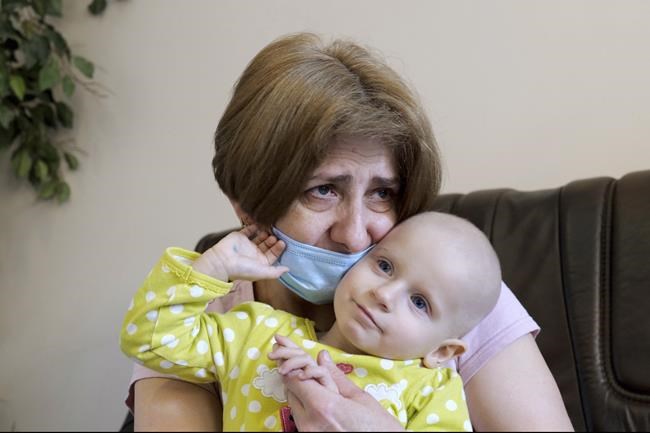
A Ukrainian grandmother holds her 22-month-old granddaughter with leukemia, Yeva Vakulenko, at a clinic in Bocheniec, Poland, on Thursday, March 17, 2022. Vakulenko is among more than 500 Ukrainian children with cancer who have been evacuated so far to a clinic in Poland. They are evaluated by doctors who then decide where they should go next for treatment. Some 200 hospitals in about 28 countries are accepting the children. (AP Photo/Pawel Kuczynski)

“It is very difficult for children to go somewhere in the middle of the night and sit in the basement for a long time,” said Nadia Kryminec as she held her granddaughter, whose sweet-natured smiles gave no hint of the ordeal she has endured.

“We were told that she was in stable condition and we should try to go. Otherwise, she is simply doomed to death,” the grandmother said.

The little girl, who her grandmother says understands everything, is one of more than 400 Ukrainian children with cancer who have been evacuated to a clinic in Poland. Doctors then place them in one of some 200 hospitals in 28 countries.

“We triage the patients when they arrive at our center,” said Dr. Marcin Włodarski, a pediatric hematologist at St. Jude Children’s Research Hospital in Memphis, Tennessee, who is staffing the Unicorn Clinic of Marian Wilemski in Bocheniec, in central Poland.

Stable patients are transferred quickly from there to hospitals in other countries while those in worse condition are first stabilized in Polish hospitals, he said.

“Then they return to us and can be sent for further travel,” Włodarski said.

Decisions have to be made fast because time is critical for the young oncology patients.

The evacuations began immediately after Russia attacked Ukraine on Feb. 24, and is a joint effort of St. Jude, the Polish Society of Pediatric Oncology and Hematology, Poland’s Fundacja Herosi (Heroes Foundation), and Tabletochki, a Ukrainian charity that advocates for children with cancer.

Dr. Marta Salek, another pediatric hematologist oncologist with St. Jude who is staffing the Polish clinic, said the center receives large numbers of patients and convoys that arrive from Lviv through humanitarian corridors.

“At times we can have convoys with only 20-something patients but we can have up to 70 patients at a time and even more,” she said.
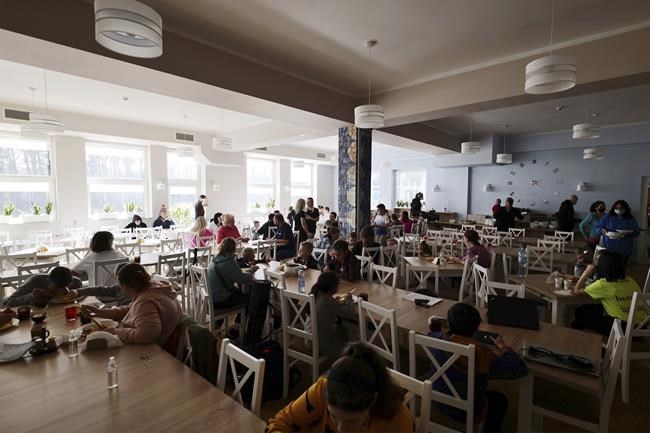
Children eat lunch at a clinic in Bocheniec, Poland, on Thursday, March 17, 2022. More than 500 Ukrainian children with cancer have been evacuated so far to a clinic in Poland. They are evaluated by doctors who then decide where they should go next for treatment. Some 200 hospitals in about 28 countries are accepting the children. (AP Photo/Pawel Kuczynski)

At the clinic, a large bin of white unicorn stuffed animals sits in a room, along with a wooden train set, brightly colored balloons and other toys that the children happily play with.

More than 3 million people — about half of them children — have fled Ukraine as the country faces a brutal military onslaught by Russian forces that has targeted civilians. Of those, more than 2 million people have arrived in Poland, the largest of Ukraine’s neighbors to its west. A Polish health ministry official said Friday that the country is treating 1,500 refugees in hospitals, many of whom are suffering hypothermia after their journey, and 840 of whom are children.

The World Health Organization said Friday that cancer is one of the major health challenges resulting from the war. It said it was supporting the effort by the organizations that “are working against the clock to reconnect pediatric cancer patients with their treatments.”

“Cancer itself is a problem, but treatment interruptions, stress and risk of infection mean that hundreds of children might die prematurely,” said Dr. Roman Kizyma, head of the Western Ukrainian Specialized Children’s Medical Centre in Lviv, where the pediatric oncology patients are first stabilized before they are sent across the border into Poland.

“We believe that these are the indirect victims of this war,” Kizyma said in a WHO statement.

Among those at the clinic this week was Anna Riabiko, from Poltava, Ukraine, who was seeking treatment for her daughter Lubov, who has neuroblastoma.

“Treatment is currently impossible in Ukraine. Fighting is taking place, there are no doctors, it is impossible to have surgery or chemotherapy. And even maintenance therapy is also impossible to obtain,” she said. “So we had to look for salvation somewhere.”

It’s not a step that all parents were able to take for their sick children, she said.

“A lot of sick children stayed there,” she said. “Because parents were worried and did not want to go into the unknown.”
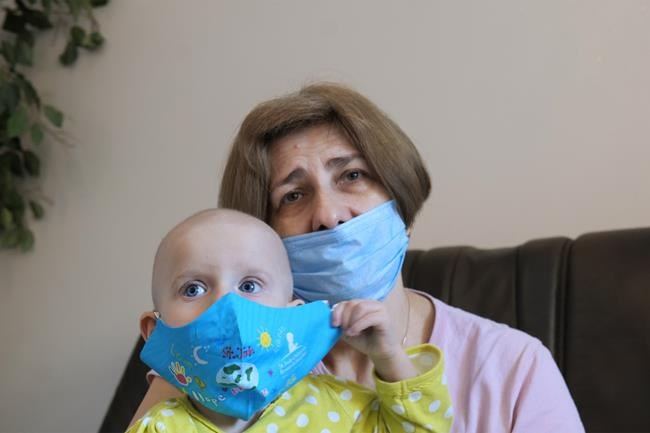
A Ukrainian grandmother holds her 22-month-old granddaughter with leukemia, Yeva Vakulenko, at a clinic in Bocheniec, Poland, on Thursday, March 17, 2022. Vakulenko is among more than 500 Ukrainian children with cancer who have been evacuated so far to a clinic in Poland. They are evaluated by doctors who then decide where they should go next for treatment. Some 200 hospitals in 28 countries are accepting the children. (AP Photo/Pawel Kuczynski)

___

This story has been corrected to show that the spelling of the Lviv doctor’s last name is Kizyma, not Kizym.

___

Vanessa Gera reported from Warsaw.

___

Follow the AP’s coverage of the war at https://apnews.com/hub/russia-ukraine

Report Error Submit a Tip

More Stories

Messing credits teammates for support

Lori Ewing, The Canadian Press 6 minute read Preview

Messing credits teammates for support

Lori Ewing, The Canadian Press 6 minute read Friday, Jan. 17, 2020

MISSISSAUGA, Ont. - The rink had always felt like home for Keegan Messing. But in the days and weeks after his brother's death, the Canadian figure skater struggled to find solace on the ice.

In a sport that requires steely nerves to reel off big jumps, and the ability to dig deep to push through searing pain, Messing had lost his will.

"It was the question of: why am I doing this?" Messing said. "In the grand scheme of life, it was: should I still do this? Can I still do this?"

Less than four months after his younger brother Paxon died in a motorcycle crash in Anchorage, Messing is aiming for his first national title at the Canadian figure skating championships, and a spot on the world championship team. He credits fellow Canadian skaters Nam Nguyen and Piper Gilles for getting him to the start gate.

Read
Friday, Jan. 17, 2020

The alternative is in the ground

Stuart Williams 5 minute read Wednesday, Jul. 29, 2026

The cheapest 750 megawatts isn’t a methane plant. It’s our own furnaces.

Manitoba Hydro wants to build up to $3 billion worth of additional methane turbines near Brandon — 750 megawatts of fossil-fuelled power, to get us through the coldest winter evenings and the driest years.

As the Public Utilities Board weighs the plan this summer, Manitobans should ask a simple question — is burning methane really the cheapest way to keep the lights on and the furnaces running?

The evidence says no.

With a bang, B.C. applauds health-care workers

Amy Smart, The Canadian Press 4 minute read Preview

With a bang, B.C. applauds health-care workers

Amy Smart, The Canadian Press 4 minute read Wednesday, Mar. 25, 2020

VANCOUVER - At the same time each night, Rev. Gary Paterson and about half a dozen other neighbours have begun gathering at least two metres apart on the rooftop patio of their building in Vancouver's west end.

They don't know who will signal the beginning, and everyone's clocks are slightly different, but just before 7 p.m., they hear clapping in the distance.

"It's usually at about two minutes to seven, like people can't restrain their enthusiasm, and then it starts to move like a wave," he said on Wednesday.

The applause is for health-care workers and other essential service providers on the frontlines of the COVID-19 pandemic.

Read
Wednesday, Mar. 25, 2020

Festival riffs off Main Street’s storied past

Melissa Martin 7 minute read Preview

Festival riffs off Main Street’s storied past

Melissa Martin 7 minute read Friday, Jun. 10, 2022

Fifty years later, Billy Joe Green can still remember one of the biggest breaks of his career. It was 1971, and his band was asked to become the house band at the Brunswick, an old Main Street hotel and bar.

People would line up around the block to see them, and for a while Green, who was barely out of his teens, could really feel as if he’d made it.

“That was like the high-end place to play for our people,” he says, with a nostalgic smile.

Oh, if the walls of the Main Street strip could talk, they would tell a million stories, and Green would be in a bunch of them. An Ojibwa man and member of Shoal Lake 40 First Nation, Green is one of Winnipeg’s most iconic blues guitarists; back then, he was jamming on the Main Street circuit, slinging out country and rock hits.

Read
Friday, Jun. 10, 2022

Olympic soccer, boxing qualifiers in China affected by virus

The Associated Press 2 minute read Preview

Olympic soccer, boxing qualifiers in China affected by virus

The Associated Press 2 minute read Wednesday, Jan. 22, 2020

KUALA LUMPUR, Malaysia - Olympic qualifying events in two sports were moved from the Chinese city of Wuhan on Wednesday because of an outbreak of a deadly viral illness.

A four-nation Asian qualifying group for the women’s soccer tournament was switched from the city at the centre of the health scare to Nanjing.

The Asia-Oceania boxing qualifying tournament scheduled for Feb. 3-14 in Wuhan was cancelled. No new plans were announced.

The decisions followed Chinese health authorities telling people in Wuhan to avoid crowds and public gatherings.

Read
Wednesday, Jan. 22, 2020

Seven Wilsons, one regional spirit

Hersh Seth 5 minute read Preview

Seven Wilsons, one regional spirit

Hersh Seth 5 minute read 2:00 AM CDT

In Dryden, Ont., a 34-metre suspension bridge crosses the Wabigoon River rapids. It is named after a man who paid for a quarter of the bridge himself. A plaque recognizes Roy Wilson’s “many contributions to City Revitalization” and mentions his 40 years in the Rotary Club, whose motto is “service above self”.

My father sold business machines from the 1970s through the ’90s, during the shift from carbon copy machines and typewriters to photocopiers, fax machines, and early office computers and printers. His sales territory — which he covered mostly by car but also by propeller plane — was Saskatchewan, the Northwest Territories, Manitoba, and northwestern Ontario, though much of it really belonged to the Wilsons.

In business machines, selling the machine was only half the job — the other half was ensuring a technician would fix it in January. Wilson’s set the standard for dealers across most of my dad’s regions. My father worked with Roy’s son Greg (who would later go on to become mayor of Dryden) but really respected Roy for teaching Greg to run the company with the towns they served as the priority.

Wilson’s service routes went beyond where roads stopped. Even if customers lived north of the highway system, Wilson’s still found a way to help, using three company planes based at the Dryden airport. As a result, a stationery shop from a paper mill town served all of northwestern Ontario and later northern Manitoba. Imagine a photocopier strapped into a small plane, a technician beside it, and a gravel runway waiting at the other end.

Read
2:00 AM CDT