Emergencies Act still needed as border blockades fall, Ottawa preps to act: ministers
Advertisement
Read this article for free:
or
Already have an account? Log in here »
To continue reading, please subscribe:
Digital Subscription
One year of digital access for only $1.44 a week*
- Enjoy unlimited reading on winnipegfreepress.com
- Read the E-Edition, our digital replica newspaper
- Access News Break, our award-winning app
- Play interactive puzzles
*Billed as $5.77 plus GST every four weeks. After 52 weeks, price increases to the regular rate of $19.95 plus GST every four weeks. Offer available to new and qualified returning subscribers only. Cancel any time.
To continue reading, please subscribe:
Add Free Press access to your Brandon Sun subscription for only an additional
$1 for the first 4 weeks*
- Enjoy unlimited reading on winnipegfreepress.com
- Read the E-Edition, our digital replica newspaper
- Access News Break, our award-winning app
- Play interactive puzzles
*Your next Brandon Sun subscription payment will increase by $1.00 and you will be charged $17.95 plus GST for four weeks. After four weeks, your payment will increase to $24.95 plus GST every four weeks.
Read unlimited articles for free today:
or
Already have an account? Log in here »
Hey there, time traveller!
This article was published 16/02/2022 (1718 days ago), so information in it may no longer be current.
OTTAWA – Liberal cabinet ministers defended the sweeping temporary powers now afforded to police under the Emergencies Act on Wednesday, even as major border blockades they decried for disrupting the economy have already been cleared.
Prime Minister Justin Trudeau invoked the Emergencies Act, which replaced the War Measures Act in 1988, on Monday for the first time in history as protesters blocked access to several Canada-U.S. border crossings and gridlocked downtown Ottawa with large trucks.
The border crossings in Windsor, Ont., Manitoba, Alberta and British Columbia have since been cleared using traditional police enforcement measures, while Ottawa remains clogged with protesters who drove in trucks nearly three weeks ago and have refused to leave.

Police in Canada’s capital city, who had been criticized for allowing the protest against COVID-19 restrictions to disrupt residents and businesses for so long, have warned protesters of their new abilities under the emergency legislation.
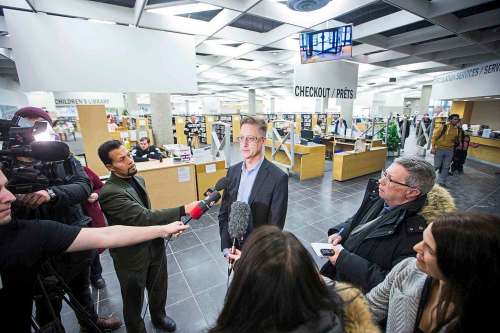
Public Safety Minister Marco Mendicino said there is no guarantee things will continue to improve and that is why the federal government is moving ahead with the Emergencies Act.
“In spite of the progress that we’ve made, we have to hold that progress,” Mendicino said Wednesday at a news conference in Ottawa.
“We have to keep our borders open. We have to keep our economy going. We have to keep Canadians at work. We have to allow the people of Ottawa to get their lives back.”
Police officers walked along the area just outside of Parliament Hill on Wednesday handing out notices to protesters encamped there, telling them they must leave the area. The notices warned the Emergencies Act gives police the power to seize vehicles that are part of the demonstration and ban people from travelling within a certain area. Police posted a similar notice online.
The interim chief, who took on the role after the abrupt resignation of former chief Peter Sloly on Tuesday, promised police will clear the streets of illegal demonstrators in the next few days.
“We’re going to take back the entirety of the downtown core and every occupied space. We’re going to remove this unlawful protest. We will return our city to a state of normalcy,” interim Chief Steve Bell told Ottawa City Council at a virtual meeting.
He says police are ready to use some methods that people are not “used to seeing in Ottawa.”
Members of the blockade that has kept the capital at a standstill since Jan. 28 have called the invocation of the Emergencies Act a scare tactic.
Trucks, RVs and other vehicles with Canadian flags or banners with the word “freedom” in giant letters along their front grilles remain on Wellington Street in front of Parliament Hill, with drivers saying they will stay put until all COVID-19 vaccine mandates and restrictions are lifted.
“They could be doing something now, eventually,” said Spencer Bautz from Saskatchewan, who has been on Parliament Hill for two weeks and found the letter from police stuffed in his vehicle door. He said demonstrators should not react with fear.
“It’d be pretty ridiculous if they actually want to take measures to enforce peaceful protests, man, that would be a big step.”
The legislation prohibits public assembly that could be reasonably be expected to disrupt the movement of people or goods, interfere with trade or critical infrastructure, or supports the threat or use of violence against people or property.
Mendicino tabled a motion Wednesday evening asking MPs to confirm the government’s decision to invoke the act, along with reports on the reasons for invoking it and the consultations undertaken with premiers, as are required by the act.
The government has until the end of day Thursday to table the regulations that identify the specific powers.
Those powers are already in effect and will remain so for 30 days unless the government revokes them sooner. The motion will be debated Thursday and takes precedence over all other business.
NDP Leader Jagmeet Singh signalled his party will support the motion, calling the situation a crisis. The Liberals are 11 seats shy of a majority in the House of Commons and the motion could pass with the support of the NDP.
The Conservatives and Bloc Québécois say they will not support the motion.
Conservative interim leader Candice Bergen said Conservatives have many questions about Trudeau’s use of the legislation, which she called a “giant sledgehammer.”
Bergen was among the many Conservative MPs who welcomed the protesters to Ottawa when they first arrived. Now, she said keeping their trucks parked on Ottawa’s streets for days on end is illegal and they need to move.
Conservatives demanded an apology from Trudeau Wednesday after he accused them of standing “with people who wave swastikas,” given their support for the protest convoy in question period.
Bloc Québécois Leader Yves-François Blanchet said existing police powers should be enough to allow the Ottawa police and RCMP to clear the protesters from the area.
The Liberal government characterized the blockades at the borders and in Ottawa as being connected by a highly co-ordinated, targeted and largely foreign-funded criminal attack on Canadian interests.
“It demanded that we all do what was required in order to restore the integrity and security of our borders and to protect Canadian interests,” Emergency Preparedness Minister Bill Blair said at the news conference Wednesday.
While the protest continued unabated outside Parliament Hill on Wednesday, Trudeau was asked inside of the West Block whether force would be needed to rid downtown of the demonstrators.
Trudeau said that is not his decision to make, but the Emergencies Act and added police resources would “make sure that laws are enforced in a proportional way, in an approach that will be decided by the police of jurisdiction.”
The Emergencies Act forbids blockades on Parliament Hill and surrounding streets, official residences, war monuments, airports, harbours, border crossings, piers, lighthouses, canals, interprovincial and international bridges, hospitals and COVID-19 vaccine clinics, trade corridors, and infrastructure needed for the supply of utilities including power generation and transmission.
It also prohibits bringing children to the antigovernment blockades, participating in the protests directly or bringing aid such as food or fuel to those involved. Anyone found guilty of violating the rules could face a fine of up to $5,000 or five years in prison.
The Children’s Aid Society of Ottawa urged parents demonstrating downtown to make arrangements for the care of their children should they become unable to care for them after potential police action.
Ottawa police have repeatedly mentioned the 100 or so children living in the trucks parked outside of Parliament Hill. They called in the Children’s Aid Society to check on them, but also explained that the kids are a complicating factor when it comes to planning a potential operation.
The Children’s Aid Society of Ottawa says that if parents and children are separated following police efforts to end the demonstration, it will work to reunite families as quickly as possible.

Late Wednesday evening, Ottawa city council ousted the chair of itspolice service board, Coun. Diane Deans, over concerns about a lack of effective oversight of the police service, whichhasfaced heavy criticism for its inaction for the first three weeks of the demonstration.
They also took issue with the board’s decision to hire a new interim chief to bolster the top ranks of the service without consulting council and the public.
This report by The Canadian Press was first published Feb. 16, 2022.
— With files from Marie Woolf
Note to readers: This is a corrected story. An earlier version reported that Mendicino tabled two motions Wednesday evening in the House of Commons.
Related Articles
Manitoba trucker vows to stay in Ottawa


Advertisement Advertise With Us
Advertisement Advertise With Us