Trucker border blockades tighten bottlenecks on choked food and auto supply chains
Advertisement
Read this article for free:
or
Already have an account? Log in here »
To continue reading, please subscribe:

Digital Subscription
One year of digital access for only $205*
- Enjoy unlimited reading on winnipegfreepress.com
- Read the E-Edition, our digital replica newspaper
- Access News Break, our award-winning app
- Play interactive puzzles
*First annual payment billed as $205.00 + GST for one year. This annual subscription will automatically renew at $233.00 + GST every 52 weeks (10% off the regular annual price of $259.35). Offer available to new and qualified returning subscribers only. Cancel any time.
To continue reading, please subscribe:
Add Free Press access to your Brandon Sun subscription for only an additional
$1 for the first 4 weeks*
- Enjoy unlimited reading on winnipegfreepress.com
- Read the E-Edition, our digital replica newspaper
- Access News Break, our award-winning app
- Play interactive puzzles
*Your next Brandon Sun subscription payment will increase by $1.00 and you will be charged $17.95 plus GST for four weeks. After four weeks, your payment will increase to $24.95 plus GST every four weeks.
Read unlimited articles for free today:
or
Already have an account? Log in here »
Hey there, time traveller!
This article was published 09/02/2022 (1700 days ago), so information in it may no longer be current.
Amid delivery backlogs and bottlenecked ports, trucker blockades at U.S. border crossing points have added more pressure to an already overloaded supply chain, with the food and automotive sectors particularly vulnerable.
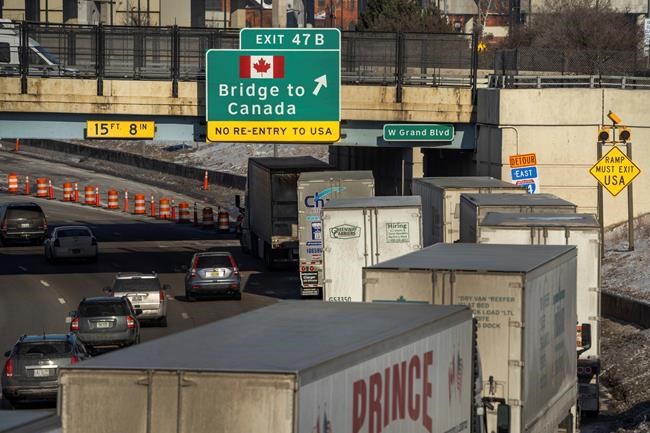
Since Monday, protesters have cut off Canada-bound traffic on the Ambassador Bridge between Detroit and Windsor, Ont. — the busiest crossing in North America — in a show of solidarity with demonstrators protesting vaccine mandates and other COVID-19 restrictions in Ottawa.
The crossing typically handles about 7,000 commercial vehicles a day carrying more than a quarter of the roughly $775 billion in annual goods trade between Canada and the United States, according to U.S. Department of Transportation and the Office of the U.S. Trade Representative.
A group of 70 trade organizations including the Canadian Chamber of Commerce has called for a “swift and immediate clearing” of the blockade, citing the need for a steady supply of food, medical products and industrial parts.
Lanes were shut down in both directions Monday night. Trucks began moving into the U.S. Tuesday morning, but not the reverse.
The delays could result in higher food prices and more spoilage, due to longer, costlier routes as trucks are diverted, allowing produce less time on shelves before getting too ripe.
“Already we are seeing delays in product of 12 to 24 hours in deliveries,” said Gary Sands, a spokesperson at the Canadian Federation of Independent Grocers.
Fruits and vegetables will arrive on grocery shelves — and kitchen counters — less fresh.
“There’s a term for that: ‘Shelflation,'” said Sylvain Charlebois, Dalhousie University professor of food distribution and policy.
“It means that it will cost more for the supply chain to distribute food and it will cost more for consumers because the shelf life … at home will be shortened, so people tend to throw away more food more quickly.”
Between $8 billion and $12 billion in agri-food crosses the Ambassador Bridge in both directions each year, Charlebois said. Some 45 per cent of Ontario agri-food imports arrive via the suspension bridge over the Detroit River, including the majority of products at the Ontario Food Terminal this time of year.
The blockade also puts a spoke in the wheel of just-in-time manufacturing and auto networks.
“For my members Toyota and Honda, they have been muddling through the last couple of days but I suspect that some production lines will be in jeopardy later today,” David Adams, president of the Global Automakers of Canada, said Wednesday afternoon.
Stellantis confirmed it had cut short the bulk of its shifts at its Windsor assembly plant Tuesday due to parts shortages caused by the blockade,affecting thousands of the automaker’s workers. The facility resumed production again Wednesday morning.
“It impacts consumers potentially in terms of shortages of products that they need. And secondly it is driving prices higher at a time when inflation is at a record high — the highest rate that it’s been at in three decades,” Canadian Chamber of Commerce president Perrin Beatty said in a phone interview.
He noted the irony of big-rigger protests holding up truckers in traffic after they were diverted to the Blue Water Bridge between Port Huron, Mich., and Sarnia, Ont.
“Yesterday some of the delays were as long as five hours at the bridge,” Beatty said. “They don’t get paid while they’re just sitting there … so it’s costing them their livelihoods.” Drivers are typically paid per mile, not per hour.
The blockade, which has affected thousands of truckers, comprised between 50 and 75 vehicles and 100 supporters, said Windsor police chief Pam Mizuno.
Meanwhile at the border crossing in Coutts, Alta., traffic continues to be shut down on and off as protesters vowed to dig in for the long haul despite Premier Jason Kenney lifting the province’s vaccine passport program, effective Wednesday.
In the national capital, downtown arteries remain paralyzed after thousands of demonstrators took to the streets to protest pandemic measures in a rally on Jan. 29 that has stretched into a nearly two-week encampment composed of about 400 trucks, according to Ottawa police.
Bank of Canada governor Tiff Macklem warned Wednesday of the perils of drawn-out blockades.
“If there were to be prolonged blockages at key entry points into Canada, that could start to have a measurable impact on economic activity in Canada,” he told reporters following a speech at a Canadian Chamber of Commerce event.

“We’ve already got a strained global supply chain, we don’t need this. Canadians are looking to buy goods, Canadian business are looking to export goods, and I think the sooner we can get this resolved the better.”
A “lengthy delay” remains for truckers rerouted to the Blue Water Bridge, despite all nine of its commercial lanes being opened, said White House press secretary Jen Psaki.
Customs authorities on both sides of the border are working closely with the auto and agricultural sectors to “discuss alternative processing” and facilitate shipments, she told reporters.
Employees who live in Michigan but work across the border are being detoured via the Detroit-Windsor Tunnel, she added.
This report by The Canadian Press was first published Feb. 9, 2022.