Canadian police forces learn from situation in Ottawa during convoy protests
Advertisement
Read this article for free:
or
Already have an account? Log in here »
To continue reading, please subscribe:

Digital Subscription
One year of digital access for only $205*
- Enjoy unlimited reading on winnipegfreepress.com
- Read the E-Edition, our digital replica newspaper
- Access News Break, our award-winning app
- Play interactive puzzles
*First annual payment billed as $205.00 + GST for one year. This annual subscription will automatically renew at $233.00 + GST every 52 weeks (10% off the regular annual price of $259.35). Offer available to new and qualified returning subscribers only. Cancel any time.
To continue reading, please subscribe:
Add Free Press access to your Brandon Sun subscription for only an additional
$1 for the first 4 weeks*
- Enjoy unlimited reading on winnipegfreepress.com
- Read the E-Edition, our digital replica newspaper
- Access News Break, our award-winning app
- Play interactive puzzles
*Your next Brandon Sun subscription payment will increase by $1.00 and you will be charged $17.95 plus GST for four weeks. After four weeks, your payment will increase to $24.95 plus GST every four weeks.
Read unlimited articles for free today:
or
Already have an account? Log in here »
Hey there, time traveller!
This article was published 07/02/2022 (1701 days ago), so information in it may no longer be current.
Police forces across Canada took different approaches to protests against COVID-19 measures over the weekend, learning from the situation in Ottawa, where demonstrators and their trucks have remain entrenched in the capital’s core for more than a week.
Thousands opposed to pandemic-related restrictions congregated in cities across the country in solidarity with the demonstration in Ottawa, but while the gatherings were large and noisy, they appeared to end peacefully as the weekend drew to a close.
In Toronto, protesters descended on the grounds of Ontario’s legislature on Saturday, largely on foot, after police closed stretches of downtown streets to ensure access to nearby hospitals. A slightly smaller group moved just north of the area to an intersection blocked by a few tractor trailers that had managed to drive downtown.
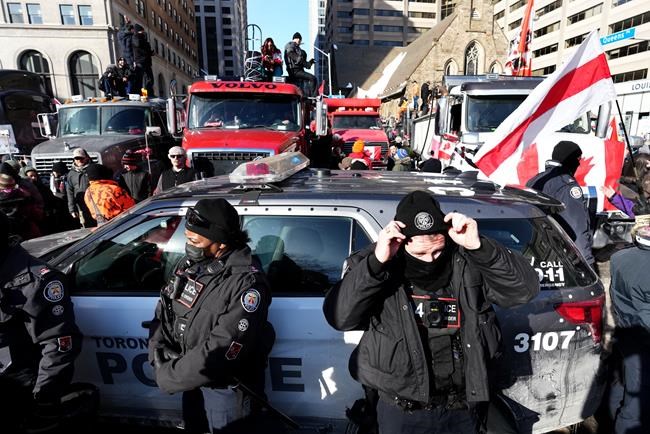
But by 8 p.m., the trucks, cars and protesters that had jammed the area left in peace – a stark contrast to what’s been happening in Ottawa.
“Our number one goal was really to keep those large trucks out of the area,” said Toronto Staff Supt. Lauren Pogue, part of the team planning the response to the protest.
“We were permitting them to peacefully demonstrate, but on foot, not with vehicles. We don’t need big tractor trailers in our downtown core.”
The weekend saw a heavy police presence, including officers on horseback and a riot squad of about 30 officers, who later moved in to briefly take control of the intersection north of the legislature. Reinforcements were also brought in from other police forces.
Police only made one arrest – someone allegedly ignited a smoke bomb outside the Ontario legislature. No one was injured during the protests and the force received just two noise complaints, despite horns blaring for several hours, Pogue said.
Toronto police “made it very clear” to demonstrators that no one would be staying overnight, Pogue said, and police had heavy tow trucks at the ready.
“Nobody is judging (Ottawa police), but we will always consider what we’re seeing and how that might play out in Toronto and how we can prevent those things from happening,” she said. “It was a very good day.”
Police in Quebec City similarly saw large crowds that dissipated by Sunday evening.
Protesters and trucks began trickling into the area outside the National Assembly on Thursday night. By Saturday, thousands of protesters and dozens of trucks were in the area as families attended the Carnaval de Quebec taking place nearby. The last demonstrators and trucks left the area on Sunday around dinner time.
Authorities made three arrests and handed out 170 tickets for municipal violations, highway safety code infractions and illegal parking over the four-day event.
Police Chief Denis Turcotte said Monday he believes the event went smoothly due to collaboration between protesters and police.
“The situation, the environment, the clientele, the way they deployed in Ottawa versus how we did here, it’s very distinct to each area,” Turcotte said.
“I’m unable to comment why it went one way in Ottawa and how it happened here. We adapted to the situation that we were facing and it worked well.”
On the west coast, Vancouver police knew a planned convoy of hundreds of trucks was headed downtown for the weekend and decided to let them in.
“Our objectives were to keep traffic moving, keep that disruption to a minimum and to provide an atmosphere where people could engage in peaceful and lawful demonstration,” said Sgt. Steve Addison.
“We certainly wanted to avoid a situation like we’re seeing in other parts of the country, where we have gridlock, and blockades.”
Vociferous counter protesters met the convoy in an effort to stop it, with one man lying down in front of a truck, he said. There were skirmishes between the two sides throughout the downtown core, Addison said. Police arrested five people, largely for minor mischief-related incidents.
“By and large, we had thousands of people enter the city, they engaged in peaceful, lawful protests and they said their piece and they left,” he said. “It was a success for us.”
In Sarnia, Ont., a Sunday demonstration near the U.S. border caused traffic disruptions, but police said they didn’t run into major issues.
Dozens of tractors and trucks parked on a highway leading to a bridge to the U.S. That led Ontario Provincial Police to shut down the highway after people got out of their vehicles on the westbound side of Highway 402.
Scores more tractors and trucks drove into downtown Sarnia, causing gridlock for several hours, said Const. Giovanni Sottosanti.
“We had officers in attendance to monitor the situation,” he said. “We didn’t run into any issues, people came, they did what they did and then they dispersed.”
Police forces, particularly the one in Toronto, clearly learned from the mistakes made by Ottawa police, said Michael Kempa, an associate professor of criminology at the University of Ottawa.
“They had a plan ready,” he said.
“I think Ottawa police miscalculated the resolve of this group of people to bed in and then refuse to leave. And once you get heavy machinery in place, it’s very difficult to move people along.”

He said Ottawa police, unsure of the size of the protest or its goals, allowed the demonstrators in.
“The police in Ottawa were a little bit reluctant to come cracking down for fear that that would galvanize the movement,” Kempa said.
Meanwhile, other police services had a week to study the situation in Ottawa and try something different, he said.
“Police agencies are ready for them,” he said. “(Police) are making it impossible to get down in the central part and grind the city to a halt just by controlling the flow of traffic.”
This report by The Canadian Press was first published Feb. 6, 2022.
Related Articles
Tow companies refuse to haul trucks out of Ottawa


Advertisement Advertise With Us
Advertisement Advertise With Us