Report: Mandatory Olympic app has serious security flaws

Advertisement

Advertise with us

RICHMOND, Va. (AP) — A smartphone app that athletes and others attending next month’s Winter Games in Beijing must install has glaring security problems that could expose sensitive data to interception, according to a report published Tuesday.

Read this article for free:


or

Already have an account? Log in here »

To continue reading, please subscribe:

Subscribe and receive a limited-edition Free Press branded hat or tote.

Digital Subscription

One year of digital access for only $205*

  • Enjoy unlimited reading on winnipegfreepress.com
  • Read the E-Edition, our digital replica newspaper
  • Access News Break, our award-winning app
  • Play interactive puzzles

*First annual payment billed as $205.00 + GST for one year. This annual subscription will automatically renew at $233.00 + GST every 52 weeks (10% off the regular annual price of $259.35). Offer available to new and qualified returning subscribers only. Cancel any time.

To continue reading, please subscribe:

Add Free Press access to your Brandon Sun subscription for only an additional

$1 for the first 4 weeks*

  • Enjoy unlimited reading on winnipegfreepress.com
  • Read the E-Edition, our digital replica newspaper
  • Access News Break, our award-winning app
  • Play interactive puzzles
Start now

*Your next Brandon Sun subscription payment will increase by $1.00 and you will be charged $17.95 plus GST for four weeks. After four weeks, your payment will increase to $24.95 plus GST every four weeks.

Hey there, time traveller!
This article was published 18/01/2022 (1692 days ago), so information in it may no longer be current.

RICHMOND, Va. (AP) — A smartphone app that athletes and others attending next month’s Winter Games in Beijing must install has glaring security problems that could expose sensitive data to interception, according to a report published Tuesday.

Citizen Lab, an internet watchdog group, said in its report the MY2022 app has seriously flawed encryption that would make users’ sensitive data — and any other data communicated through it — vulnerable to being hacked. Other important user data on the app wasn’t encrypted at all, the report found.

That means the data could be read by Chinese internet service providers or telecommunications companies through Wi-Fi hotspots at hotels, airports and Olympic venues.
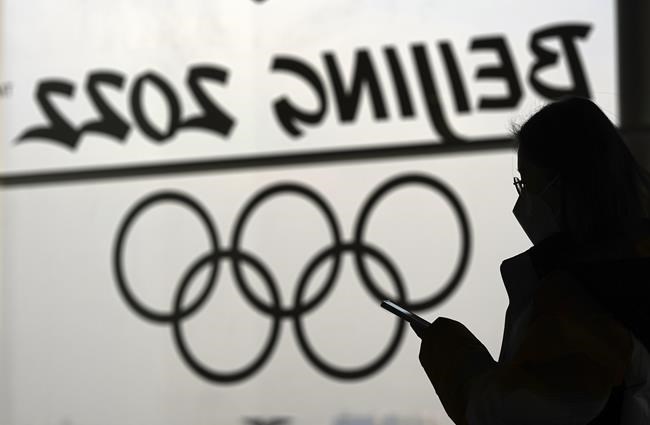
A woman looks at her phone as she passes an Olympic logo inside the main media center for the Beijing Winter Olympics Tuesday, Jan. 18, 2022, in Beijing. (AP Photo/David J. Phillip)

China is requiring all international Olympic attendees — including coaches and journalists — to download and start using the app 14 days before their departure. The app allows users to submit required health information on a daily basis and is part of China’s aggressive effort to manage the coronavirus pandemic while hosting the games, which begin Feb. 4. The multipurpose app also includes chat features, file transfers, weather updates, tourism recommendations and GPS navigation.

Citizen Lab’s report comes amid heightened concerns over athletes’ data and privacy. Many countries are advising their athletes not to take their normal smartphones to China, but instead to bring temporary — or burner — phones that do not store any sensitive personal data, according to news reports.

The U.S. Olympic & Paralympic Committee issued an advisory to athletes telling them to “assume that every device and every communication, transaction, and online activity will be monitored.”

“There should be no expectation of data security or privacy while operating in China,” the advisory said.

China has a well-documented history of conducting muscular surveillance of its citizens and aggressive cyber-spying on others. But Citizen Lab said there was no evidence that the easily discoverable security flaws in the MY2022 app were placed intentionally by the Chinese government. For one, much of the sensitive health information held on the app is required to be submitted directly to authorities on health customs forms, the report said.

Citizen Lab said the security vulnerabilities found in MY2022 app are similar to those found in popular Chinese web browsers and noted that “insufficient protection of user data is endemic to the Chinese app ecosystem.”

“In light of previous work analyzing popular Chinese apps, our findings concerning MY2022 are, while concerning, not surprising,” the report said.

Citizen Lab said it reported the security issues to the Beijing Organizing Committee last month but did not receive a response. The report also said the app’s security flaws could run afoul of Apple’s and Google’s policies for software used on iPhones and Android devices. The two companies did not immediately return a request for comment.

The Android version of the MY2022 app included a list named “illegalwords.txt” that included 2,442 keywords, including some that could be politically sensitive and relate to China’s actions toward Tibet and the Uyghur ethnic group.

The report said despite having the list bundled with the app, it does not appear to function. The Chinese government has long required tech companies to censor content and keywords deemed politically sensitive or inappropriate.

____

Frank Bajak in Boston contributed to this report.

Report Error Submit a Tip

More Stories

Another new year starts with hope

Niigaan Sinclair 5 minute read Preview

Another new year starts with hope

Niigaan Sinclair 5 minute read Tuesday, Dec. 29, 2020

The year began with hope that many long-standing challenges for Indigenous communities could be overcome.

For example, on Jan. 1, Bill C-92 came into effect, enabling Indigenous communities to take control of child and family services, making them “free to develop policies and laws based on their particular histories, cultures, and circumstances.”

This followed the 2019 passing of Bill C-91 and the creation of a federal Indigenous languages office — committing the government to support and fund “Indigenous-led language reclamation, revitalization, maintenance and strengthening activities.”

January also marked the opening of the Indian day school settlement process, offering more than 200,000 survivors compensation for harms perpetuated at 699 schools, and a $200-million education, healing and commemoration fund.

Read
Tuesday, Dec. 29, 2020

Manitoba doctor denies working to revive Carberry ER in response to recruitment lawsuit

Erik Pindera 4 minute read Preview

Manitoba doctor denies working to revive Carberry ER in response to recruitment lawsuit

Erik Pindera 4 minute read 9:40 AM CDT

A Manitoba doctor has denied he was working as a recruiter after an Ontario doctor accused him of misleading him about a position at the Carberry hospital.

Dr. Klevis Iliriani, who worked at the hospital in Carberry from May to August 2024, filed his statement of claim in Court of King’s Bench earlier this year.

Iliriani, who lives in an Ottawa suburb, has alleged recruiters negligently misrepresented the job at the Carberry hospital and breached the terms of his contract, which resulted in less pay than promised.

His court filing names defendants Dr. Dave Maharajh and Barry Banek as the recruiters.

Read
9:40 AM CDT

Local high school, collegiate athletes trying to focus on future, not dwell on season past

Taylor Allen 15 minute read Preview

Local high school, collegiate athletes trying to focus on future, not dwell on season past

Taylor Allen 15 minute read Friday, Jul. 3, 2020

Nobody can relate to what today’s young athletes are going through.

Imagine entering your final year of high school and being told at the last minute that you can’t compete for a provincial championship. Or what it feels like to be the kid who made sacrifices their entire life to one day earn a scholarship and when that time comes, they’re informed the next season might not happen and their university experience will consist of them sitting behind a computer screen, taking online classes.

The realities in today’s pandemic world are unprecedented. No coach or parent can look at these athletes and say, ‘I know what you’re going through.’ Neither can Adrienne Leslie-Toogood, the director of sport psychology for the Canadian Sport Centre Manitoba. But the former University of Manitoba Bisons shooting guard said it’s important for athletes to not pretend that everything is fine during these challenging times.

“I think that bitter ends up resulting down the road if you don’t allow yourself to feel deeply. That’s the one thing we know in sport for sure, that we feel deeply. We celebrate, we work hard, we invest our heart and soul, so things can hurt pretty bad, too,” Leslie-Toogood says.

Read
Friday, Jul. 3, 2020

French tandem cements place among greatest ice dance duos with Olympic gold medal

Rosie DiManno - Star Columnist, Toronto Star 7 minute read Preview

French tandem cements place among greatest ice dance duos with Olympic gold medal

Rosie DiManno - Star Columnist, Toronto Star 7 minute read Monday, Feb. 14, 2022

Gabriella Papadakis and Guillaume Cizeron stayed for another four years after being edged out by Canada’s Tessa Virtue and Scott Moir at 2018 Games.

Read
Monday, Feb. 14, 2022

Report: Mandatory Olympic app has serious security flaws

Alan Suderman, The Associated Press 4 minute read Preview

Report: Mandatory Olympic app has serious security flaws

Alan Suderman, The Associated Press 4 minute read Tuesday, Jan. 18, 2022

Muzzin’s loss means the Leafs are without their second defensive pairing — his partner Justin Holl is in NHL COVID health and safety protocols.

Read
Tuesday, Jan. 18, 2022

Virus testing the new normal as China sticks to 'zero-COVID'

Ken Moritsugu, The Associated Press 5 minute read Preview

Virus testing the new normal as China sticks to 'zero-COVID'

Ken Moritsugu, The Associated Press 5 minute read Thursday, Jun. 9, 2022

BEIJING (AP) — Thousands of coronavirus testing sites have popped up on sidewalks across Beijing and other Chinese cities in the latest development in the country's “zero-COVID” strategy.

Lines form every day, rain or shine, even where the spread of the virus has largely stopped. Some people need to go to work. Others want to shop. All are effectively compelled to get tested by a requirement to show a negative test result to enter office buildings, malls and other public places.

Liu Lele, who works for a live-streaming company, has no problem getting tested regularly but said the daytime operating hours don't always fit his schedule.

“Sometimes I get held up at work," he said after finishing a test Thursday near Beijing's historic Bell and Drum towers. "I wish there were sites open 24 hours or not closing until 7 or 8 p.m.”

Read
Thursday, Jun. 9, 2022