Canada’s electric vehicle charging ambitions falling short, industry group says

Advertisement

Advertise with us

OTTAWA - The federal government is promising to spend close to $880 million over the next four years to build about 65,000 new charging stations for electric or fuel cell-powered passenger vehicles.

Read this article for free:


or

Already have an account? Log in here »

To continue reading, please subscribe:

Subscribe and receive a limited-edition Free Press branded hat or tote.

Digital Subscription

One year of digital access for only $205*

  • Enjoy unlimited reading on winnipegfreepress.com
  • Read the E-Edition, our digital replica newspaper
  • Access News Break, our award-winning app
  • Play interactive puzzles

*First annual payment billed as $205.00 + GST for one year. This annual subscription will automatically renew at $233.00 + GST every 52 weeks (10% off the regular annual price of $259.35). Offer available to new and qualified returning subscribers only. Cancel any time.

To continue reading, please subscribe:

Add Free Press access to your Brandon Sun subscription for only an additional

$1 for the first 4 weeks*

  • Enjoy unlimited reading on winnipegfreepress.com
  • Read the E-Edition, our digital replica newspaper
  • Access News Break, our award-winning app
  • Play interactive puzzles
Start now

*Your next Brandon Sun subscription payment will increase by $1.00 and you will be charged $17.95 plus GST for four weeks. After four weeks, your payment will increase to $24.95 plus GST every four weeks.

Hey there, time traveller!
This article was published 20/12/2021 (1710 days ago), so information in it may no longer be current.

OTTAWA – The federal government is promising to spend close to $880 million over the next four years to build about 65,000 new charging stations for electric or fuel cell-powered passenger vehicles.

But an industry group representing some of Canada’s biggest automakers says Canada needs to be building millions of stations.

Brian Kingston, president of the Canadian Vehicle Manufacturers Association, said a national electric-charging network needs years of careful planning to ensure the charging stations are available when and where people need them.
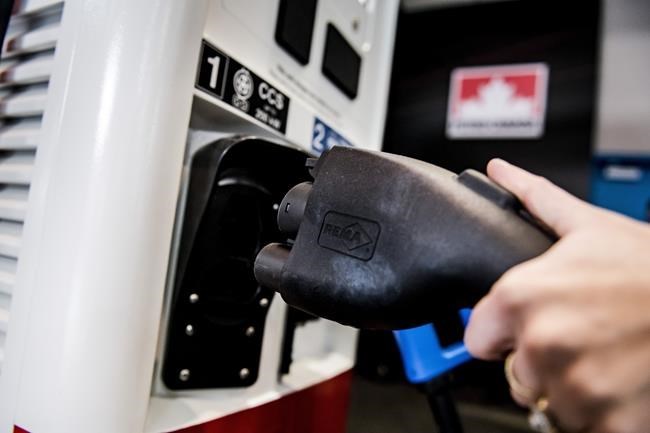
Petro-Canada's electric vehicle charging station is photographed while on display at the Canadian International Auto Show in Toronto on February 14, 2019. THE CANADIAN PRESS/Christopher Katsarov

“We haven’t done the planning and we haven’t put the investment into a charging network,” he said.

Canada is mandating EV sales — 50 per cent of new cars sold in 2030 and 100 per cent in 2035 — but nobody is taking the lead to make sure people know what that means for how much electricity, or how many charging stations, will be needed, he added.

The association represents three of Canada’s biggest automakers — Ford, GM and the new multinational Stellantis, formed earlier this year in a merger that now represents brands such as Dodge, Jeep and Chrysler.

Kingston said automakers are committed to the transition to electric — the three companies the association represents are investing US$100 billion in electrification over the next few years, with plans to bring 120 new EV models to the market.

But he said new models and more supply would solve only one piece of the electric transition, because if the charging networks don’t keep pace, people aren’t going to make the switch.

Or, even worse, they’re going to switch back, he said.

A study published in Nature Energy journal last spring said as many as one in five zero-emission vehicle owners went back to gas power because of inconvenient charging access.

“So I just use that as a caution to government that, you know, we better start planning this like tomorrow,” he said.

He argues Canada hasn’t done the planning and instead has a fractured response with very low ambitions compared to the rest of the world.

Canada currently has about 15,000 public or semi-private chargers available, and at least another 2,000 are in various stages of construction with public funding. Natural Resources Canada has another $180 million in the existing budget to build 17,000 or so more in the next three years.

The Liberals promised to spend another $700 million by 2026 to build an additional 50,000 new ones.

Kingston said to keep pace with Europe’s goal of having one public charger for every 10 EVs, Canada will need almost four million chargers by 2050. To get to California’s goal of one for every seven vehicles, that’s closer to six million needed in Canada.

An analysis done for Natural Resources Canada recently suggested Canada will need, on average, one charger for every 20 EVs by 2025 and, after more EVs roll on to streets, the ratio would fall to about one in every 49 vehicles by 2050.

“It’s obvious that we don’t have an ambitious enough plan to build charging infrastructure,” Kingston said, adding overbuilding is needed at first to encourage EV adoption.

The Natural Resources analysis also notes that longer term, it’s more likely that public chargers will need to be high-speed, capable of recharging a car in less than an hour.

The International Energy Agency said this year Canada has about 0.06 publicly available chargers for every EV on the road, ranking about 20th in the world, neck and neck with the United States as a whole.

In November, an Ernst and Young analysis of the EV readiness of the world’s 10 biggest auto markets said Canada was in the bottom three, largely because of low demand and a lacklustre charging system. China is on top, followed by Sweden and Germany.

Wilf Steimle, president of the Electric Vehicle Society, said charging is one of the biggest concerns raised by people thinking about making the switch.

“What owners care about is, by the time I’ve gone to the bathroom, and grab another cup of coffee, is my car ready to go, because I don’t want to stand there waiting for it for half an hour or so,” he said.

This report by The Canadian Press was first published Dec. 20, 2021.

Report Error Submit a Tip

More Stories

Manitoba Ag Days takes flight with focus on drone tech advancements

Abiola Odutola 5 minute read Preview

Manitoba Ag Days takes flight with focus on drone tech advancements

Abiola Odutola 5 minute read Wednesday, Jan. 21, 2026

BRANDON — Manitoba Ag Days kicked off its annual event on Tuesday with a strong spotlight on innovation as the large-scale drones showcased on the trade show floor drew plenty of attention.

The Spider-i M400 agricultural spray drone marks a shift in how producers should think about the technology, Ag Drone Canada president Travis Karle said.

Karle, who has been a pilot for 35 years, said he has spent the last four years working with manufacturers to develop a proper high-capacity, high-volume, aerial spray drone. Karle described the M400 as “by far the biggest drone in the industry,” featuring a tank capacity of up to 210 litres, three batteries and extended flight time.

“Instead of thinking of that as a drone, now we’re looking at a piece of farm equipment,” he said. “We’re 100 acres per hour-plus with that drone of that size.”

Read
Wednesday, Jan. 21, 2026

Man who tried to kill pregnant woman pleads guilty

Tessa Adamski 4 minute read 2:00 AM CDT

BRANDON — A 21-year-old man has pleaded guilty to attempted murder for cutting a pregnant woman’s throat and repeatedly stabbing her during a home invasion in Erickson in 2023.

Carter Prince, who was 18 at the time, said he was too intoxicated by alcohol to remember the violent assault against Candace McMunn while she was asleep in her basement.

An agreed statement of facts says the 30-year-old woman awoke to the accused crawling into bed with her early in the morning on June 6, 2023.

McMunn tried to grab a knife from the teen, whom she had never met, as he hit her head 20 to 30 times and stabbed her.

Canada trails allies on EV charging stations

Mia Rabson, The Canadian Press 4 minute read Preview

Canada trails allies on EV charging stations

Mia Rabson, The Canadian Press 4 minute read Monday, Dec. 20, 2021

OTTAWA - The federal government is promising to spend close to $880 million over the next four years to build about 65,000 new charging stations for electric or fuel cell-powered passenger vehicles.

But an industry group representing some of Canada's biggest automakers says Canada needs to be building millions of stations.

Brian Kingston, president of the Canadian Vehicle Manufacturers Association, said a national electric-charging network needs years of careful planning to ensure the charging stations are available when and where people need them.

"We haven't done the planning and we haven't put the investment into a charging network," he said.

Read
Monday, Dec. 20, 2021

Marc Liss makes handmade rings and knives from barrels, blades and antlers

Gabrielle Piché 7 minute read Preview

Marc Liss makes handmade rings and knives from barrels, blades and antlers

Gabrielle Piché 7 minute read Friday, Jun. 3, 2022

Old Gimli-based whisky barrels are ending up in homes across the globe.

Not in full barrel form, but as rings and knife handles.

The wood is one of several materials repurposed to support Marc Liss’s life work. Other ingredients include deer antlers shed near a Manitoban Hutterite colony and circular sawmill blades used in the 1850s through 1950s.

“It’s really not what I expected to be doing with my life,” Liss said of his business, Origin Handcrafted Goods.

Read
Friday, Jun. 3, 2022

Vikings survive Sabres onslaught

Mike Sawatzky 5 minute read Preview

Vikings survive Sabres onslaught

Mike Sawatzky 5 minute read Wednesday, Nov. 27, 2024

The Vincent Massey Vikings may have dug themselves out of bigger holes this season, but none more monumental than Wednesday’s comeback at Investors Group Athletic Centre.

The No. 1-seeded Brandon squad survived four match points in a tension-filled fourth set en route to a riveting 23-25, 25-20, 21-25, 30-28, 15-11 victory over the fourth-seeded Steinbach Sabres in provincial AAAA varsity girls volleyball semifinal action.

Massey capitalized on the attacking clout of all-star left side Jersey Hansen-Young, who supplied 32 kills and five service aces, and Grade 10 sensation Hannah McGregor, a six-foot left side, who chipped in with 20 kills and one ace. Zoe Price added six kills and an ace for the winners.

“It was a lot of pressure but everybody really just stayed focused and knew what they had to do,” said Hansen-Young, recently voted the top varsity girls player in the province in the FP’s top 10 coaches’ poll.

Read
Wednesday, Nov. 27, 2024

City investigating false results

By Bartley Kives 4 minute read Preview

City investigating false results

By Bartley Kives 4 minute read Friday, Jan. 30, 2015

The end of Winnipeg's 46-hour boil-water advisory has led to the beginning of an investigation into how water-sample tests yielded what's now believed to be erroneous evidence of fecal contamination of the city's water supply.

Winnipeg residents were advised to boil their water from 5:45 p.m. on Tuesday to 3:31 p.m. on Thursday, when Mayor Brian Bowman first announced the end of the advisory on Twitter and then strode up to reporters and sipped from a glass of tap water.

"We've got a clean bill of health," the mayor said in the foyer at city hall. "I know and appreciate the inconvenience we've all, in different ways, had to endure."

The precautionary boil-water advisory, unprecedented in the city's recent history, was ordered after six of 39 water samples collected on Monday tested positive for coliform bacteria, whose presence in water suggests fecal contamination and the possible presence of other, potentially more dangerous pathogens.

Read
Friday, Jan. 30, 2015