U.S. not currently contemplating wider travel limits in face of Omicron, Biden says
Advertisement
Read this article for free:
or
Already have an account? Log in here »
To continue reading, please subscribe:
Digital Subscription
One year of digital access for only $1.44 a week*
- Enjoy unlimited reading on winnipegfreepress.com
- Read the E-Edition, our digital replica newspaper
- Access News Break, our award-winning app
- Play interactive puzzles
*Billed as $5.77 plus GST every four weeks. After 52 weeks, price increases to the regular rate of $19.95 plus GST every four weeks. Offer available to new and qualified returning subscribers only. Cancel any time.
To continue reading, please subscribe:
Add Free Press access to your Brandon Sun subscription for only an additional
$1 for the first 4 weeks*
- Enjoy unlimited reading on winnipegfreepress.com
- Read the E-Edition, our digital replica newspaper
- Access News Break, our award-winning app
- Play interactive puzzles
*Your next Brandon Sun subscription payment will increase by $1.00 and you will be charged $17.95 plus GST for four weeks. After four weeks, your payment will increase to $24.95 plus GST every four weeks.
Read unlimited articles for free today:
or
Already have an account? Log in here »
Hey there, time traveller!
This article was published 29/11/2021 (1796 days ago), so information in it may no longer be current.
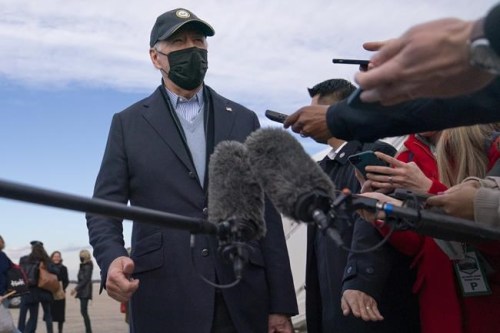
WASHINGTON – President Joe Biden is urging Americans to confront Omicron with caution instead of panic, insisting Monday it’s too soon to say whether the heavily mutated, highly contagious COVID-19 variant will demand wider limits on travel into the United States.
For now, the Biden administration’s strategy will instead be to double down on convincing people to get vaccinated if they aren’t already, and to get a booster shot as soon as possible if they are.
“This variant is a cause for concern, not a cause for panic,” Biden said from the Roosevelt Room of the White House, where he played down any possibility of a return to the shutdowns, lockdowns and widespread travel bans of the pandemic’s painful first year.

“We have the best vaccine in the world, the best medicines, the best scientists, and we’re learning more every single day. We’ll fight this variant with scientific and knowledgeable actions and speed, not chaos and confusion.”
A U.S. ban on foreign visitors from eight countries in Africa, which took effect Monday, was imposed because of how widespread the variant is in that part of the world, not to try to keep it out of the U.S. — a largely futile strategy in any event, the president suggested.
It’s “almost inevitable” that the Omicron variant — two cases of which turned up in Ottawa over the weekend, the first publicly acknowledged cases in North America — will be detected in the U.S., Biden said. Limiting travel from Africa gives the White House a chance to get its message out.
“We needed time to give people an opportunity to say, ‘Get that vaccination now’ … it’s going to move around the world. I think it’s almost inevitable there will be at some point that strain here in the United States,” he said.
“The degree of the spread impacts on whether or not there is a need for any (additional) travel restriction, but I don’t anticipate that at this point, and we’ll see — we’ll see how that works.”
The president also called on other countries, although he didn’t single any out, to do their part to donate a share of their vaccine supply in order to help snuff out the pandemic around the world. Health officials have long insisted that the best way to tamp down potentially dangerous variants is to deny the virus the hosts it needs to to spread widely and mutate.
The U.S. has donated more than 275 million free vaccine doses around the world, he said — more than all other countries combined.
“I will always make sure that our people are protected first. But vaccinating the world is just one more tool, and how we need to meet our moral obligation as Americans, and how to best protect Americans as well,” he said.
“Now we need the rest of the world to step up as well … We can’t let up until the world is vaccinated.”
So far, however, the U.S. in particular and the G7 in general have failed to articulate a coherent strategy for ensuring that happens in a timely way, said Dr. Peter Hotez, dean of the National School of Tropical Medicine at Baylor College of Medicine in Houston.
In the rush to produce an effective vaccine against COVID-19, no one stopped to consider the need for a simpler, scalable treatment that could be more readily manufactured, distributed and administered in the developing world, Hotez told MSNBC.
“When you rely exclusively on a brand new technology, as any engineer will tell you, there’s a learning curve before you can go from zero to nine billion (doses),” he said.
“It was a science policy failure, shared by the G7 leaders, that they never took a step back and had that situational awareness to say, ‘Hey, we also need a simple vaccine with an older technology that we can make now.'”
Biden has repeatedly said he supports the idea of a World Trade Organization waiver on intellectual property protections that would give developing countries better access to the technology that would allow them to produce their own vaccines, instead of depending on donations.
As recently as last week, Biden urged the 164 WTO member states gathering in Geneva this week to clear the way for vaccine manufacturers to share their formulas and supplies. The European Union, Germany and the U.K. are among those opposed to the measure, which requires unanimity to pass.
Canada has so far hedged its bets on the idea of a waiver, insisting it would be taking part in the talks but stopping short of delivering a full-throated endorsement.
Prime Minister Justin Trudeau’s Liberal government “opposed developing countries manufacturing vaccines for their citizens,” New Democrat health critic Don Davies said Monday during question period in the House of Commons.
In response, International Development Minister Harjit Sajjan would only tout Canada’s own record on donating vaccines — at least 200 million doses promised to the international vaccine initiative known as COVAX by the end of next year, and $2.6 billion in international aid.
Industry Minister François-Philippe Champagne added in French that Canada is working within the Ottawa Group — a subset of 13 WTO members that includes the EU — to eliminate global trade barriers that impact essential medical goods, but did not specifically mention the waiver.

White House press secretary Jen Psaki said Monday that South Africa itself already has more vaccine doses than it has the capacity to administer, thanks in part to logistical difficulties, personnel issues and widespread vaccination hesitancy.
“In a lot of countries, it’s not just about having vaccine doses, it is about ensuring there’s operational capacity,” Psaki said.
“It’s about having not just the vaccine doses, but also the apparatus, the capability and also addressing vaccine hesitancy — which is, as you know, something that we have worked hard to address in this country.”
This report by The Canadian Press was first published Nov. 29, 2021.
— With files from Laura Osman in Ottawa
Related Articles
WHO warns that new virus variant poses 'very high' risk
Advertisement Advertise With Us
Advertisement Advertise With Us