Omicron brings COVID-19 vaccine inequity ‘home to roost’

Advertisement

Advertise with us

LONDON (AP) — The emergence of the new omicron variant and the world's desperate and likely futile attempts to keep it at bay are reminders of what scientists have warned for months: The coronavirus will thrive as long as vast parts of the world lack vaccines.

Read this article for free:


By clicking the button above, an account will be created and you will begin to receive some of our recommended newsletters. You may opt out of any newsletter by visiting your Email and Communication Preferences page or by clicking "unsubscribe" at the bottom of any email.

or

Already have an account? Log in here »

To continue reading, please subscribe:

Digital Subscription

One year of digital access for only $1.44 a week*

  • Enjoy unlimited reading on winnipegfreepress.com
  • Read the E-Edition, our digital replica newspaper
  • Access News Break, our award-winning app
  • Play interactive puzzles

*Billed as $5.77 plus GST every four weeks. After 52 weeks, price increases to the regular rate of $19.95 plus GST every four weeks. Offer available to new and qualified returning subscribers only. Cancel any time.

To continue reading, please subscribe:

Add Free Press access to your Brandon Sun subscription for only an additional

$1 for the first 4 weeks*

  • Enjoy unlimited reading on winnipegfreepress.com
  • Read the E-Edition, our digital replica newspaper
  • Access News Break, our award-winning app
  • Play interactive puzzles
Start now

*Your next Brandon Sun subscription payment will increase by $1.00 and you will be charged $17.95 plus GST for four weeks. After four weeks, your payment will increase to $24.95 plus GST every four weeks.

Hey there, time traveller!
This article was published 29/11/2021 (1797 days ago), so information in it may no longer be current.

LONDON (AP) — The emergence of the new omicron variant and the world’s desperate and likely futile attempts to keep it at bay are reminders of what scientists have warned for months: The coronavirus will thrive as long as vast parts of the world lack vaccines.

The hoarding of limited COVID-19 shots by rich countries — creating virtual vaccine deserts in many poorer ones — doesn’t just mean risk for the parts of the world seeing shortages; it threatens the entire globe.

That’s because the more the disease spreads among unvaccinated populations, the more possibilities it has to mutate and potentially become more dangerous, prolonging the pandemic for everyone.
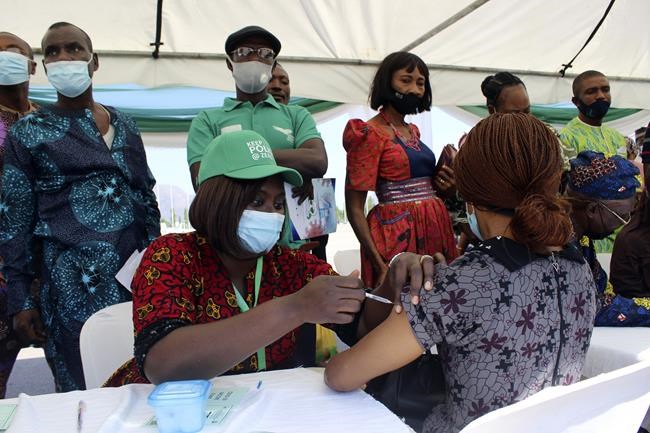
FILE - A woman receives an AstraZeneca coronavirus vaccine in Abuja, Nigeria, on Nov 19, 2021. The emergence of the new omicron variant and the world’s desperate and likely futile attempts to keep it at bay are reminders of what scientists have warned for months: The coronavirus will thrive as long as vast parts of the world lack vaccines. (AP Photo/Gbemiga Olamikan, File)

“The virus is a ruthless opportunist, and the inequity that has characterized the global response has now come home to roost,” said Dr. Richard Hatchett, CEO of CEPI, one of the groups behind the U.N.-backed COVAX shot-sharing initiative.

Perhaps nowhere is the inequality more evident than in Africa, where under 7% of the population is vaccinated. South African scientists alerted the World Health Organization to the new omicron variant last week, though it may never be clear where it first originated. Researchers are now rushing to determine whether it is more infectious or able to evade current vaccines.

COVAX was supposed to avoid such inequality — but instead the initiative is woefully short of shots and has already abandoned its initial goal of 2 billion doses.

Even to reach its scaled-back target of distributing 1.4 billion doses by the end of 2021, it must ship more than 25 million doses every day. Instead, it has averaged just over 4 million a day since the beginning of October, with some days dipping below 1 million, according to an Associated Press analysis of the shipments.

Shipments in recent days have ramped up, but nowhere near the amount needed.

Meanwhile, richer nations often have a glut of shots, and many are now offering boosters — something the WHO has discouraged because every booster is essentially a dose that is not going to someone who’s never even gotten their first shot. Despite the U.N. health agency’s appeal to countries to declare a moratorium on booster shots until the end of the year, more than 60 countries are now administering them.

“What it highlights are the continuing and fundamental risks to everyone associated with not seriously addressing the inequalities still at play globally in the fight against disease and poor health,” said Dr. Osman Dar, director of the One Health Project at the Chatham House think tank.

Anna Marriott, health policy manager for Oxfam, said COVAX was limited from the outset after being pushed to the back of the vaccine queue by rich countries.

“The COVAX team may be delivering as fast as they can, but they can’t deliver vaccines they haven’t got,” Marriott said.

Just 13% of vaccines COVAX contracted for and 12% of promised donations have actually been delivered, according to calculations by the International Monetary Fund from mid-November. About a third of the vaccines dispensed by COVAX have been donations, according to the vaccine alliance known as Gavi, and the initiative is now partly a clearinghouse for those donated doses, the very situation it was set up to avoid.

Last week, COVAX sent out a news release praising a European Union pledge to ship 100 million vaccines to Africa by the end of the year — but only 1/20 of that amount was actually on planes.

A medical worker wears plastic gloves at a temporary screening clinic for the coronavirus in Seoul, South Korea, Monday, Nov. 29, 2021. The emergence of the new omicron variant and the world’s desperate and likely futile attempts to keep it at bay are reminders of what scientists have warned for months: The coronavirus will thrive as long as vast parts of the world lack vaccines. (AP Photo/Lee Jin-man)

Asked about the logistical challenges of distributing the other 94 million doses in only six weeks, Aurelia Nguyen, managing director of COVAX maintained that arrangements “are in place to move a vast number of doses between now and the end of the year.”

In a statement, she said the issue was ensuring that “conditions are right on the ground for doses to be administered.”

In minutes released ahead of an executive meeting this week, Gavi fretted that the perception that rich countries are dumping older or lesser vaccines on poor countries could undermine the whole project. On Monday, in a joint statement with WHO and the African Union among others, it admonished that “the majority of the donations to date have been ad hoc, provided with little notice and short shelf lives.”

Fury over dose dumping is already very real. In Malawi and South Sudan, tens of thousands of out-of-date doses were destroyed.

But it’s not just getting the vaccines into poorer countries that’s a problem, according to some experts. COVAX is “falling short on getting vaccines from the (airport) tarmac into people’s arms,” said Dr. Angela Wakhweya, senior director for health equity and rights at CARE.

Authorities in Congo, for instance, returned their entire COVAX shipment this summer when they realized they would not be able to administer doses before they expired.

In a “risk management” report on COVAX, Gavi warned that “poor absorption” of vaccines by developing countries could lead to “wastage” of some doses. One problem is logistics — just getting the doses in the right country at the right time. But just as important is the ability of often underfunded national health systems to distribute the shots where they’re most needed, along with syringes and other necessary gear. A third issue is persuading sometimes hesitant people to get the vaccines.

World Health Organization Director-General Tedros Adhanom Ghebreyesus, however, has disputed distribution is a problem, saying the only obstacle to immunization in poor countries is supply.

Most COVAX doses distributed so far have been AstraZeneca’s vaccine, a shot that has yet to be authorized in the U.S. and whose botched rollout in Europe helped fuel anti-vaccine sentiment when the vaccine was linked to rare blood clots. The vaccines mostly used in the U.S. and much of Europe — made by Pfizer-BioNTech and Moderna — have only been available in tiny amounts via COVAX.

The U.S., which blocked vaccine sales overseas and exports of key ingredients for months, has donated 275 million doses in all, more than any other country, but the vast majority of the Biden administration’s 1.1 billion pledge has a deadline of September 2022. The European Union, which has in general allowed vaccines manufactured in the bloc to be sold anywhere in the world, has actually delivered about a third of its 500 million promised doses.
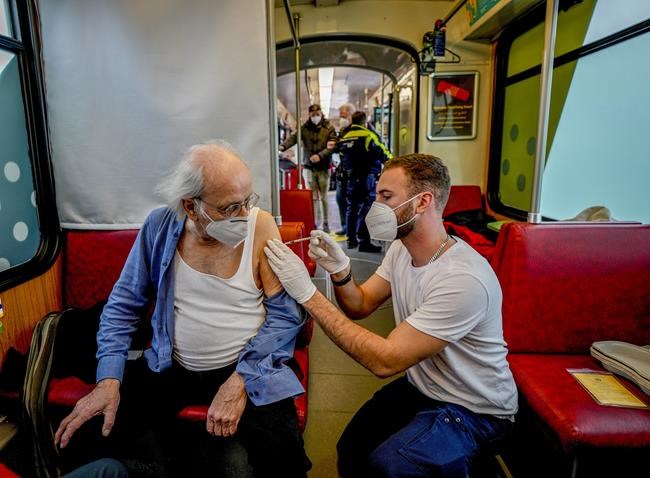
FILE - An 85-year-old man receives a booster vaccination in the so called
FILE - An 85-year-old man receives a booster vaccination in the so called "vaccination express" tram in central Frankfurt, Thursday, Nov. 4, 2021. The emergence of the new omicron variant and the world’s desperate and likely futile attempts to keep it at bay are reminders of what scientists have warned for months: The coronavirus will thrive as long as vast parts of the world lack vaccines. Meanwhile, richer nations often have a glut of shots, and many are now offering boosters. (AP Photo/Michael Probst, File)

Efforts to ramp up global production beyond a select group of manufacturers have stalled, which many activists and scientists blame on pharmaceutical companies’ opposition to waive intellectual property rights for the highly lucrative vaccines.

COVAX’s failure to deliver anywhere close to enough vaccines has led some to wonder if it’s worth the effort to fight for the shots, given that the pandemic has so far not devastated Africa as many had initially feared — and has often been the worst in richer nations. That’s a strategy few public health officials would endorse.

“I think what Africa could do to really shame the world is to stop asking for vaccines,” said Christian Happi, a Nigerian virologist who sat on the scientific advisory board of CEPI. “The vaccines have not arrived, and anyways it may turn out that we don’t need them as much as the West.”

___

Hinnant reported from Paris. Associated Press writer Zeke Miller contributed from Washington.

___

Follow AP’s coverage of the coronavirus pandemic at https://apnews.com/hub/coronavirus-pandemic

Report Error Submit a Tip

More Stories

Doctor’s departure stressful for teen

Kevin Rollason 6 minute read Preview

Doctor’s departure stressful for teen

Kevin Rollason 6 minute read Sunday, Oct. 24, 2021

Morgan Walker is a typical teen — but only because a piece of his brain the size of a deck of cards was removed four years ago.

Walker, who had seizures multiple times a day before his surgery, fears other people might not be so lucky.

That’s because his surgeon, Dr. Demitre Serletis, is leaving the province and Health Sciences Centre. Serletis will start practising at the Cleveland Clinic in the new year.

“I was kind of shocked, but I understood why,” Walker said from his home in Brandon. “The government really hasn’t been respecting doctors.”

Read
Sunday, Oct. 24, 2021

Nobel laureate Toni Morrison dead at 88

Hillel Italie, The Associated Press 18 minute read Preview

Nobel laureate Toni Morrison dead at 88

Hillel Italie, The Associated Press 18 minute read Tuesday, Aug. 6, 2019

NEW YORK - Nobel laureate Toni Morrison, a pioneer and reigning giant of modern literature whose imaginative power in "Beloved," ''Song of Solomon" and other works transformed American letters by dramatizing the pursuit of freedom within the boundaries of race, has died at age 88.

Publisher Alfred A. Knopf announced that Morrison died Monday night at Montefiore Medical Center in New York. Morrison's family issued a statement through Knopf saying she died after a brief illness.

"Toni Morrison passed away peacefully last night surrounded by family and friends," the family announced. "The consummate writer who treasured the written word, whether her own, her students or others, she read voraciously and was most at home when writing."

Few authors rose in such rapid, spectacular style. She was nearly 40 when her first novel, "The Bluest Eye," was published. By her early 60s, after just six novels, she had become the first black woman to receive the Nobel literature prize, praised in 1993 by the Swedish academy for her "visionary force" and for her delving into "language itself, a language she wants to liberate" from categories of black and white. In 2012, Barack Obama awarded her a Presidential Medal of Freedom.

Read
Tuesday, Aug. 6, 2019

Defunding police ‘illogical step’: Pallister

Carol Sanders 5 minute read Preview

Defunding police ‘illogical step’: Pallister

Carol Sanders 5 minute read Tuesday, Jun. 9, 2020

Manitoba Premier Brian Pallister says he’s open to channelling justice funding to preventive programs, but questions whether defunding police is the best approach — warning there will always be criminals taking advantage of vulnerable people.

“I think the motivation that lies in frustrations of the actions of some police services — not necessarily here in Winnipeg exclusively, but elsewhere — is justifiable and understandable, and I get it,” Pallister said Tuesday, when asked to comment on the 30,000 signatures collected for a Justice 4 Black Lives Winnipeg petition calling for the abolition of the city police.

“But then moving to defunding police is, to me, an illogical step from that one. Don’t let your frustration lose your common sense... There’s a lot of people out there in vulnerable communities who depend on the police to protect them and make sure they’re safe from the action of criminals.”

There has been a widespread call to restructure police funding in the wake of George Floyd’s death May 25 in Minneapolis.

Read
Tuesday, Jun. 9, 2020

Nine more deaths, 107 new COVID-19 cases in Manitoba

Katie May 6 minute read Preview

Nine more deaths, 107 new COVID-19 cases in Manitoba

Katie May 6 minute read Monday, Dec. 28, 2020

Manitoba is restarting its COVID-19 vaccination efforts, following a five-day break — and amidst questions about the delay.

The planned pause over Christmas was in the name of efficiency, a provincial government spokesman says, offering no other explanation on the reasoning behind the decision not to vaccinate anyone Dec. 24-28.

On Monday, the province announced nine more pandemic deaths and 107 new cases of the novel coronavirus.

As part of Manitoba's vaccination plan, the most recent immunization clinic happened Dec. 23; the next was set to start Dec. 29.

Read
Monday, Dec. 28, 2020

RCMP to bolster traffic enforcement after ‘concerning’ spike in deadly collisions

Free Press staff 3 minute read Preview

RCMP to bolster traffic enforcement after ‘concerning’ spike in deadly collisions

Free Press staff 3 minute read Yesterday at 12:46 PM CDT

Manitoba RCMP are boosting traffic enforcement after a spike in fatal collisions.

So far this year, 73 people have been killed in 65 collisions — a 28 per cent increase from the 57 deaths in the same January to October period last year, the Mounties said Friday.

The increase in fatalities is 28 per cent higher than the province’s five-year average.

“It’s concerning to me personally, but it’s also concerning to us, the RCMP, to see this many crashes occurring and this many people losing their lives,” RCMP traffic services enforcement commander Staff Sgt. Jon Greer said.

Read
Yesterday at 12:46 PM CDT

Behind the scenes at circus spectacle Odysseo, it's the horses who hold the reins

Erin Lebar / Photos by Ruth Bonneville 15 minute read Preview

Behind the scenes at circus spectacle Odysseo, it's the horses who hold the reins

Erin Lebar / Photos by Ruth Bonneville 15 minute read Wednesday, Jun. 13, 2018

It’s almost 4 p.m. on a particularly steamy May afternoon and Cavalia Odysseo rider Chelsea Jordan is putting on her makeup in the back corner of the very humid artistic tent.

She’s already spent some time layering on foundation, and is now into the decorative portion of the 30-minute process, placing a pair of small gems on her forehead and enhancing her naturally sharp cheekbones with some extra contouring.

“This is the messy part of the business,” she jokes as she sticks on fake lashes over an eyelid covered in earth-toned shadow.

It’s odd that makeup is considered the messy part of the day when Jordan spends the majority of her time surrounded by horses, but as with most people involved in Odysseo, the glitzy and glamorous aspects of being a member of the largest touring production in the world aren’t nearly as fun as the time she gets to spend with her four-legged cast-mates.

Read
Wednesday, Jun. 13, 2018