Thousands of animals dead in ‘agricultural disaster,’ says B.C. government

Advertisement

Advertise with us

Thousands of farm animals have died in an "agriculture disaster" in British Columbia set off by floods that swamped an area of the province known for its prime farming industry.

Read this article for free:


By clicking the button above, an account will be created and you will begin to receive some of our recommended newsletters. You may opt out of any newsletter by visiting your Email and Communication Preferences page or by clicking "unsubscribe" at the bottom of any email.

or

Already have an account? Log in here »

To continue reading, please subscribe:

Digital Subscription

One year of digital access for only $1.44 a week*

  • Enjoy unlimited reading on winnipegfreepress.com
  • Read the E-Edition, our digital replica newspaper
  • Access News Break, our award-winning app
  • Play interactive puzzles

*Billed as $5.77 plus GST every four weeks. After 52 weeks, price increases to the regular rate of $19.95 plus GST every four weeks. Offer available to new and qualified returning subscribers only. Cancel any time.

To continue reading, please subscribe:

Add Free Press access to your Brandon Sun subscription for only an additional

$1 for the first 4 weeks*

  • Enjoy unlimited reading on winnipegfreepress.com
  • Read the E-Edition, our digital replica newspaper
  • Access News Break, our award-winning app
  • Play interactive puzzles
Start now

*Your next Brandon Sun subscription payment will increase by $1.00 and you will be charged $17.95 plus GST for four weeks. After four weeks, your payment will increase to $24.95 plus GST every four weeks.

Hey there, time traveller!
This article was published 17/11/2021 (1809 days ago), so information in it may no longer be current.

Thousands of farm animals have died in an “agriculture disaster” in British Columbia set off by floods that swamped an area of the province known for its prime farming industry.

Agriculture Minister Lana Popham said many farmers attempted to move their animals by boat as their properties flooded but were forced to abandon them, “as the roads were disappearing beneath them.”

Even the animals that were successfully moved are in poor health and some may need to be euthanized, she said.
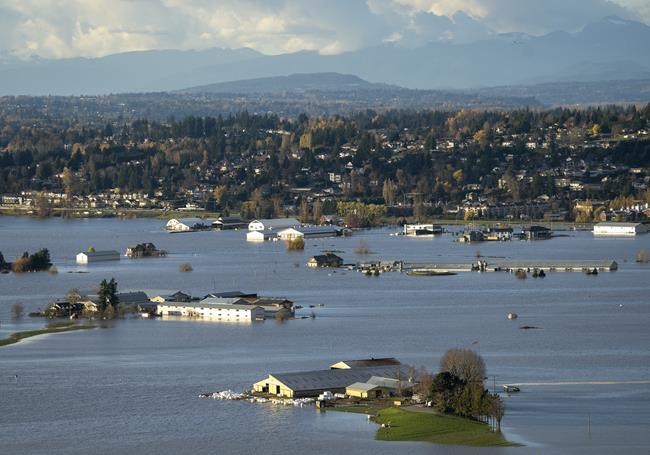
Properties inundated by flood waters are seen in Abbotsford, B.C., Tuesday, Nov. 16, 2021. Farmers in B.C. are coming together to save livestock as parts of the Fraser Valley are under water due to devastating flooding says an association that represents the province's dairy farmers. THE CANADIAN PRESS/Jonathan Hayward

“The animals that are getting moved through those water flows have been able to make it to a safe spot, but to tell you the truth, they’re not in good shape when they get there,” she said Wednesday during the same news conference where the B.C. government declared a state of emergency.

She said hundreds of farms have been affected by flooding, many of them in the Fraser Valley, about 100 kilometres east of Vancouver.

“And we have thousands of animals that have perished. We have many, many more that are in difficult situations and we’re seeing an animal welfare issue develop,” Popham said.

There will have to be euthanizations, while there are also animals that have survived that will be in critical need of care, the minister said.

The government is working to get safe access for veterinarians to those farms as soon as possible.

The animals that survived will be in critical need of food for the next 24 hours as flooding wiped out access to feed, said Popham.

Dozens of the farms under evacuation orders in the Fraser Valley region are poultry farms, says the national group that speaks for chicken farmers.

Lisa Bishop-Spencer, the communications director with Chicken Farmers of Canada, said of the 310 chicken farms in B.C., 61 farms are being evacuated, 22 of which are broiler farms, where chickens are raised for their meat.

“Everyone’s still trying to make sure that themselves and their families are safe and taking as best care of their birds as possible, but we don’t have any specific information on losses yet,” she said.

It’s fair to expect some losses as farmers were faced with challenging conditions trying to move animals to safety, she said.

Dairy and chicken farms cover the Sumas Prairie area of Abbotsford, the same location that residents in 1,000 properties were told to evacuate on Tuesday.

Farmers spent hours Tuesday working to transport their animals to safety, in some cases relying on boats and other watercraft.

B.C. is the third-largest chicken-producing province in the country, said Bishop-Spencer, but their organization is working to ensure there are no supply issues once help has been given to all farmers and animals.

“We’re working with federal and provincial partners just to deploy support and assistance wherever,” she said.

The mayor of Abbotsford said he does not know how many farm animals may have been lost as floodwaters washed over the city Tuesday.

Sumas Prairie is part of Abbotsford, which was deluged by water over a 72-hour period starting Saturday.

Mayor Henry Braun said he watched farmers trudge through water that was 1.5 metres deep to get the livestock out.

“We have no numbers. There’s a lot of birds out there too. I saw barns that looked like they were half full of water. I can’t imagine that there are any birds left alive, but we don’t have those numbers.”

Braun said Tuesday he knew the farmers wanted to protect their animals.

“Many would give their lives for their animals,” Braun said.

The situation grew more frantic Tuesday night when it appeared a crucial water pump station would be overwhelmed.

Braun urged those farmers who had ignored the evacuation order to leave their animals and get out.

By Wednesday, the pump station had been surrounded by sandbags and Braun said he felt better about the situation.

Holger Schwichtenberg, chair of the board for the BC Dairy Association, took in 30 milking cows at his own farm in Agassiz Tuesday from a farm in the Fraser Valley.

He says the move was stressful for the cows but they’ve managed to integrate them with his 110 animals.

“Some are a little unhappy. They’re doing a lot of mooing because this is new and different, and cows love routine … but they fit in very nicely,” he said Wednesday.

The association is aware of losses, but it’s unclear how many are milking cows, he said.

The B.C. Milk Marketing Board has advised dairy farmers in areas like Abbotsford, Chilliwack and the B.C. Interior to dump any milk into manure piles because mudslides and road washouts have made it impossible to transport.

Many B.C. dairy producers have no road access at all to their farms right now. In other cases where milk can be picked up from the farm, there is nowhere for it to go.

Schwichtenberg said this week’s flooding has put a strain on the industry, which is still reeling from a disastrous summer.

“We had a long, hot summer, we had a very poor growing season unless you had irrigation, the ongoing effects of COVID, and now we have this situation,” he said.

“It’s testing the resilience of dairy farmers, that’s for sure.”

This report by The Canadian Press was first published Nov. 17, 2021.

Report Error Submit a Tip

More Stories

The new normal in Canadian politics

David McLaughlin 5 minute read Preview

The new normal in Canadian politics

David McLaughlin 5 minute read 2:01 AM CDT

“Nothing happening, all at once.”

Welcome to the new normal of Canadian politics, where normality is the new normal. Routine and stable are in; disruptive and excessive are out. Exhibits A and B are the Alberta referendum and the British Columbia election. Voters opted for stability over volatility.

The opposite of being normal is being different from the norm. In politics that means different from where we’ve been and what we’ve come to expect. Two competing trends have dominated our politics for the past decade and a half — progressivism and populism. Think Justin Trudeau and liberal, progressive identity politics in Canada, and Donald Trump and conservative, populist MAGA politics in America. We are now experiencing a swing away from both those trends.

Representing this “new normal” are Prime Minister Mark Carney, for one, and newly elected British Columbia premier, Lorne Doerksen, for another. Both are considered normal because they talk and act like adults in a childish political world. Their political flair is to not have any political flair. They stand out for not standing out.

Read
2:01 AM CDT

Letters, Oct. 31

6 minute read 2:01 AM CDT

Civic election a missed opportunity

The outcome of the latest municipal election in Winnipeg is nothing short of baffling. The decline of what was once a proud, beautiful prairie hub is impossible to ignore.

Winnipeg is rapidly sliding into a state of structural and social dilapidation, yet voters have inexplicably chosen to hand incumbent Mayor Scott Gillingham a second term. The decision smells of complacency, and sadly, it represents a massive missed opportunity for real urban renewal.

Walking through downtown Winnipeg today is an exercise in heartbreak. A city centre that should be a bustling economic and cultural core has instead transformed into an absolute eyesore. Encampments and tents are permitted to dot the heart of the city. Streets that used to thrive are now dominated by the tragic, visible reality of severe addiction, with individuals wandering and staggering through public spaces without adequate intervention or care.

The trick to attracting wee, treat-seeking ghosts and goblins on Halloween is to go all-in

Jen Zoratti 5 minute read Preview

The trick to attracting wee, treat-seeking ghosts and goblins on Halloween is to go all-in

Jen Zoratti 5 minute read Wednesday, Oct. 31, 2018

When I was a kid in the 1990s, I lived for Halloween.

My mom, a gifted seamstress, made all of my costumes. Deciding what I’d dress up as involved imagination and a trip to the fabric or craft store.

I loved flipping through the McCall’s patterns, and running my hands along the bolts of fabric that my mom would transform into Little Bo Peep, or Dorothy from the Wizard of Oz, or, one year, a Christmas tree — complete with the star on top. Old things were repurposed into new things.

Trick-or-treating was my... I don’t know, some sort of sports reference. The goal? Amass as much candy as possible. We’d troll the neighbourhood for hours, dragging snow-sodden pillow cases full of it. We’d target specific streets, lured mostly by the promise of full-sized chocolate bars.

Read
Wednesday, Oct. 31, 2018

Human rights museum responds to reopening backlash

Julia-Simone Rutgers 4 minute read Preview

Human rights museum responds to reopening backlash

Julia-Simone Rutgers 4 minute read Thursday, Jul. 29, 2021

The Canadian Museum for Human Rights reopened to fully vaccinated members of the public this week, drawing cries of discrimination from those who have chosen not to get vaccinated against COVID-19.

While the some of the backlash has been “disturbing,” museum CEO Isha Khan said the conflict has opened room for a conversation about human rights during the pandemic.

“We made the decision to open in compliance with that law, really because we’re a public institution and we saw it as our responsibility to open as soon as we could to the public — within the restrictions as they currently are,” Khan said Thursday.

“But it’s really important to us, as the Canadian Museum for Human Rights we have a mandate for human rights education, that we’re trying to ground the conversation in human rights principles.”

Read
Thursday, Jul. 29, 2021

A little toponder, a lot to celebrate

Erna Buffie 5 minute read 2:01 AM CDT

Well, another civic election season has come and gone, and I have to say it was a doozy. The most surprising event was the steady climb in support for young mayoral candidate Noah Redden, who started out with just four per cent public support in September but had reached a solid 14 per cent support in October.

On election day, Redden nearly came in second, less than one percentage point behind Kevin Klein, an experienced politician.

Indeed, the 27-year-old’s accomplishment was nothing short of astonishing. Particularly given that his shoestring campaign was given very little coverage — largely, according to one pundit, because he didn’t send out any press releases.

This when Redden’s unwritten press releases were there for everyone to see on Instagram, as he popped up in locations across the city, posting videos about what he hoped to achieve as mayor.

Court ruling concludes Canadian Wheat Board saga

Laura Rance-Unger 4 minute read Preview

Court ruling concludes Canadian Wheat Board saga

Laura Rance-Unger 4 minute read 2:01 AM CDT

It remains to be seen whether the recent court ruling in a lawsuit filed after Canadian Wheat Board’s dissolution in 2012 puts the whole debate to rest, as some no doubt hope.

But either way, the dust has settled on the post-CWB world. The sun still rises and a new generation of farmers on the land only knows by name an institution that for generations influenced every aspect of Prairie grain farming.

The first Rural Revival column I wrote for this newspaper more than 30 years ago was about a thousand farmers from Western Canada demonstrating in support of the Wheat Board. It was in the aftermath of the Western Grain Marketing Panel report, one of several efforts that eventually included a plebiscite to help the federal government decide what to do about a vocal minority of farmers who wanted marketing “freedom.”

The polls at the time suggested about two-thirds of farmers were comfortable enough with the single-desk system for food wheat and barley to keep it around. It served as a counterbalance to canola, which they sold on the open market. They essentially had a dual market.

Read
2:01 AM CDT