Showing solidarity isn’t a holiday, it’s a full-time job

Advertisement
Read this article for free:
or
Already have an account? Log in here »
To continue reading, please subscribe:

Digital Subscription
One year of digital access for only $205*
- Enjoy unlimited reading on winnipegfreepress.com
- Read the E-Edition, our digital replica newspaper
- Access News Break, our award-winning app
- Play interactive puzzles
*First annual payment billed as $205.00 + GST for one year. This annual subscription will automatically renew at $233.00 + GST every 52 weeks (10% off the regular annual price of $259.35). Offer available to new and qualified returning subscribers only. Cancel any time.
To continue reading, please subscribe:
Add Free Press access to your Brandon Sun subscription for only an additional
$1 for the first 4 weeks*
- Enjoy unlimited reading on winnipegfreepress.com
- Read the E-Edition, our digital replica newspaper
- Access News Break, our award-winning app
- Play interactive puzzles
*Your next Brandon Sun subscription payment will increase by $1.00 and you will be charged $17.95 plus GST for four weeks. After four weeks, your payment will increase to $24.95 plus GST every four weeks.
Read unlimited articles for free today:
or
Already have an account? Log in here »
Hey there, time traveller!
This article was published 27/09/2021 (1820 days ago), so information in it may no longer be current.
Six-year-old Phyllis Webstad proudly wore her brand new orange shirt to her first day at St. Joseph Mission Residential School in 1973.
The shirt, bright and shiny with a lace-up front, was a gift from her grandmother, who never had a lot of money. Phyllis picked out the shirt herself, and she was so excited to wear it.
But when she got to school, her clothes were stripped from her and never returned. She never wore her orange shirt again. “The colour orange has always reminded me of that and how my feelings didn’t matter,” Webstad later wrote, “how no one cared and how I felt like I was worth nothing.”
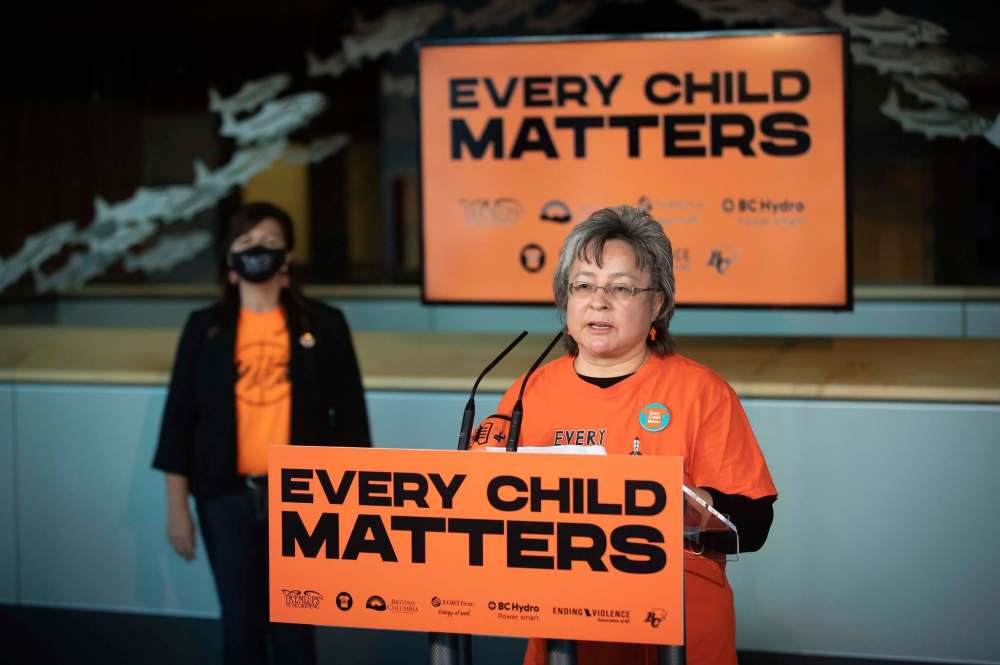
Today, Webstad is a residential school survivor, author and the founder of Orange Shirt Day, which has been recognized every Sept. 30 since 2013. The orange shirt is now a symbol of all that was stolen from generations of Indigenous children — their languages, their cultures, their identities, their senses of self-worth — in Canada’s system of forced assimilation.
Orange Shirt Day now shares the day with the National Day for Truth and Reconciliation, which became a federal statuatory holiday this year following the spring’s harrowing discoveries of hundreds of unmarked graves at former residential schools across the country. The choice of date was intentional; according to a Government of Canada press release, it “builds on the grassroots momentum of Orange Shirt Day, which is already known as a day to remember the legacy of residential schools and move forward with reconciliation.”
Indeed, the momentum of Orange Shirt Day can be seen in the unprecedented demand for orange shirts — not just this September but for this past Canada Day as well. Orange shirts that declare every child matters still hang in people’s windows. And at many schools around the city, you can still see orange ribbons woven through chain-link fences.
Purchasing and wearing an orange shirt — and not a fake from Amazon, either — is a great way to show solidarity for residential school survivors and their families. But Orange Shirt Day cannot begin and end with that act alone. The thing about momentum is, it can slow. If we want to keep these issues of the frontburner and prevent them from fading from view, we will have to make them a priority. Every day is a day for truth and reconciliation.
For non-Indigenous people, this will require doing the hard work. It will involve interrogating your own biases and thinking about the ways in which you benefit from colonial structures. It will mean reading the Truth and Reconciliation Commission’s 94 calls to action; as justice Murray Sinclair said when the calls were rolled out back in 2015, “Reconciliation is not an Aboriginal problem — it is a Canadian problem. It involves all of us.”
Non-Indigenous folks: look at the traditional media you consume with curiosity. Whose voices do we hear from most? Why is it that missing white girls tend to get more media coverage than missing brown girls? Why do we often only see stories of Indigenous trauma and struggle and not Indigenous joy and success? That goes for social media, too: who are you following? Whose voices and ideas do you engage with? Whose perspectives do you seek out?
Do you know what intergenerational trauma is? Do you have as much tenderness for the kids who came home, including those now struggling with homelessness and addiction, as you do for the ones who never did?

Are you having conversations with your kids about the residential school system? There are age-appropriate resources for little ones, including Webstad’s book Phyllis’s Orange Shirt and David Robertson’s When We Were Alone.
Are you willing to listen to the truth?
“Every child matters” isn’t just a slogan. Reconciliation requires participation and commitment. Wear orange on Sept. 30. Continue to honour your commitment every day after that.
jen.zoratti@freepress.mb.ca
Twitter: @JenZoratti
Jen Zoratti is a Winnipeg Free Press columnist and author of the newsletter, NEXT, a weekly look towards a post-pandemic future.
Our newsroom depends on a growing audience of readers to power our journalism. If you are not a paid reader, please consider becoming a subscriber.
Our newsroom depends on its audience of readers to power our journalism. Thank you for your support.
Jen Zoratti is a Winnipeg Free Press columnist and author of the newsletter, NEXT, a weekly look towards a post-pandemic future.
Our newsroom depends on a growing audience of readers to power our journalism. If you are not a paid reader, please consider becoming a subscriber.
Our newsroom depends on its audience of readers to power our journalism. Thank you for your support.
Related Articles
‘Dumbfounded’: Winnipeg author challenges Ontario school division’s move to pull Indigenous fantasy novel


Advertisement Advertise With Us
Advertisement Advertise With Us