Texas bans most abortions, with high court mum on appeal

Advertisement

Advertise with us

The nation's most far-reaching curb on abortions since they were legalized a half-century ago took effect Wednesday in Texas, with the Supreme Court silent on an emergency appeal to put the law on hold.

Read this article for free:


By clicking the button above, an account will be created and you will begin to receive some of our recommended newsletters. You may opt out of any newsletter by visiting your Email and Communication Preferences page or by clicking "unsubscribe" at the bottom of any email.

or

Already have an account? Log in here »

To continue reading, please subscribe:

Subscribe and receive a limited-edition Free Press branded hat or tote.

Digital Subscription

One year of digital access for only $205*

  • Enjoy unlimited reading on winnipegfreepress.com
  • Read the E-Edition, our digital replica newspaper
  • Access News Break, our award-winning app
  • Play interactive puzzles

*First annual payment billed as $205.00 + GST for one year. This annual subscription will automatically renew at $233.00 + GST every 52 weeks (10% off the regular annual price of $259.35). Offer available to new and qualified returning subscribers only. Cancel any time.

To continue reading, please subscribe:

Add Free Press access to your Brandon Sun subscription for only an additional

$1 for the first 4 weeks*

  • Enjoy unlimited reading on winnipegfreepress.com
  • Read the E-Edition, our digital replica newspaper
  • Access News Break, our award-winning app
  • Play interactive puzzles
Start now

*Your next Brandon Sun subscription payment will increase by $1.00 and you will be charged $17.95 plus GST for four weeks. After four weeks, your payment will increase to $24.95 plus GST every four weeks.

Hey there, time traveller!
This article was published 01/09/2021 (1867 days ago), so information in it may no longer be current.

The nation’s most far-reaching curb on abortions since they were legalized a half-century ago took effect Wednesday in Texas, with the Supreme Court silent on an emergency appeal to put the law on hold.

If allowed to remain in force, the law, which bans most abortions, would be the strictest against abortion rights in the United States since the high court’s landmark Roe v. Wade decision in 1973.

The Texas law, signed by Republican Gov. Greg Abbott in May, prohibits abortions once medical professionals can detect cardiac activity, usually around six weeks and before most women know they’re pregnant.
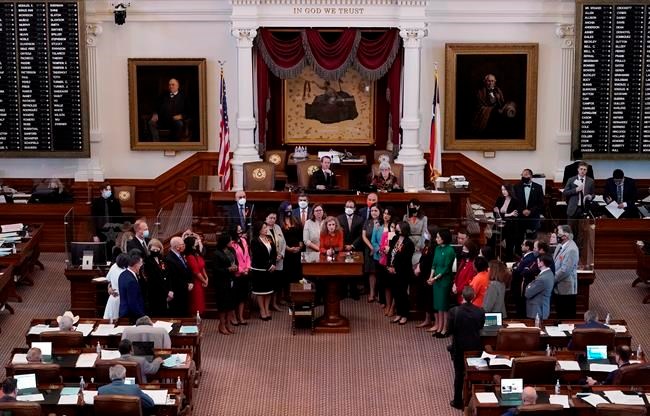
FILE - In this May 5, 2021, file photo, Texas state Rep. Donna Howard, D-Austin, center at lectern, stands with fellow lawmakers in the House Chamber in Austin, Texas, as she opposes a bill introduced that would ban abortions as early as six weeks and allow private citizens to enforce it through civil lawsuits, under a measure given preliminary approval by the Republican-dominated House. Abortion providers in Texas are asking the Supreme Court to prevent enforcement of a state law that would allow private citizens to sue anyone for helping a woman get an abortion after about six weeks of pregnancy. (AP Photo/Eric Gay, File)

It’s part of a broader push by Republicans across the country to impose new restrictions on abortion. At least 12 other states have enacted bans early in pregnancy, but all have been blocked from going into effect.

What makes the Texas law different is its unusual enforcement scheme. Rather than have officials responsible for enforcing the law, private citizens are authorized to sue abortion providers and anyone involved in facilitating abortions. Among other situations, that would include anyone who drives a woman to a clinic to get an abortion. Under the law, anyone who successfully sues another person would be entitled to at least $10,000.

“Starting today, every unborn child with a heartbeat will be protected from the ravages of abortion,” Abbott said in a statement posted on Twitter. “Texas will always defend the right to life.”

But protests were quick.

President Joe Biden said in a statement that the law “blatantly violates the constitutional right established under Roe v. Wade and upheld as precedent for nearly half a century.” He said the law “outrageously” gives private citizens the power “to bring lawsuits against anyone who they believe has helped another person get an abortion.”

Likewise, the American Medical Association said it was deeply disturbed by “this egregious law” and disappointed by the Supreme Court’s inaction.

The law “not only bans virtually all abortions in the state, but it interferes in the patient-physician relationship and places bounties on physicians and health care workers simply for delivering care,” said a statement from Dr. Gerald E. Harmon, the AMA president.

In a phone call with reporters, Marc Hearron, a lawyer for the Center for Reproductive Rights, said the abortion providers his group represents were still hoping to hear from the Supreme Court but “as of now, most abortion is banned in Texas.”

Clinics have said the law would rule out 85% of abortions in Texas and force many clinics to close. Planned Parenthood is among the abortion providers that have stopped scheduling abortions beyond six weeks from conception.
FILE - In this May 5, 2021, file photo, Texas state Rep. Donna Howard, D-Austin, center at lectern, stands with fellow lawmakers in the House Chamber in Austin, Texas, as she opposes a bill introduced that would ban abortions as early as six weeks and allow private citizens to enforce it through civil lawsuits, under a measure given preliminary approval by the Republican-dominated House. A Texas law banning most abortions in the state took effect at midnight on Sept. 1 but the Supreme Court has yet to act on an emergency appeal to put the law on hold. If allowed to remain in force, the law would be the most dramatic restriction on abortion rights in the United States since the high court’s landmark Roe v. Wade decision legalized abortion across the country in 1973. (AP Photo/Eric Gay, File)

Abortion opponents who wrote the law also made it difficult to challenge in court, in part because it’s hard to know whom to sue.

Abortion rights advocates say it will force many women to travel out of state for abortions, if they can afford to do so and also navigate issues including childcare and taking time off work. The Guttmacher Institute, a research organization that supports abortion rights, says if legal abortion care in Texas shuts down, the average one-way driving distance to an abortion clinic for Texans would increase from 12 miles to 248 miles.

Already, abortion clinics beyond the Texas border are feeling the impact. At the Trust Women clinic in Oklahoma City, there had been 80 appointments scheduled over the past two days, more than double the typical number of patients, said Rebecca Tong, co-executive director of the clinic. Two-thirds of those patients were from Texas, another sharp increase, and the earliest opening was now three weeks out.

“Oklahoma has just barely enough clinics for the amount of people here,” Tong said. “If anyone is thinking, ‘Oh, they can just go out of state, it’ll be so easy,’ a lot of clinics in the Midwest and South, we don’t do abortion care five days a week.”

Late into the night Tuesday before the ban took effect clinics in Texas were filled with patients, said Amy Hagstrom Miller, CEO of Whole Women’s Health, which has four abortion clinics in Texas.

Twenty-seven women were still in the waiting room after 10 p.m. at one clinic, leaving doctors crying and scrambling over whether they would see all of them in time, she said. The last abortion at one of her clinics finished at 11:56 p.m. in Fort Worth, where Hagstrom Miller said anti-abortion activists outside shined bright lights in the parking lot after dark looking for wrongdoing, and twice called police.

“This morning I woke up feeling deep sadness. I’m worried. I’m numb,” she said.

The law is part of a hard-right agenda that Texas Republicans muscled through the statehouse this year ahead of the 2022 midterm elections, when Abbott is up for a third term as governor.

Another law taking effect Wednesday ended required firearm training and background checks to carry handguns in public in Texas, and GOP lawmakers on Tuesday approved election changes that will further tighten what are already some of the strictest voting laws in the nation.
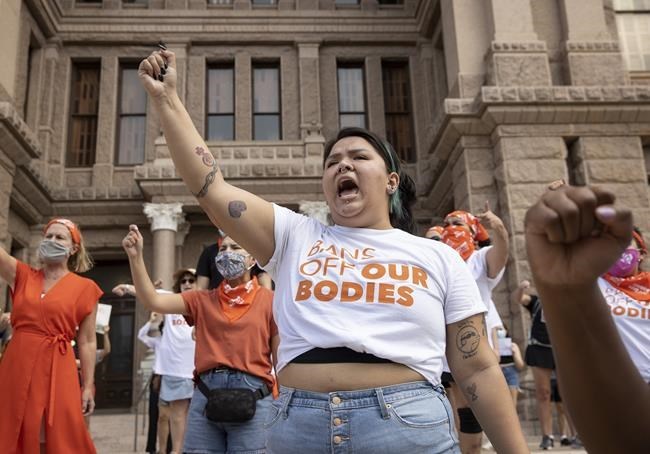
Leen Garza participates in a protest against the six-week abortion ban at the Capitol in Austin, Texas, on Wednesday, Sept. 1, 2021. Dozens of people protested the abortion restriction law that went into effect Wednesday. (Jay Janner/Austin American-Statesman via AP)

Texas has long had some of the nation’s toughest abortion restrictions, including a sweeping law passed in 2013. The Supreme Court eventually struck down that law, but not before more than half of the state’s 40-plus clinics closed.

Lawmakers also are moving forward in an ongoing special session in Texas with proposed new restrictions on medication abortion, a method using pills that accounts for roughly 40% of abortions in the U.S.

Even before the Texas case arrived at the high court the justices had planned to tackle the issue of abortion rights in a major case that will be heard after the court begins hearing arguments again in the fall. That case involves the state of Mississippi, which is asking to be allowed to enforce an abortion ban after 15 weeks of pregnancy.

___

AP writer Paul J. Weber reported from Austin, Texas.

Report Error Submit a Tip

More Stories

Poilievre unveils five-point steel plan, urges Ottawa to sue Stelco’s U.S. owner

Brett Bundale, The Canadian Press 4 minute read Friday, Oct. 9, 2026

Conservative Leader Pierre Poilievre is calling on Ottawa to sue Stelco's American owner as part of a five-point plan aimed at protecting Canada's struggling steel industry.

Poilievre was in Burlington, Ont. on Friday, speaking at a site overlooking Stelco's operations across Hamilton Harbour. The steelmaker began issuing layoff notices this week after announcing plans to lay off up to 500 workers at its Hamilton and Lake Erie facilities.

He said the lawsuit should seek to bring back workers and restart idled operations at Stelco, or force its sale to a Canadian owner willing to resume production.

"The only thing that we would accept is these workers getting their paycheques, making Canadian steel to build our country," Poilievre said.

Puppies, stocks — ‘zoomies’ abound

Andrew Froese 4 minute read Yesterday at 2:01 AM CDT

This spring, I adopted a three-month-old rescued German Shepherd mix. To say she is easily excitable is an understatement.

It is not really her fault. A puppy’s frontal cortex, the part of the brain that helps with decision-making and impulse control, is still developing. When an older dog, or a human, gets tired, we generally understand we should rest. Puppies have not quite figured that out. They often interpret tiredness as a signal something is wrong, which makes them more alert, more reactive and harder to settle.

That creates a feedback loop. The puppy gets tired, which makes her frantic, which makes her more tired, which makes her even more frantic. Eventually, this becomes what people call the “zoomies”: frantic sprinting, biting, jumping and general chaos.

From the outside, it looks like the puppy has too much energy. In reality, the opposite is true. The zoomies are not a sign of excess energy. They are a sign the puppy is overtired and does not know it yet.

Canada backs International Criminal Court after U.S. imposes sanctions

Anja Karadeglija, The Canadian Press 2 minute read Preview

Canada backs International Criminal Court after U.S. imposes sanctions

Anja Karadeglija, The Canadian Press 2 minute read Friday, Oct. 9, 2026

OTTAWA - Canada signed a joint statement in support of the International Criminal Court after the United States moved to sanction the organization today.

The statement says the signatories strongly disagree with the sanctions and reaffirm their "continued and unwavering" support for the court.

Canada issued the statement jointly with Denmark, Germany, France, Italy, Japan, the Netherlands and the United Kingdom.

The sanctions cut the court off from U.S.-based financial services, technology companies and U.S. currency, and are part of a campaign to dismantle the tribunal over investigations into the United States and its allies, including Israel.

Read
Friday, Oct. 9, 2026

Is this the season of secession?

David McLaughlin 5 minute read Preview

Is this the season of secession?

David McLaughlin 5 minute read Yesterday at 2:01 AM CDT

Canada has entered its season of secession. Like El Nino, the currents of grievance can blow hot and cold. Today, they are hot. But how hot for how long? The odds of Alberta and now Quebec separating from Canada are not high, but they are never zero.

After a year of waving the flag in a surge of national patriotism to confront Donald Trump’s attacks on Canada — economic and verbal — it is both jarring and frustrating for most Canadians to be reminded of the pervasive and persistent tensions that come with governing our federation.

When we need new national purpose to confront big economic sovereignty and security challenges from outside, that purpose is undermined and diminished by having to confront homegrown grievances.

We’ve seen and seen off two separation referendums in Quebec. Now we have a newly elected separatist party coming to power. In Alberta, voters will soon decide whether the independence road is one they want to travel.

Read
Yesterday at 2:01 AM CDT

Kinew, Canadian ambassador to U.S. discuss trade

Free Press staff 2 minute read Yesterday at 2:01 AM CDT

Canada’s ambassador to the United States met Manitoba Premier Wab Kinew and local business leaders during a visit to Winnipeg this week.

Mark Wiseman and Kinew spoke about trade uncertainty with the United States and opportunities for Manitoba businesses, a government news release says.

The provincial U.S. Trade Council, the Business Council of Manitoba and part of the Premier’s Business and Jobs Council spoke to Wiseman about the impacts of trade uncertainty.

Province down 4,400 jobs

Final hurdles are moving on in your mind and life

Maureen Scurfield 3 minute read Yesterday at 2:01 AM CDT

DEAR MISS LONELYHEARTS: I just ran into my former husband with his new woman. It was a shock. She looked nothing like me — not nearly as good. In fact, she’s the opposite of me — red-haired, freckled, tall and skinny like a rake. I’m short, dark, with golden skin from my Italian background. That was what my husband used to say he loved in a woman.

Does that mean he lied — that he really didn’t like my looks and secretly longed for the opposite? That seems crazy to me. But I should mention that in our last miserable years together he didn’t even want to hold me in his arms and look at me. He sometimes slept at his office (or so he said) because he was “too tired to drive home.”

He could have been elsewhere — like in some other woman’s home — because he always used his cellphone to call me, not his office line.

How can I forget about the man I loved so much and finally move on?