High jumper Sam Grewe wins gold, heads to medical school

Advertisement

Advertise with us

TOKYO (AP) — Sam Grewe made a choice when he was 13 to have his right leg amputated after he was diagnosed with an aggressive bone cancer.

Read this article for free:


By clicking the button above, an account will be created and you will begin to receive some of our recommended newsletters. You may opt out of any newsletter by visiting your Email and Communication Preferences page or by clicking "unsubscribe" at the bottom of any email.

or

Already have an account? Log in here »

To continue reading, please subscribe:

Digital Subscription

One year of digital access for only $1.44 a week*

  • Enjoy unlimited reading on winnipegfreepress.com
  • Read the E-Edition, our digital replica newspaper
  • Access News Break, our award-winning app
  • Play interactive puzzles

*Billed as $5.77 plus GST every four weeks. After 52 weeks, price increases to the regular rate of $19.95 plus GST every four weeks. Offer available to new and qualified returning subscribers only. Cancel any time.

To continue reading, please subscribe:

Add Free Press access to your Brandon Sun subscription for only an additional

$1 for the first 4 weeks*

  • Enjoy unlimited reading on winnipegfreepress.com
  • Read the E-Edition, our digital replica newspaper
  • Access News Break, our award-winning app
  • Play interactive puzzles
Start now

*Your next Brandon Sun subscription payment will increase by $1.00 and you will be charged $17.95 plus GST for four weeks. After four weeks, your payment will increase to $24.95 plus GST every four weeks.

Hey there, time traveller!
This article was published 31/08/2021 (1887 days ago), so information in it may no longer be current.

TOKYO (AP) — Sam Grewe made a choice when he was 13 to have his right leg amputated after he was diagnosed with an aggressive bone cancer.

He could have chosen to keep the leg, but he said it would have been a frail limb once surgeons carved out the “fist-size tumor.” That procedure also would have ruled out any sports for life.

“There’s no doubt in my mind that I made the right decision,” the American said Tuesday after taking gold in the high jump in the T64 class at the Paralympics.
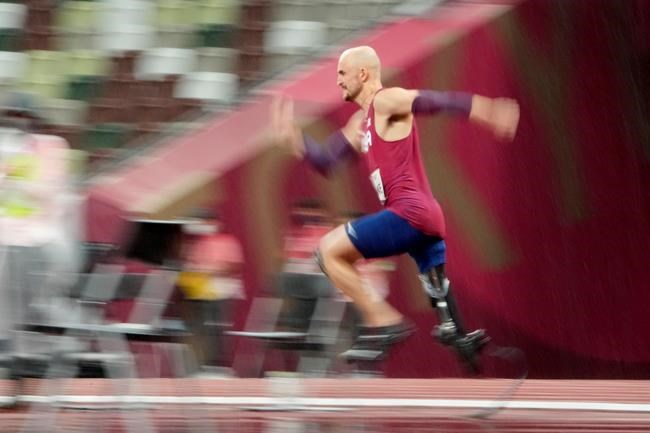
Sam Grewe of the United States competes in the men's high jump T63 final during the Tokyo 2020 Paralympics Games at the National Stadium in Tokyo, Japan, Tuesday, Aug. 31, 2021. (AP Photo/Eugene Hoshiko)

Grewe said he thought at the time about still wanting to be an athlete.

“I want to lose my leg if that’s what it takes,” he recalled.

His winning jump Tuesday of 1.88 meters was just under the world record he holds for the class at 1.90 (6 feet, 2 3/4 inches). He beat silver medalist Mariyappan Thangavelu of India, who won gold five years ago in Rio de Janeiro. Grewe settled for silver last time.

Grewe, who jumps with a prosthetic blade, cleared the winning height on his final jump of three after his Indian rival missed all three attempts.

“I remember very vividly at my start, looking up at the board and seeing my name second,” Grewe said. “I knew with that jump I was going to clear it because I was not ready to walk away with that silver again.”

Now he has gold. And now the real challenges begin for a 23-year-old man who has already faced many.

Grewe enrolled a month ago in medical school at the University of Michigan, hoping to be the kind of physician he never saw when he was a patient — a doctor with a disability. He’s been studying six hours daily in Tokyo, which he described as “therapeutic.”

His professors apparently don’t know the word “timeout.”

“When I lost my leg I had a great health care support system; great doctors, great nurses but none of them had disabilities,” he said. “When I lost my leg I found myself kind of lost. They didn’t point me in any sort of direction. I felt I was kind of dumped out into the world, one leg down.”
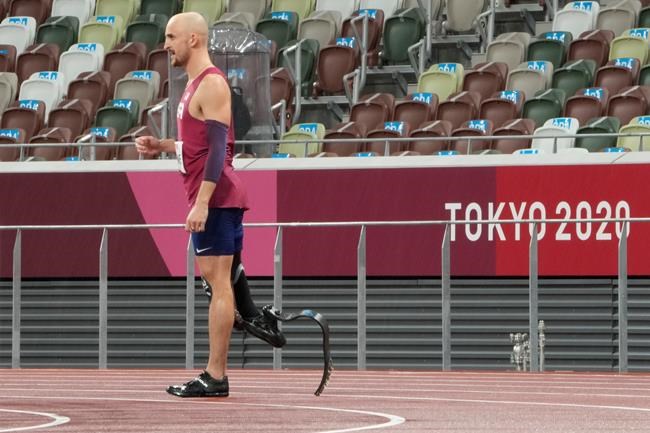
Sam Grewe of the United States prepares to compete in the men's high jump T63 final during the Tokyo 2020 Paralympics Games at the National Stadium in Tokyo, Japan, Tuesday, Aug. 31, 2021. (AP Photo/Eugene Hoshiko)

Grewe flashed the kind of black humor that is typical of some athletes with disabilities. It could make for an interesting bedside manner.

Asked what area of medicine he might pursue, Grewe suggested orthopedic surgery.

“You know, I feel it’s just karma to cut a few legs off here and there,” he said, snickering a bit. “Yeah, it’s just karma to cut off a few legs.”

Grewe has been a mentor — actually more than that — to fellow jumper Ezra Frech, who was born without a left knee and left fibula (a bone below the knee). As a 2-year-old boy, he had surgery to remove most of the leg.

“Sam is an older brother for me, he’s really like family,” said Frech, who cleared 1.80 on Tuesday but failed to win a medal.

Frech is 16 and the youngest member of the American Paralympic track and field team.

“I watched Sam compete in Rio, and I realized that’s what I want to do with my life,” Frech added.

Grewe said Frech would call him almost daily and send videos of his jumping technique. Grewe could empathize easily, already filling a spot as coach, role model, and caregiver.

“I think there are so many lessons that can’t be learned in a textbook for doctors,” Grewe said. “Things like compassion, empathy, taking a holistic approach when you’re working with a patient.”
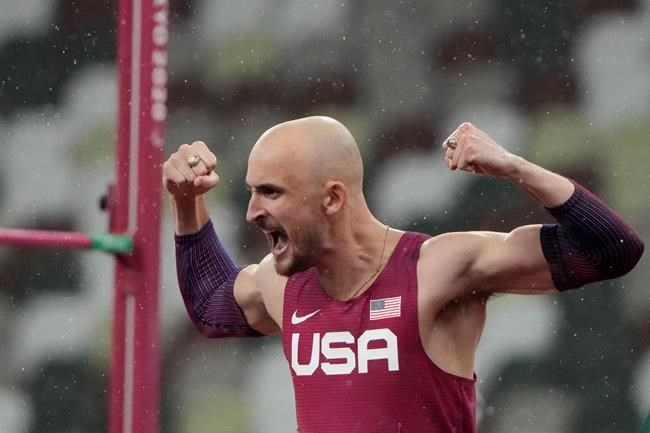
Sam Grewe of the United States reacts in the men's high jump T63 final during the Tokyo 2020 Paralympics Games at the National Stadium in Tokyo, Japan, Tuesday, Aug. 31, 2021. (AP Photo/Eugene Hoshiko)

Grewe said a man in Tokyo encountered him recently as he was walking to the track and handed him a note. It explained that his 10-year-old son had been diagnosed with the same bone cancer that Grewe had, and also went ahead with the choice of losing his leg.

Grewe said the man had seen him jump, which offered assurance that his son would also recover and have a full sporting life. He said the young boy was now playing soccer in middle school, a moment he said that brought him back “full circle” the the young boy he once was.

“I wouldn’t wish any of my peers to go and get cancer so they could experience what it’s like to be a patient,” Grewe said. “But I learned so much during my time as a patient. It almost felt irresponsible to not go out and give back those lessons to people like me who are going through similar experiences.”

___

More AP Olympics: https://apnews.com/hub/2020-tokyo-olympics and https://twitter.com/AP_Sports

Report Error Submit a Tip

More Stories

Court ruling concludes Canadian Wheat Board saga

Laura Rance-Unger 4 minute read Preview

Court ruling concludes Canadian Wheat Board saga

Laura Rance-Unger 4 minute read 2:01 AM CDT

It remains to be seen whether the recent court ruling in a lawsuit filed after Canadian Wheat Board’s dissolution in 2012 puts the whole debate to rest, as some no doubt hope.

But either way, the dust has settled on the post-CWB world. The sun still rises and a new generation of farmers on the land only knows by name an institution that for generations influenced every aspect of Prairie grain farming.

The first Rural Revival column I wrote for this newspaper more than 30 years ago was about a thousand farmers from Western Canada demonstrating in support of the Wheat Board. It was in the aftermath of the Western Grain Marketing Panel report, one of several efforts that eventually included a plebiscite to help the federal government decide what to do about a vocal minority of farmers who wanted marketing “freedom.”

The polls at the time suggested about two-thirds of farmers were comfortable enough with the single-desk system for food wheat and barley to keep it around. It served as a counterbalance to canola, which they sold on the open market. They essentially had a dual market.

Read
2:01 AM CDT

Teemu Selanne living the good life in southern California

Mike McIntyre 19 minute read Preview

Teemu Selanne living the good life in southern California

Mike McIntyre 19 minute read Friday, Oct. 15, 2021

LAGUNA BEACH — He likes his coffee black. His steak “medium rare plus.” And he’s an extremely generous pour, especially when it comes to a Moscow mule.

His left knee is giving him all sorts of trouble these days, he’s admittedly almost always running behind schedule and his biggest pride and joy are his four children, who keep him and his wife Sirpa hopping with their numerous athletic pursuits.

He is Teemu Selanne, the beloved Winnipeg Jets legend who, you’ll be happy to know, is still living the good life just a stone’s throw from the Pacific Ocean in this little piece of southern California paradise.

Despite being nearly eight years removed from the end of a Hall of Fame hockey career, the Finnish Flash remains a big deal around here. That was clear as we sat down earlier this week for an exclusive chat inside “Selanne’s Steak Tavern” — a high-end eatery he owns that sits along the stunning Pacific Coast Highway.

Read
Friday, Oct. 15, 2021

Behind the scenes at circus spectacle Odysseo, it's the horses who hold the reins

Erin Lebar / Photos by Ruth Bonneville 15 minute read Preview

Behind the scenes at circus spectacle Odysseo, it's the horses who hold the reins

Erin Lebar / Photos by Ruth Bonneville 15 minute read Wednesday, Jun. 13, 2018

It’s almost 4 p.m. on a particularly steamy May afternoon and Cavalia Odysseo rider Chelsea Jordan is putting on her makeup in the back corner of the very humid artistic tent.

She’s already spent some time layering on foundation, and is now into the decorative portion of the 30-minute process, placing a pair of small gems on her forehead and enhancing her naturally sharp cheekbones with some extra contouring.

“This is the messy part of the business,” she jokes as she sticks on fake lashes over an eyelid covered in earth-toned shadow.

It’s odd that makeup is considered the messy part of the day when Jordan spends the majority of her time surrounded by horses, but as with most people involved in Odysseo, the glitzy and glamorous aspects of being a member of the largest touring production in the world aren’t nearly as fun as the time she gets to spend with her four-legged cast-mates.

Read
Wednesday, Jun. 13, 2018

Defunding police ‘illogical step’: Pallister

Carol Sanders 6 minute read Preview

Defunding police ‘illogical step’: Pallister

Carol Sanders 6 minute read Tuesday, Jun. 9, 2020

Manitoba Premier Brian Pallister says he’s open to channelling justice funding to preventive programs, but questions whether defunding police is the best approach — warning there will always be criminals taking advantage of vulnerable people.

“I think the motivation that lies in frustrations of the actions of some police services — not necessarily here in Winnipeg exclusively, but elsewhere — is justifiable and understandable, and I get it,” Pallister said Tuesday, when asked to comment on the 30,000 signatures collected for a Justice 4 Black Lives Winnipeg petition calling for the abolition of the city police.

“But then moving to defunding police is, to me, an illogical step from that one. Don’t let your frustration lose your common sense... There’s a lot of people out there in vulnerable communities who depend on the police to protect them and make sure they’re safe from the action of criminals.”

There has been a widespread call to restructure police funding in the wake of George Floyd’s death May 25 in Minneapolis.

Read
Tuesday, Jun. 9, 2020

Has the political wind changed?

Gwynne Dyer 5 minute read 2:01 AM CDT

It has been quite a week. First we had “Lula” – Luiz Inácio da Silva (as nobody but his mother ever called him) – defying everybody’s expectations. After winding up two million votes behind his challenger, Flávio Bolsonaro, in the first round of the Brazilian presidential election, he made a “miraculous” comeback in the second.

It was like a man going into a revolving door behind you and coming out in front. At the end of the first round, Lula was two million votes behind; at the end of the second round on Oct. 25 he was four million votes ahead. So how did he win a fourth term without cheating?

That’s what Bolsonaro claims he did, having fled to the United States; Trump, Flávio’s mentor, hints at the same. But Lula’s victory was not miraculous. He only learned to read when he was 10, and at 80 he still refused to have a mobile phone. His team finally made him get one and use it.

He wouldn’t do social media videos, so they created a WhatsApp channel called Lula’s Army, and made him appear on it at least daily. The channel went from zero to 10.8 million viewers in two weeks, and Lula won.

The trick to attracting wee, treat-seeking ghosts and goblins on Halloween is to go all-in

Jen Zoratti 5 minute read Preview

The trick to attracting wee, treat-seeking ghosts and goblins on Halloween is to go all-in

Jen Zoratti 5 minute read Wednesday, Oct. 31, 2018

When I was a kid in the 1990s, I lived for Halloween.

My mom, a gifted seamstress, made all of my costumes. Deciding what I’d dress up as involved imagination and a trip to the fabric or craft store.

I loved flipping through the McCall’s patterns, and running my hands along the bolts of fabric that my mom would transform into Little Bo Peep, or Dorothy from the Wizard of Oz, or, one year, a Christmas tree — complete with the star on top. Old things were repurposed into new things.

Trick-or-treating was my... I don’t know, some sort of sports reference. The goal? Amass as much candy as possible. We’d troll the neighbourhood for hours, dragging snow-sodden pillow cases full of it. We’d target specific streets, lured mostly by the promise of full-sized chocolate bars.

Read
Wednesday, Oct. 31, 2018