Sew and steady
April Tawipisim's colourful creations are the result of years of cultural reclamation

Advertisement
Read this article for free:
or
Already have an account? Log in here »
To continue reading, please subscribe:
Digital Subscription
One year of digital access for only $1.44 a week*
- Enjoy unlimited reading on winnipegfreepress.com
- Read the E-Edition, our digital replica newspaper
- Access News Break, our award-winning app
- Play interactive puzzles
*Billed as $5.77 plus GST every four weeks. After 52 weeks, price increases to the regular rate of $19.95 plus GST every four weeks. Offer available to new and qualified returning subscribers only. Cancel any time.
To continue reading, please subscribe:
Add Free Press access to your Brandon Sun subscription for only an additional
$1 for the first 4 weeks*
- Enjoy unlimited reading on winnipegfreepress.com
- Read the E-Edition, our digital replica newspaper
- Access News Break, our award-winning app
- Play interactive puzzles
*Your next Brandon Sun subscription payment will increase by $1.00 and you will be charged $17.95 plus GST for four weeks. After four weeks, your payment will increase to $24.95 plus GST every four weeks.
Read unlimited articles for free today:
or
Already have an account? Log in here »
Hey there, time traveller!
This article was published 30/08/2021 (1873 days ago), so information in it may no longer be current.
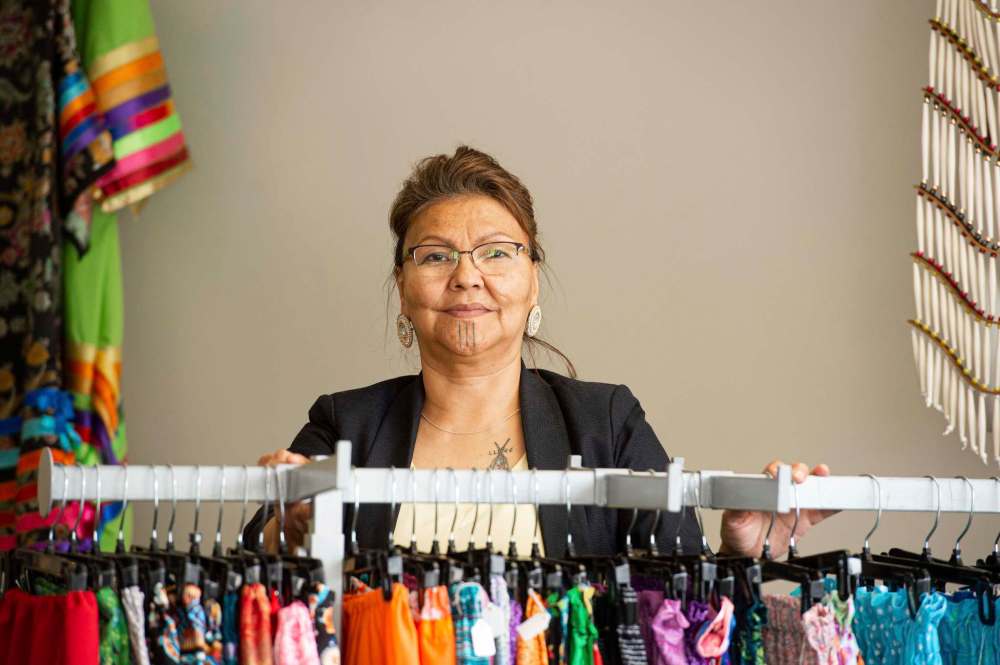
On a grey morning with rain spitting down from the dark clouds, April Tawipisim stands in the window of her Portage Avenue storefront next to a mannequin wearing a yellow dress decorated with flowers of blue and green, an eye-catching blur of colour to the traffic speeding by.
The dress took real work: painstaking, careful work. The kind that not just any sewing machine can do. The kind that requires knowledge just as much as technique. A kind of work that takes time and a bit of belief.
For Tawipisim, who earlier this summer started Turtle Woman Indigenous Wear, which sells handmade jingle dresses, ribbon skirts and shirts, and other contemporary attire inspired by Indigenous cultures, getting here has taken years, decades even. A life.
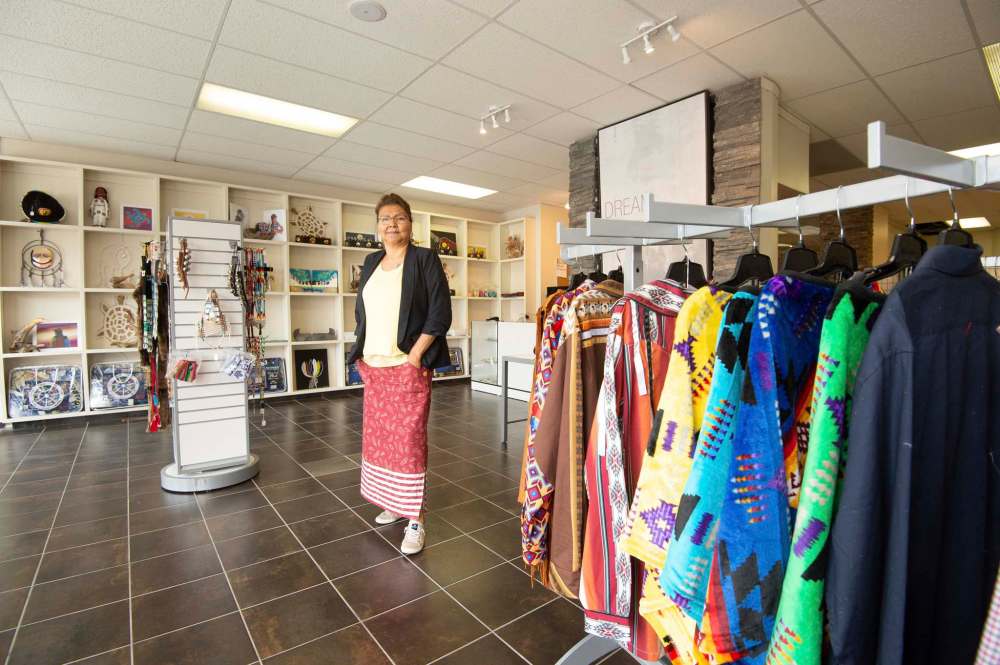
“When I want to do something, I have the vision of it,” she says.
“I see it, and I know what it’s going to look like at the end.”
Born and raised in Brochet, Tawipisim, a Cree woman and a member of Barren Lands First Nation, graduated from university with a degree in management, and had a long career, working in areas such as low-income housing, municipal finances and community education. All along, the idea of running her own business was buried in her brain. The only question was what it would be and when it could be.
During the pandemic, she figured that out.
In the seemingly distant pre-pandemic past, Tawipisim had sewed a variety of dresses, shirts and skirts, making regalia in anticipation of a busy powwow season. She intended to take her creations to the events and sell what she had.
But COVID-19 trampled on that idea, with powwows and any large community events postponed for the past two summers. However, she wasn’t discouraged: Tawipisim kept sewing and built up a large stock, trusting the fact that at some point, people would have occasion to wear her wares.
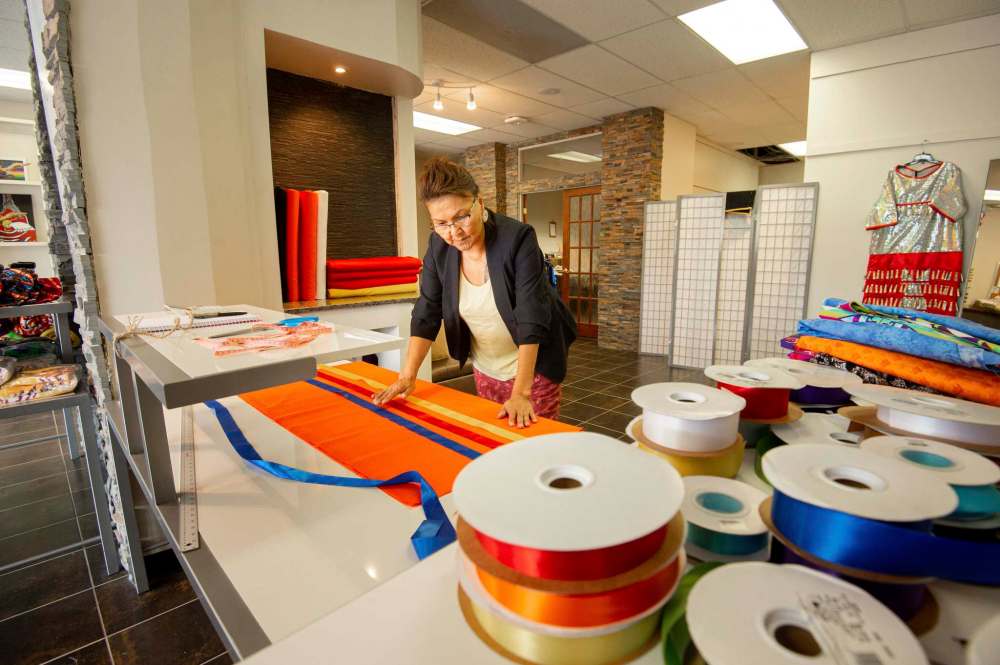
It’s with that stock, plus more since sewn by Tawipisim’s in-house team, and materials and garments acquired from Indigenous designers across Canada, that Turtle Woman Indigenous Wear opened. And though she expected a warm response, Tawipisim was surprised to receive one quite so hot: all 40 of the ribbon skirts she’d opened with were sold in less than two weeks, with custom orders coming in rapid succession. (A big selling point: her women’s garments have pockets.)
It’s good for business, she says, but also a sign of something good happening in the world: a growing wave of Indigenous people looking to wear clothing designed by Indigenous people, not just to ceremonies but in day-to-day life, and to learn more about their history.
“There is a resurgence in people wanting to reclaim their culture, especially now with all those children being found,” says Tawipisim, whose mother was a survivor of the residential school system. “A lot of people are doing soul searching, I’d say, learning about themselves and their culture.”
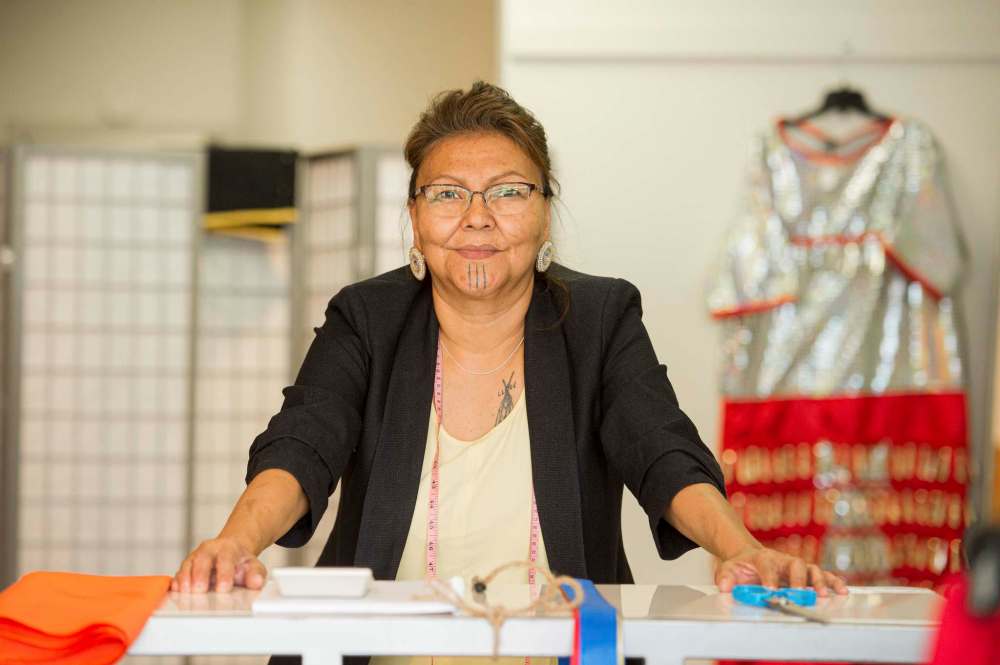
That’s also what Tawipisim has been doing for decades, though with more decisive action in recent years. She changed her name to April, the first name her mother wanted to give her, and her last name to Tawipisim, her grandfather’s name, meaning “Eclipse.” She got a traditional tattoo of three stripes on her chin. She put words in her mother tongue, Woodland Cree, on her business’s sign. The name of the business — Turtle Woman — is an homage to her mom’s collection of turtle art and trinkets, and her mom’s photo, taken at residential school, is seen in the sign as well.
“It’s been, I’d say, a 12-year journey,” she says.
What happened 12 years ago was this: Tawipisim went to a powwow in Thompson, where she was living at the time. “I was there as an observer more than anything,” she said. “I hadn’t even worn a skirt, let alone made one.”
Growing up, events like this did not happen in her community. For many years, Indigenous people were barred from cultural practices like it, she says, and for many, even after that wasn’t the case, people were still scared or hesitant to do it. The connection was missing, a result of colonialism and cultural erasure.
She watched the powwow with great interest, but was confused to find very few people, especially children, dancing. She had no idea how to either.
So she went home, opened up YouTube, and became her own dance instructor, researching jingle dresses, grass dances and more, teaching herself the steps. She formed a club, starting with 20 kids and growing to 40, learning not just how to dance, but what the dances meant.
“The kids pick things up pretty quick,” she says.
The mesmerizing, percussive jingle dance, for instance, has a relatively modern story. It began in the early 1900s, according to Tawipisim and other sources, when in his sleep, an Ojibwa medicine man was instructed to make a jingle dress, covered in metallic cones or chimes, for his ailing granddaughter. He was told that if he made the dress and she danced in it, she would be healed.
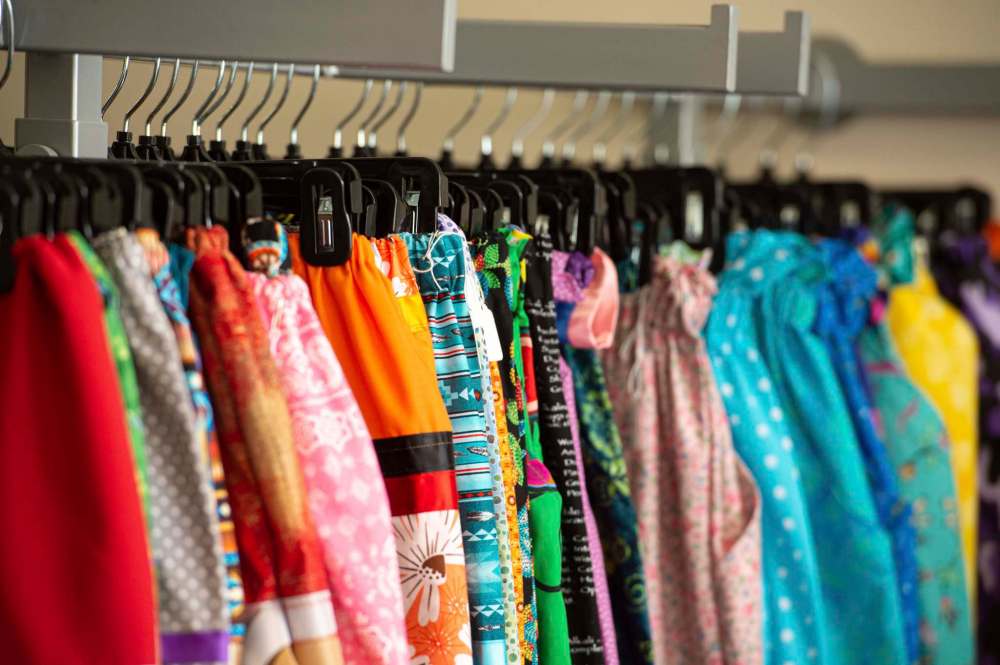
At first, the young girl was too weak to dance alone, and had to be carried by the tribe, according to the National Congress of American Indians. But soon, she gained strength and, cured of her sickness, danced on her own. For that reason, the jingle dress is referred to by many as a healing dress.
“The young girl was likely infected with the flu pandemic of 1918 which hit Native communities around the Great Lakes hard,” the NCAI said. “This was closely followed by a ban on ritual dancing on reservations, yet despite this, the jingle dress dance spread from the Ojibwa people, first to the Lakota and then on to the rest of Indian Country.”
A century later, during another pandemic, Tawipisim is learning more about that history of healing, and at her store, she’s realizing how many people — specifically young ones — are eager to learn it too. A pair of tiny dresses for four-year-old girls rest on the store’s front counter, back for a few routine alterations.

It’s tough, Tawipisim says, to start a business in the middle of the pandemic. But it’s also rewarding, she adds, to share and learn with customers and community members alike. With help from her sister and brother-in-law, along with her sewers, she’s enjoyed about as gleeful an opening month as possible.
Down the road, the grandmother of eight hopes to expand the store’s stock to include more Indigenous-made clothing, apparel, art and other wares, kind of like a small-scale department store.
“I view this as a passion, as something I’ve always wanted to do,” she says as the rain slows.
It took time, but she’s doing it now.
ben.waldman@freepress.mb.ca
Ben Waldman covers a little bit of everything for the Free Press.
Our newsroom depends on a growing audience of readers to power our journalism. If you are not a paid reader, please consider becoming a subscriber.
Our newsroom depends on its audience of readers to power our journalism. Thank you for your support.
Ben Waldman covers a little bit of everything for the Free Press.
Our newsroom depends on a growing audience of readers to power our journalism. If you are not a paid reader, please consider becoming a subscriber.
Our newsroom depends on its audience of readers to power our journalism. Thank you for your support.
Related Articles
Warm and fuzzy for Winnipeg winter



Advertisement Advertise With Us
Advertisement Advertise With Us