Pandemic leadership, recovery plans to be front and centre in election campaign

Advertisement

Advertise with us

OTTAWA - Procurement Minister Anita Anand is loathe to talk much about the low points of Canada's vaccine procurement campaign last winter.

Read this article for free:


By clicking the button above, an account will be created and you will begin to receive some of our recommended newsletters. You may opt out of any newsletter by visiting your Email and Communication Preferences page or by clicking "unsubscribe" at the bottom of any email.

or

Already have an account? Log in here »

To continue reading, please subscribe:

Digital Subscription

One year of digital access for only $1.44 a week*

  • Enjoy unlimited reading on winnipegfreepress.com
  • Read the E-Edition, our digital replica newspaper
  • Access News Break, our award-winning app
  • Play interactive puzzles

*Billed as $5.77 plus GST every four weeks. After 52 weeks, price increases to the regular rate of $19.95 plus GST every four weeks. Offer available to new and qualified returning subscribers only. Cancel any time.

To continue reading, please subscribe:

Add Free Press access to your Brandon Sun subscription for only an additional

$1 for the first 4 weeks*

  • Enjoy unlimited reading on winnipegfreepress.com
  • Read the E-Edition, our digital replica newspaper
  • Access News Break, our award-winning app
  • Play interactive puzzles
Start now

*Your next Brandon Sun subscription payment will increase by $1.00 and you will be charged $17.95 plus GST for four weeks. After four weeks, your payment will increase to $24.95 plus GST every four weeks.

Hey there, time traveller!
This article was published 17/08/2021 (1901 days ago), so information in it may no longer be current.

OTTAWA – Procurement Minister Anita Anand is loathe to talk much about the low points of Canada’s vaccine procurement campaign last winter.

Those days when Pfizer and Moderna were calling to say Canada’s shipments of vaccines were delayed or not coming at all. The weeks when vaccine rates in Israel, the United Kingdom or the United States were soaring and Canadians were wondering why they were being left behind.

But the 54-year-old former law professor will pause to acknowledge that with Canada now one of the most vaccinated countries in the world, things are a lot less tense around her office.
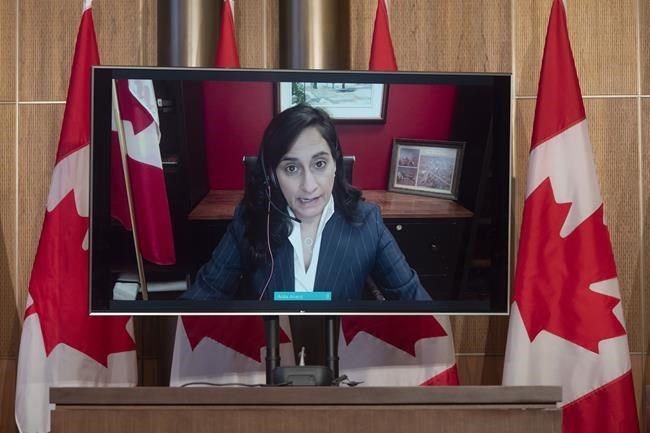
Public Services and Procurement Minister Anita Anand announces a delay to COVID vaccine delivery at the start of a technical briefing on the COVID pandemic in Canada, on January 15, 2021 in Ottawa. THE CANADIAN PRESS/Adrian Wyld

“My days are still very busy, because we have not finished our vaccine procurements as of yet, but I can say that I am sleeping better at night because of the strides we have made in procurement,” Anand said in an interview with The Canadian Press.

She said she is eager to show voters what those strides were, from overcoming the global supply crunch on personal protective equipment, to securing millions of rapid tests, and now being among the most vaccinated countries in the world.

“When you ask me whether I’m prepared to defend that record, yes, I am.,” Anand said, her voice steely.

But the Conservatives and the NDP will be telling voters that Canada was slow to acknowledge the threat COVID-19 posed, was not prepared with the personal protective equipment needed and was months slower than many other countries to get vaccines in the door.

Charles Bird, the managing principal at Earnscliffe Strategy Group in Toronto and a former provincial Liberal campaign director in Ontario, said there is no doubt that the pandemic is going to be top of mind for voters “for the simple reason that it’s not over.”

But Bird and other political strategists say for all parties the key factor in winning the pandemic vote will be where we go from here, rather than what they did so far.

Bird said the Liberals will want the ballot question to be “who do you trust to see us through what’s left of the pandemic and into a recovery?” while the Conservatives will want it to be “who is going to pay for all of this?”

Shakir Chambers, also a principal at Earnscliffe, and a former conservative political adviser in Ottawa and Ontario, said while there will be a lot of finger pointing between parties about decisions made during the pandemic, most voters “don’t have very long memories.”

“What they’re looking at now as we are in this kind of post-pandemic world, (is) what is the strategy to bring us out of out of an economic slump and focus on economic recovery?” he said. “I think, again, whoever that group is that presents that better picture will likely come into this election as a victor.”

There are already signs of where the two biggest parties will differ on this front. Prime Minister Justin Trudeau, with his mantra “build back better” is focusing on rebuilding an economy paying particular attention to those hurt most by the pandemic’s economic downturn.

Women, people of colour and Indigenous people bore the brunt of the job losses and added child care from school and daycare closures. Trudeau recently signed billion-dollar child care agreements with nearly all the provinces, inked the first provincial pharmacare agreement with Prince Edward Island, and committed money for capital improvements in long-term care to multiple provinces.

O’Toole is pushing what he calls “Canada’s Recovery Plan,” which includes policies to expand broadband coverage and tax credits to make Canada innovative again. He would scrap Trudeau’s child-care deals favour of a refundable tax credit of between $4,500 and $6,000 per child, aiming to cover up to 75 per cent of child-care costs for low-income families.

Both are arguing about who will do more to restore the life sciences industry, decimated by previous Conservative and Liberal governments alike.

Chambers said O’Toole will also have to fend off a Liberal attempt to convince voters who may be irritated by how their provincial government handled the pandemic that the federal Conservatives would be the same.

Seven provincial premiers are conservative or lead right-leaning governments, and many are being pummelled in the polls for their handling of the pandemic. While the federal government has a mandate for borders and bought vaccines, decisions on everything from school closures and business restrictions to mask mandates fall squarely in provincial space.

“I think what Justin Trudeau is trying to do is he’s trying to conflate all conservative politicians as one,” said Chambers. “And so if people in a certain province don’t like a certain leader or conservative premier, let’s just paint Erin O’Toole with that brush.”

Some experts have said Trudeau and Ontario Premier Doug Ford are likely to remain civil, at least as long as there isn’t a COVID-19 surge, as the federal Liberal leader tries to project calm as the politician best able to keep Canadians safe.

Bird said O’Toole’s job there could be made harder as Canadians are watching the partisan divide in the pandemic response in the United States, where Republican governors in some states aren’t just refusing to implement statewide restrictions, they’re preventing local health officials from doing it too.

“A lot of Canadians are keenly aware and completely freaked out at what’s happening south of the border,” said Bird.

This report by The Canadian Press was first published Aug. 17, 2021.

Report Error Submit a Tip

More Stories

The new normal in Canadian politics

David McLaughlin 5 minute read Preview

The new normal in Canadian politics

David McLaughlin 5 minute read 2:01 AM CDT

“Nothing happening, all at once.”

Welcome to the new normal of Canadian politics, where normality is the new normal. Routine and stable are in; disruptive and excessive are out. Exhibits A and B are the Alberta referendum and the British Columbia election. Voters opted for stability over volatility.

The opposite of being normal is being different from the norm. In politics that means different from where we’ve been and what we’ve come to expect. Two competing trends have dominated our politics for the past decade and a half — progressivism and populism. Think Justin Trudeau and liberal, progressive identity politics in Canada, and Donald Trump and conservative, populist MAGA politics in America. We are now experiencing a swing away from both those trends.

Representing this “new normal” are Prime Minister Mark Carney, for one, and newly elected British Columbia premier, Lorne Doerksen, for another. Both are considered normal because they talk and act like adults in a childish political world. Their political flair is to not have any political flair. They stand out for not standing out.

Read
2:01 AM CDT

Human rights museum responds to reopening backlash

Julia-Simone Rutgers 4 minute read Preview

Human rights museum responds to reopening backlash

Julia-Simone Rutgers 4 minute read Thursday, Jul. 29, 2021

The Canadian Museum for Human Rights reopened to fully vaccinated members of the public this week, drawing cries of discrimination from those who have chosen not to get vaccinated against COVID-19.

While the some of the backlash has been “disturbing,” museum CEO Isha Khan said the conflict has opened room for a conversation about human rights during the pandemic.

“We made the decision to open in compliance with that law, really because we’re a public institution and we saw it as our responsibility to open as soon as we could to the public — within the restrictions as they currently are,” Khan said Thursday.

“But it’s really important to us, as the Canadian Museum for Human Rights we have a mandate for human rights education, that we’re trying to ground the conversation in human rights principles.”

Read
Thursday, Jul. 29, 2021

The long and winding road

Editorial 4 minute read Preview

The long and winding road

Editorial 4 minute read 2:01 AM CDT

As theatre goes, it sent a strong message.

Manitoba Premier Wab Kinew, standing in front of microphones and television cameras, holding up his Indigenous status card and saying that he didn’t feel Canada should have “a race-based form of identification in this country, but that is a reality,” adding that it was time to abolish the Indian Act.

“I think it’s time to abolish the Indian Act, get rid of the Indian Act, move past the Indian Act, and it needs to be done with First Nations people and First Nations governments, of course. I think it’s long overdue that we have a relationship with Indigenous Peoples in Canada that reflects who we are as Canadians today,” he said.

The Indian Act — the name alone suggests how out-dated and out of place the law has become. Originally dating from 1876, the law was put in place to “amend and consolidate the laws respecting Indians” and gave the Minister of the Interior the responsibility to “control and management of the reserves, lands, moneys and property of Indians in Canada.”

Read
2:01 AM CDT

Provincial budget fails to chart new course

Editorial 4 minute read Preview

Provincial budget fails to chart new course

Editorial 4 minute read Wednesday, Apr. 13, 2022

If the 2022 Manitoba budget was intended to provide a lifeline for the Progressive Conservative government, it must surely be considered a failure.

Prior to the budget’s release, Premier Heather Stefanson and her government were teetering on the edge of the political abyss. Manitobans are profoundly unhappy with the government’s performance on most issues, including pandemic management. National polls show Ms. Stefanson is Canada’s least popular premier.

That political context made this budget a high-priority project for the Tories. It was, simply put, their best chance to shed the lingering burden left by former premier Brian Pallister, and rebuild the party brand under a new leader.

Unfortunately, Ms. Stefanson’s first budget remains shackled to the deeply flawed fiscal and political logic that defined the Pallister years. And no single budgetary measure embodies that failure more than the premier’s decision to continue cutting education property taxes.

Read
Wednesday, Apr. 13, 2022

The trick to attracting wee, treat-seeking ghosts and goblins on Halloween is to go all-in

Jen Zoratti 5 minute read Preview

The trick to attracting wee, treat-seeking ghosts and goblins on Halloween is to go all-in

Jen Zoratti 5 minute read Wednesday, Oct. 31, 2018

When I was a kid in the 1990s, I lived for Halloween.

My mom, a gifted seamstress, made all of my costumes. Deciding what I’d dress up as involved imagination and a trip to the fabric or craft store.

I loved flipping through the McCall’s patterns, and running my hands along the bolts of fabric that my mom would transform into Little Bo Peep, or Dorothy from the Wizard of Oz, or, one year, a Christmas tree — complete with the star on top. Old things were repurposed into new things.

Trick-or-treating was my... I don’t know, some sort of sports reference. The goal? Amass as much candy as possible. We’d troll the neighbourhood for hours, dragging snow-sodden pillow cases full of it. We’d target specific streets, lured mostly by the promise of full-sized chocolate bars.

Read
Wednesday, Oct. 31, 2018

Nobel laureate Toni Morrison dead at 88

Hillel Italie, The Associated Press 18 minute read Preview

Nobel laureate Toni Morrison dead at 88

Hillel Italie, The Associated Press 18 minute read Tuesday, Aug. 6, 2019

NEW YORK - Nobel laureate Toni Morrison, a pioneer and reigning giant of modern literature whose imaginative power in "Beloved," ''Song of Solomon" and other works transformed American letters by dramatizing the pursuit of freedom within the boundaries of race, has died at age 88.

Publisher Alfred A. Knopf announced that Morrison died Monday night at Montefiore Medical Center in New York. Morrison's family issued a statement through Knopf saying she died after a brief illness.

"Toni Morrison passed away peacefully last night surrounded by family and friends," the family announced. "The consummate writer who treasured the written word, whether her own, her students or others, she read voraciously and was most at home when writing."

Few authors rose in such rapid, spectacular style. She was nearly 40 when her first novel, "The Bluest Eye," was published. By her early 60s, after just six novels, she had become the first black woman to receive the Nobel literature prize, praised in 1993 by the Swedish academy for her "visionary force" and for her delving into "language itself, a language she wants to liberate" from categories of black and white. In 2012, Barack Obama awarded her a Presidential Medal of Freedom.

Read
Tuesday, Aug. 6, 2019