Liberals add $1.4 billion to climate change mitigation fund: McKenna

Advertisement

Advertise with us

OTTAWA - Infrastructure Minister Catherine McKenna says the federal government is adding almost $1.4 billion to the disaster mitigation and adaptation fund this year to help communities across Canada facing climate change and environmental disasters.

Read this article for free:


or

Already have an account? Log in here »

To continue reading, please subscribe:

Subscribe and receive a limited-edition Free Press branded hat or tote.

Digital Subscription

One year of digital access for only $205*

  • Enjoy unlimited reading on winnipegfreepress.com
  • Read the E-Edition, our digital replica newspaper
  • Access News Break, our award-winning app
  • Play interactive puzzles

*First annual payment billed as $205.00 + GST for one year. This annual subscription will automatically renew at $233.00 + GST every 52 weeks (10% off the regular annual price of $259.35). Offer available to new and qualified returning subscribers only. Cancel any time.

To continue reading, please subscribe:

Add Free Press access to your Brandon Sun subscription for only an additional

$1 for the first 4 weeks*

  • Enjoy unlimited reading on winnipegfreepress.com
  • Read the E-Edition, our digital replica newspaper
  • Access News Break, our award-winning app
  • Play interactive puzzles
Start now

*Your next Brandon Sun subscription payment will increase by $1.00 and you will be charged $17.95 plus GST for four weeks. After four weeks, your payment will increase to $24.95 plus GST every four weeks.

Hey there, time traveller!
This article was published 20/07/2021 (1873 days ago), so information in it may no longer be current.

OTTAWA – Infrastructure Minister Catherine McKenna says the federal government is adding almost $1.4 billion to the disaster mitigation and adaptation fund this year to help communities across Canada facing climate change and environmental disasters.

Speaking to reporters in Toronto Tuesday, McKenna says the funding will support communities in conducting projects to face the risks of wildfires and floods, rehabilitate storm water systems and restore wetlands and shorelines.

Her department says in a news release $670 million of the funding will be dedicated to small-scale projects between $1 million and $20 million while remaining funding will be allocated to large-scale projects above $20 million.
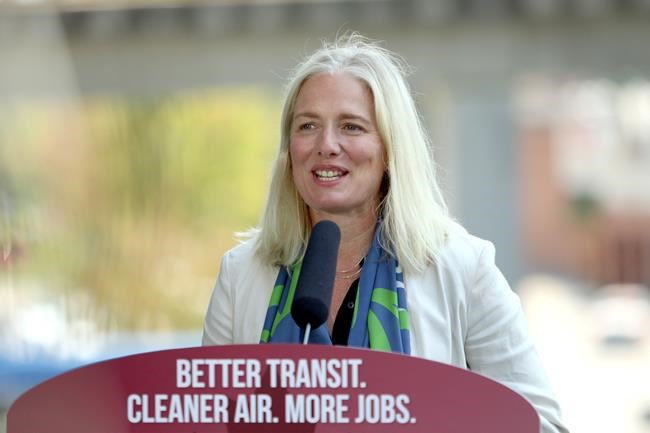
Minister of Infrastructure and Communities Catherine McKenna talks about the recent transit announcement during a press conference at Surrey City Hall in Surrey, B.C., on Friday, July 9, 2021. THE CANADIAN PRESS/Chad Hipolito

British Columbia’s government has said accommodations for wildfire evacuees are filling up as the flames and smoke from numerous blazes spread, forcing more people from their homes and contributing to an acrid haze that’s blanketing cities in neighbouring Alberta.

Smoke from the fires in B.C., as well as others in northern Saskatchewan, Manitoba and northwest Ontario, has resulted in special air quality advisories across the country.

The disaster mitigation and adaptation fund started in 2018 as a $2 billion program over 10 years to support communities in establishing the infrastructure they need to better handle natural disasters including floods, wildfires, earthquakes and droughts.

The new $1.4 billion fund will be spent over 12-year period, the department says.

McKenna says at least 10 per cent of the funding will go to Indigenous recipients.

“Climate change is having a devastating impact on Indigenous communities and a disproportionate impact,” she says.

She says dealing with climate change should be through the same approach that the government has been taking in dealing with COVID-19 pandemic.

“We need to listen to science and scientists. We need to work with partners from municipalities to provinces to the private sector,” she says.

“We all need to work together because, really, we have no choice.”

This report by The Canadian Press was first published July 20, 2021.

——

This story was produced with the financial assistance of the Facebook and Canadian Press News Fellowship.

Report Error Submit a Tip

More Stories

Paper trail

Allison Gillmor closer look 4 minute read Preview

Paper trail

Allison Gillmor closer look 4 minute read 2:02 AM CDT

WHAT IT IS: Copy Paperis a 2014 textile-based piece by Ontario-born, Winnipeg-based artist Kristin Nelson, currently on view at WAG-Qaumajuq as part of the exhibition Terra Cognita/Incognita.

Of the 125 works in the show — which uses historical and contemporary pieces from WAG-Qaumajuq’s permanent collection to explore how artists have represented the landscape over time and across cultures —probably the most attention-getting are the beautiful paintings of Canada’s lakes, plains, forests and mountains.

So, how does this seemingly modest, somewhat enigmatic work connect to Terra Cognita/Incognita’s larger themes?

WHAT IT’S ABOUT: In the middle of the exhibition, an antique desk holds several objects of beauty and utility, and this is where Copy Paper sneaks in, as something both “cognita and incognita,” known and unknown.

Read
2:02 AM CDT

Veterinarian petitions Ottawa to consider four-legged patients in legal cannabis regime

Solomon Israel 5 minute read Preview

Veterinarian petitions Ottawa to consider four-legged patients in legal cannabis regime

Solomon Israel 5 minute read Thursday, Jun. 6, 2019

An Ontario veterinarian has launched a formal petition asking the government to include animals and the physicians who care for them in Canada's cannabis regulations.

"What we're hearing repeatedly from Health Canada... is that the entire framework surrounding cannabis legalization was focused on human consumption," said Sarah Silcox, who practices palliative and hospice care for companion animals in Ajax, Ont., and serves as president of the Canadian Association of Veterinary Cannabinoid Medicine.

"And so they hadn't even considered animals being involved in this, or veterinarians being involved in the medical side of things. And what that's left us with is this catch-22, because now it's perfectly legal for a Canadian adult to go out and purchase cannabis, and to give it to their animal, and yet veterinarians have no legal pathway to authorize its use... Therefore we're really limited in terms of the education and support that we can give our clients to ensure that they're doing that safely."

The online petition on the House of Commons e-petitions website was launched May 27, and already has more than 500 signatures — enough to require the government to table an official response in Parliament.

Read
Thursday, Jun. 6, 2019

Kittie Wong

2 minute read Preview

Kittie Wong

2 minute read Sunday, Aug. 14, 2022

Kittie Wong wears three different hats for the Winnipeg Free Press editorial department: page designer, picture editor and web editor.

Read
Sunday, Aug. 14, 2022

FAQ: Winnipeg’s boil-water advisory

4 minute read Preview

FAQ: Winnipeg’s boil-water advisory

4 minute read Wednesday, Jan. 28, 2015

To boil water: Fill a pot with water from the cold-water tap. Heat it until bubbles come from the bottom of the pot to the top. Once the water reaches a rolling boil, let it boil for one minute (kettles with an automatic shutoff feature may not boil for a full minute).

Read
Wednesday, Jan. 28, 2015

Controlling pace of response path to success

Tim Kist 5 minute read 2:02 AM CDT

WITH the recent collapse of Canada-U.S. trade talks, the economic, political and social changes are coming at business leaders on a daily basis.

While you cannot control the pace of these changes, you can control the pace of response and timing of actions your organization takes. This is a time for thoughtful analysis and careful action, not chasing the latest trends.

Artificial intelligence, for example, can write articles, create images, draft emails and perform seemingly countless other tasks. But is this new tool solving a current business problem?

Successful companies know they must develop a strategy before launching any tactics. Otherwise, the strategy is based on “hope” — and we all know hope is not a strategy.

An opportunity to re-imagine downtown

Brent Bellamy 6 minute read Preview

An opportunity to re-imagine downtown

Brent Bellamy 6 minute read Tuesday, Aug. 3, 2021

The pandemic has been devastating for downtown Winnipeg. An abundance of “For Lease” signs in storefront windows has provided an intuitive glimpse, but a new report titled “State of Downtown: The impact of the pandemic to date” has quantified the profound challenges facing the economic, social and cultural heart of our city.

With the exodus of students and office workers, storefront businesses downtown have lost an average of $2 million per week in gross revenue since the pandemic began. This has led to more than 2,000 people losing their jobs and almost 50 storefront businesses permanently closing. The conference, hotel, hospitality, and arts and culture industries saw devastating declines, and more than 1.5 million square feet of office space are now vacant.

The pandemic has also exacerbated long-standing challenges of poverty and homelessness, with social agencies struggling to meet the needs of downtown’s vulnerable population.

The report paints a dire image, but we have been here before. Twenty years ago, downtown Winnipeg was in a similar situation. Population was at an all-time low as people moved to the suburbs, retail shops relocated from Portage Avenue to distant shopping malls, and office space was in decline. In the face of this challenge, government and private industry came together to rebuild downtown.

Read
Tuesday, Aug. 3, 2021