Why are Olympics going on despite public, medical warnings?

Advertisement

Advertise with us

TOKYO (AP) — Public sentiment in Japan has been generally opposed to holding the Tokyo Olympics and Paralympics, partly based on fears the coronavirus will spike as almost 100,000 people — athletes and others — enter for both events.

Read this article for free:


or

Already have an account? Log in here »

To continue reading, please subscribe:

Subscribe and receive a limited-edition Free Press branded hat or tote.

Digital Subscription

One year of digital access for only $205*

  • Enjoy unlimited reading on winnipegfreepress.com
  • Read the E-Edition, our digital replica newspaper
  • Access News Break, our award-winning app
  • Play interactive puzzles

*First annual payment billed as $205.00 + GST for one year. This annual subscription will automatically renew at $233.00 + GST every 52 weeks (10% off the regular annual price of $259.35). Offer available to new and qualified returning subscribers only. Cancel any time.

To continue reading, please subscribe:

Add Free Press access to your Brandon Sun subscription for only an additional

$1 for the first 4 weeks*

  • Enjoy unlimited reading on winnipegfreepress.com
  • Read the E-Edition, our digital replica newspaper
  • Access News Break, our award-winning app
  • Play interactive puzzles
Start now

*Your next Brandon Sun subscription payment will increase by $1.00 and you will be charged $17.95 plus GST for four weeks. After four weeks, your payment will increase to $24.95 plus GST every four weeks.

Hey there, time traveller!
This article was published 16/06/2021 (1916 days ago), so information in it may no longer be current.

TOKYO (AP) — Public sentiment in Japan has been generally opposed to holding the Tokyo Olympics and Paralympics, partly based on fears the coronavirus will spike as almost 100,000 people — athletes and others — enter for both events.

The Japanese medical community is largely against it. The government’s main medical adviser Dr. Shigeru Omi has said it’s “abnormal” to hold the Olympics during a pandemic. So far, only 5% of Japanese are fully vaccinated.

The medical journal The Lancet has raised questions about the health risks and criticized the World Health Organization and other health bodies for not taking a clear stand. The New England Journal of Medicine has said the IOC’s decision to proceed “is not informed by the best scientific evidence.”
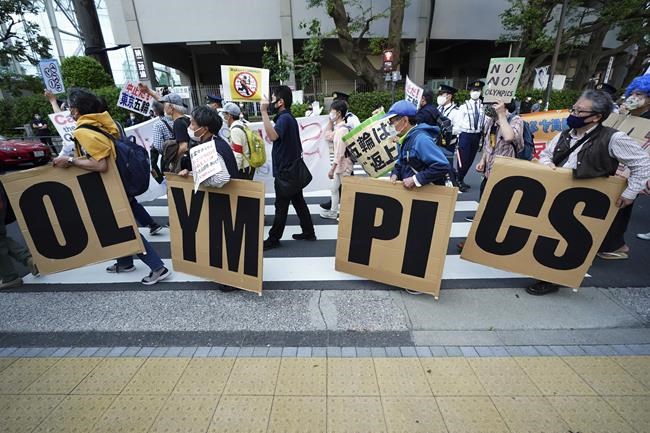
FILE - In this May 9, 2021, file photo, people who are against the Tokyo 2020 Olympics set to open in July, march to protest around Tokyo's National Stadium during an anti-Olympics demonstration. Public sentiment in Japan has been generally opposed to holding the Tokyo Olympics and Paralympics. This is partly based of fears the coronavirus will spike as almost 100,000 people — athletes and others — enter for both events.(AP Photo/Eugene Hoshiko, File)

The second-largest selling newspaper in Japan, the Asahi Shimbun, has called for the Olympics to be canceled. So have other regional newspapers.

Still, they are going ahead. How have the International Olympic Committee and the Japanese government of Prime Minister Yoshihide Suga been able to bypass strong opposition?

At the core is the Host City Contract that gives the IOC the sole authority to cancel. If Japan cancels, it would have to compensate the IOC. Of course, the IOC is unlikely to sue a host city. So any deal would be worked out behind the scenes.

And there are billions at stake. Japan has officially spent $15.4 billion but government audits suggest it’s twice that much. Japanese advertising giant Dentsu Inc., a key player in landing the corruption-tainted bid in 2013, has raised more than $3 billion from local sponsors.

Estimates suggest a cancellation could cost the IOC $3 billion-$4 billion in lost broadcast rights income. Broadcast income and sponsors account for 91% of the IOC income, and American network NBCUniversal provides about 40% of the IOC’s total income.

Fans from abroad have been banned already, and a decision on local fans attending Olympic venues should come as early as next week.

Associated Press sought perspectives from inside and outside Japan with the Olympics set to open on July 23.

___

“It’s a bit like a gambler who already has lost too much. Pulling out of it now will only confirm the huge losses made, but carrying on you can still cling to the hope of winning big and taking it all back. It’s true that public opinion is unlikely to be kind even if Suga decides to cancel at the last minute. He might as well take the chance and hope for the best by going ahead with it. At least there is some chance that he can claim the games to be a success — just by doing it — and saturating the media with pride and glory might help him turn the negative opinion around.”

—Koichi Nakano, political scientist, Sophia University

___

“The IOC carries a brand that is powerful. Athletes from around the world coming together to compete in peace is a heart-tugging draw. It takes an entertainment event and infuses it with a certain level of piety and awe. Who is against peace? With this “Olympism” as a goal, it has snagged corporate sponsors willing to pay lots of money. Therefore, the IOC has the leverage to exact contract terms very favorable to it and it certainly has done that in this case. The fact that only the IOC can formally decide to pull the plug on the games — even in the case of unforeseeable health events — is testament to this.”

—Mark Conrad, lawyer, Gabelli School of Business, Fordham University

___

“The host city contract hands over all the power to the IOC. The Olympic industry has had 120-plus years to win hearts and minds around the globe, with obvious success. In the age of the internet, their PR controls the message and protects the brand 24/7. The IOC is also beyond the reach of any oversight agency, including the governments of host countries. It can violate a country’s human rights protections with immunity, including athletes’ right to access domestic courts of law.”

—Helen Jefferson Lenskyj, sociologist, author “The Olympic Games: A Critical Approach”

___

“Based on what I am hearing, people within the government have been given their instructions to make the games happen, and that is their singular focus right now — for better or for worse. Their hope is to get through the games with as few missteps as possible. Politicians may well be aware of the risk they are taking but hope that once the games begin the Japanese public will persevere ‘for the good of Japan’ and forget how we got there.”

—Aki Tonami, political scientist, University of Tsukuba

___

“The IOC is an elitist club that garners support from other elites and people — and countries — that aspire to joining the elite. From a sports perspective, the IOC represents the custodian of the exclusive medals that athletes in numerous sports aspire to, acts as the chief promoter of the mythology of the healing power of sport, and the organization that most international sports federations and national Olympic committees are reliant on for funding.”
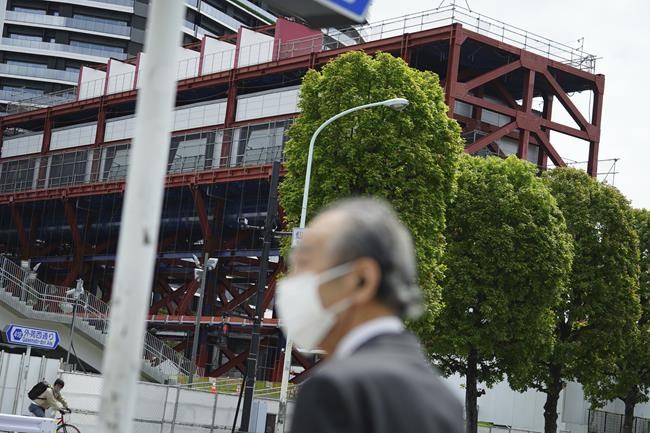
FILE - In this April 6, 2021, file photo, aman wearing a protective mask to help curb the spread of the coronavirus walks across a street as a massive steel structure in front of Japan National Stadium, where opening ceremony and many other events are planned for postponed Tokyo 2020 Olympics, in Tokyo. Public sentiment in Japan has been generally opposed to holding the Tokyo Olympics and Paralympics. This is partly based of fears the coronavirus will spike as almost 100,000 people — athletes and others — enter for both events. (AP Photo/Eugene Hoshiko, File)

—John Horne, sociologist, Waseda Univeristy, author with Garry Whannel of “Understanding the Olympics”

___

“Politically, the opposition is so weak, the government can do pretty much anything it wants. Although a disastrous Olympics would damage the LDP’s credibility, the party likely feels safe because a majority of the public doubts the capability of the opposition to govern. The government may be hoping that once the games start, public opinion will turn. At the very least, producing a distraction, and at most, perhaps a rally round the flag effect.”

—Gill Steel, political scientist, Doshisha University

___

“You notice how nobody seems to be in charge. You have all these different entities: the Tokyo organizing committee, the Japanese Olympic Committee, the Prime Minister’s office, the Governor of Tokyo Yuriko Koike, the Japan Sports Agency, the Foreign Ministry, the Ministry of Education, Culture, Sports, Science and Technology. Suga is asked in the Diet about canceling the games and says it’s not his responsibility. Nobody wants to lose face. You saw the same in the run up to the 1964 Games. In fact, it wasn’t until Feb. 11, 1963 — some 600 days before the opening ceremony — that Japan finally found somebody willing to accept the presidency of the local organizing committee.”

—Robert Whiting, author of several books on Japan including the latest “Tokyo Junkie”

___

“A lot of the opposition is shallow and movable, though of course that’s contingent on the Olympics actually working out. There will be a lot of people (broadcasters, etc.) invested in trying to make it look like a good show, so I think they’ll have the winds at their back if there’s not an appreciable spike in COVID deaths or any heat-related tragedies for the athletes.”

—David Leheny, political scientist, Waseda University

___

“If it turns out there is a surge in coronavirus patients and it becomes a catastrophe, that’s not the responsibility of the IOC. It’s the Japanese government that will be stuck with the responsibility.”

—Ryu Homma, author, former advertising agency executive

___

Associated Press reporter Yuri Kageyama contributed to this report.

___

More AP Olympics: https://apnews.com/hub/olympic-games and https://twitter.com/AP_Sports

Report Error Submit a Tip

More Stories

250 years ago Thomas Jefferson and the American Declaration of Independence

Allan Levine 5 minute read Preview

250 years ago Thomas Jefferson and the American Declaration of Independence

Allan Levine 5 minute read Saturday, Jul. 4, 2026

In the 16th and 17th centuries, countries and territories such as the Netherlands and Portugal boldly declared their independence from Spain. But 250 years ago, on July 4, 1776, the American Declaration of Independence — marked in the U.S. by the semiquincentennial celebrations — was the first time an overseas colony (the 13 colonies, in this case) had set out in an official document its reasons for breaking away from its mother country.

Because the Declaration ultimately gave birth to the United States, it is considered one of the greatest of historical treatises. Thomas Jefferson, its primary author, later explained that his main aim was “not to find out new principles, or new arguments, never before thought of … but to place before mankind the common sense of the subject; in terms so plain and firm as to command their assent.”

He did so brilliantly, creating, in theory at least, an enlightened argument for American independence based on the political, economic, social and philosophical thinking of the era.

Influenced by such philosophers as John Locke and Montesquieu, Jefferson, then 33 years old, a lawyer, landowner, Virginia politician and a delegate to the Second Continental Congress which met in Philadelphia, passionately believed in natural law — that all human beings were born free and equal and that no king or ruler could abolish these rights. It was a key point he made in the Declaration’s well-known preamble.

Read
Saturday, Jul. 4, 2026

Why is Cuba embracing freer markets?

Peter McKenna 5 minute read Preview

Why is Cuba embracing freer markets?

Peter McKenna 5 minute read Friday, Jul. 24, 2026

As long as Donald Trump is entangled in a war with Iran, Cuba is probably safe from being next on his hit list.

But if the mercurial U.S. president can somehow extricate himself from the Persian Gulf trap, then all bets are off. One thing is certain: Trump is not going to give up the idea of getting his greedy hands on the Caribbean island.

In response to Trump’s threats of military invasion, the beleaguered Cuban government is understandably in full panic mode. Right now, it is just trying desperately to keep its head above water as the situation on the ground in Cuba deteriorates further with each passing day.

Not all of the blame for the country’s current humanitarian crisis can be laid at the feet of the Trump White House. The Cuban political leadership deserves its fair share of blame for poor economic and financial management, for too much emphasis on expanding the tourism market, and for not enough attention on modernizing the electrical grid and attracting much-needed foreign investment.

Read
Friday, Jul. 24, 2026

Bond yields are rising, reflecting fear, loathing about state of world

Joel Schlesinger 6 minute read Preview

Bond yields are rising, reflecting fear, loathing about state of world

Joel Schlesinger 6 minute read Saturday, Sep. 12, 2026

It can seem counter-intuitive, but rising bond yields reflect investor worry. (After all, aren’t higher yields attractive?)

At the same time, investors’ bagful of anxieties is running headlong into greater demand for borrowing than at any time in human history.

It’s a full-course meal of mayhem: trade wars, unending real wars, accelerating government budgets and big tech companies borrowing as much as they can to achieve artificial intelligence supremacy.

Don’t forget the orange zest of economic unrest: an unpredictable, often incomprehensible president of the United States.

Read
Saturday, Sep. 12, 2026

Staying away to keep the heat on

Editorial 4 minute read Preview

Staying away to keep the heat on

Editorial 4 minute read 2:00 AM CDT

It’s a tough sell these days for U.S. tourism groups seeking to attract Canadian visitors as tension, tariffs and traded verbal barbs continue to rise between the two countries.

Or, as one Canadian marketing executive put it, “It’s just a wasted effort.”

Indeed, it does seem as if — for a sizable percentage of the Canadian population, anyway — there’s nothing U.S. tourism officials can say that will rekindle interest in vacation visits to American destinations, as long as President Donald Trump remains in office and continues to actively antagonize what was once his country’s closest trading partner and most steadfast ally.

With Canada having applied, as promised by Prime Minister Mark Carney, reciprocal tariffs on $28 billion worth of U.S. goods crossing into this country, there’s no reason to believe relations between the governments of the two nations will improve soon.

Read
2:00 AM CDT

Beware invasive, ‘frightening’ waterhemp

Laura Rance-Unger 4 minute read Preview

Beware invasive, ‘frightening’ waterhemp

Laura Rance-Unger 4 minute read Saturday, Aug. 29, 2026

There’s a threat lurking on the edge of Manitoba farmers’ fields this fall that’s even scarier than the escalating trade war with their biggest customer.

Provincial extension advisers are warning farmers to watch for a weed known as “tall waterhemp,” which, true to its name, may already be towering above ready-to-harvest crops.

Those wispy tentacles waving in the breeze look pretty innocuous from a distance. But this highly invasive member of the pigweed family produces hundreds of thousands of seeds that are just itching for dispersal through farmers’ combines and across their fields.

Each of those tiny seeds — one small pill container filled halfway holds 44,000 — can produce plants with stems the width of saplings and heights of two to five metres. One or two plants can quickly turn into a patch. If waterhemp takes over a field, it can choke out the growing crop and cut yields by more than 90 per cent.

Read
Saturday, Aug. 29, 2026

Dark money drags democracy toward the abyss

Russell Wangersky 6 minute read Saturday, Sep. 12, 2026

There’s an object lesson playing out to the south of us, and not exactly the one you may be thinking about.

It’s not the obvious one of “don’t elect a federal leader who has a clear history of caring about his own grievances before he thinks about the needs of his citizens,” or more simply, “don’t elect someone who is less an agent of change than he is an agent of chaos.”

No, the lesson playing out to the south of us — one likely to have an impact on U.S. midterm elections later this fall as well as the last U.S. presidential election — is that there is a clear danger in allowing dark money to fuel political campaigns.

There are estimates that political action campaigns — or PACs — will once again dump billions of U.S. dollars into the mix, funding advertising campaigns and other political campaign efforts, and steamrolling less-funded efforts.