Athlete warning: Follow the rules at Tokyo Olympics, or else
Advertisement
Read this article for free:
or
Already have an account? Log in here »
To continue reading, please subscribe:
Digital Subscription
One year of digital access for only $1.44 a week*
- Enjoy unlimited reading on winnipegfreepress.com
- Read the E-Edition, our digital replica newspaper
- Access News Break, our award-winning app
- Play interactive puzzles
*Billed as $5.77 plus GST every four weeks. After 52 weeks, price increases to the regular rate of $19.95 plus GST every four weeks. Offer available to new and qualified returning subscribers only. Cancel any time.
To continue reading, please subscribe:
Add Free Press access to your Brandon Sun subscription for only an additional
$1 for the first 4 weeks*
- Enjoy unlimited reading on winnipegfreepress.com
- Read the E-Edition, our digital replica newspaper
- Access News Break, our award-winning app
- Play interactive puzzles
*Your next Brandon Sun subscription payment will increase by $1.00 and you will be charged $17.95 plus GST for four weeks. After four weeks, your payment will increase to $24.95 plus GST every four weeks.
Read unlimited articles for free today:
or
Already have an account? Log in here »
Hey there, time traveller!
This article was published 14/06/2021 (1963 days ago), so information in it may no longer be current.
TOKYO (AP) — If athletes coming to Japan for the Tokyo Olympics needed a warning, they got it Tuesday as officials rolled out the third and final rendition of so-called Playbooks — the rulebooks governing behavior for these pandemic-tainted games.
The message: Follow the rules when the Olympics open in just over five weeks, or else expect a warning or a fine — or anything in between.
“Respect the Playbook, respect the rules,” said Olympic Games Executive Director Christophe Dubi, speaking on a remote hook-up with Tokyo organizers.
The Playbooks rolled out Tuesday were for athletes. But updates for others like media, broadcasters, sponsors, and so forth will come within the next few days, and all the Playbook rules are quite similar.
Officials say 15,400 athletes are expected for the Olympics and Paralympics. The Olympics open on July 23 followed by the Paralympic on Aug. 24.
Including athletes, the total number expected for both events, factoring in media, broadcasters, Olympic Family, sponsors and others is about about 93,000.
All those entering Japan for the Olympics will be required to follow complex testing rules — before leaving home and after arriving.
They must also agree to have their location monitored by GPS, download several apps, sign a pledge to follow the rules, maintain social distancing, stay off public transportation for the first 14 days and keep organizers informed of your whereabouts.
“We expect everybody to follow the rules. But we also have to be aware there could be infractions,” said Olympic Games Operations Director Pierre Ducrey, also speaking remotely.
“Yes, we expect you to play by the rules, but if you don’t there will be sanctions that could be coming your way.”
Ducrey said the range of punishments could go from a warning, to temporary or permanent expulsion from the Olympics, to withdrawal of accreditation or a fine. Officials also suggested the Japanese government has the power of deportation, and individual sports federations and national Olympic committees may have their own penalties.
Dubi declined to offer specifics about possible financial penalties. He said that would be determined by a disciplinary commission. But he said rules would apply “before, during and after” athletes compete.
“It is to reinforce the message, which is: The Playbooks are there to be followed. No transgressions,” Dubi said.
Athletes are also being required to sign waivers, typical of the Olympics. This time an added clause relieves the IOC of responsibly from any fallout from COVID-19.
Dubi suggested athletes or national federations would have insurance coverage for most eventualities.
“Then there are a number of cases for which the risks cannot be covered and this is then the responsibility of the participants,” Dubi said. He said this was standard practice in the sports industry.
The International Olympic Committee says more that 80% of those staying in the Olympic Village will be fully vaccinated. This contrasts with about 5% of the Japanese population that has been vaccinated in a slow rollout that is just now speeding up.
The Japanese medical community has largely opposed holding these Olympics in Tokyo, arguing the risks are too great. The government’s main medical adviser Dr. Shigeru Omi has said it’s “abnormal” to hold the Olympics during a pandemic.
The second version of the Playbooks, published in April, was criticized last month in an editorial by The New England Journal of Medicine that said, among other things, that the Playbooks “are not built on scientifically rigorous risk assessment.”
Tokyo and other regions of the country remain under a state of emergency that expires on Sunday. Reports in Japan suggest the government is likely to lift the state of emergency but still impose rules on restaurant hours and other businesses that draw crowds.
Fans from abroad have been banned from Tokyo and organizers say a decision on having any local fans at Olympic venues will be announced by the end of the month.
The IOC is pushing ahead with all the contortions, partly because it gets almost 75% of its revenue from selling broadcast rights. That income flow has been stalled during the postponement of the Tokyo Games.
In addition, Japan has officially spent $15.4 billion on organizing the Olympics, although government audits say the figure is much larger.
Jeff Shell, who heads NBCUniversal, said this week these Olympics might be the most profitable ever, despite the pandemic.

NBC, the American rights holder, is the single largest source of IOC income, representing about 40% of total income. It paid the IOC about $4.4 billion for four Olympics from 2014 through 2020, and $7.75 billion more for six games — 2022 through 2032.
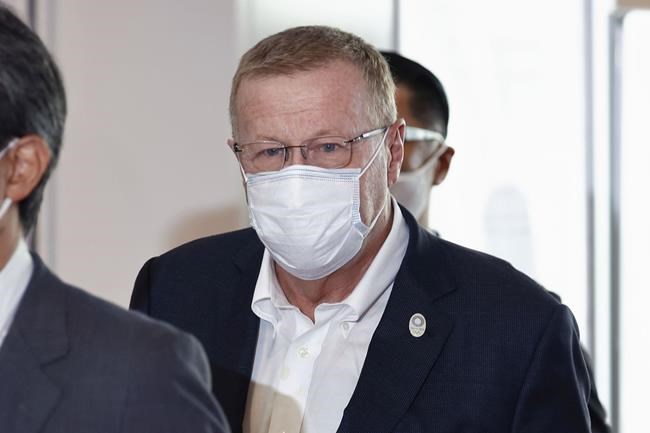
John Coates, the IOC vice president in charge of Tokyo preparations, arrived in Tokyo from Australia on Tuesday. He has been a controversial figure in Japan, saying the postponed Olympics would go ahead even if the country were under a state of emergency.
Officials last week said he would be quarantined for three days, followed by 11 days of restricted activities during the COVID-19 pandemic.
___
More AP Olympics: https://apnews.com/hub/olympic-games and https://twitter.com/AP_Sports
Related Articles
Olympic athletes to put on own medals at Tokyo ceremonies








Advertisement Advertise With Us
Advertisement Advertise With Us