Liberal MP questions Justice Department’s legal advice on fired scientists
Advertisement
Read this article for free:
or
Already have an account? Log in here »
To continue reading, please subscribe:

Digital Subscription
One year of digital access for only $205*
- Enjoy unlimited reading on winnipegfreepress.com
- Read the E-Edition, our digital replica newspaper
- Access News Break, our award-winning app
- Play interactive puzzles
*First annual payment billed as $205.00 + GST for one year. This annual subscription will automatically renew at $233.00 + GST every 52 weeks (10% off the regular annual price of $259.35). Offer available to new and qualified returning subscribers only. Cancel any time.
To continue reading, please subscribe:
Add Free Press access to your Brandon Sun subscription for only an additional
$1 for the first 4 weeks*
- Enjoy unlimited reading on winnipegfreepress.com
- Read the E-Edition, our digital replica newspaper
- Access News Break, our award-winning app
- Play interactive puzzles
*Your next Brandon Sun subscription payment will increase by $1.00 and you will be charged $17.95 plus GST for four weeks. After four weeks, your payment will increase to $24.95 plus GST every four weeks.
Read unlimited articles for free today:
or
Already have an account? Log in here »
Hey there, time traveller!
This article was published 10/05/2021 (1977 days ago), so information in it may no longer be current.
OTTAWA – A Liberal MP is advising the Public Health Agency of Canada not to rely on legal advice from the federal Justice Department because it is not always right.
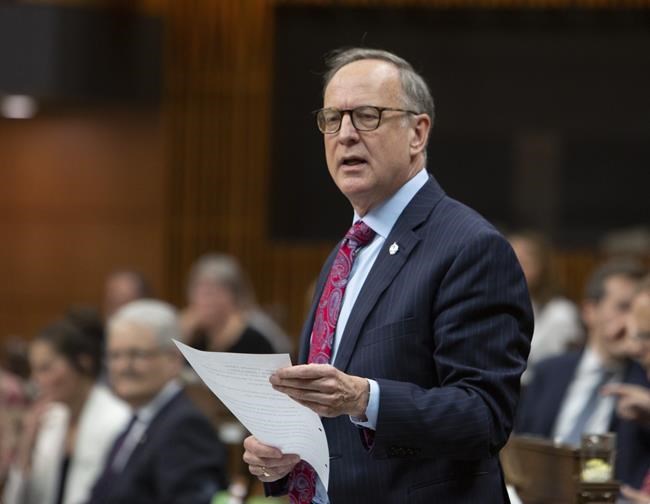
Toronto MP Rob Oliphant, parliamentary secretary to the Foreign Affairs minister, gave the advice late Monday at a House of Commons committee that is trying to find out why two scientists at Canada’s highest security laboratory were fired.
PHAC president Iain Stewart told the special committee on Canada-China relations that revealing details would breach the Privacy Act and jeopardize national security and an ongoing RCMP investigation.
He says that advice was given by the Justice Department.
Committee members, backed up by parliamentary law clerk Philippe Dufresne, insist they have the constitutional authority to order the production of any documents they please and that their authority takes precedence over any other laws.
But Christian Roy, director and senior general counsel of health legal services at the Justice Department, says the department has never recognized the power of committees to compel documents in violation of the Privacy Act or other laws.
Oliphant questioned Roy’s legal opinion.
“Lawyers are not always right and Justice lawyers are particularly, in my mind, not always right,” he told the committee.
He noted that Justice lawyers were wrong in claiming a law banning genetic discrimination was unconstitutional, after fighting it all the way to the Supreme Court of Canada.
Moreover, Oliphant said he was “horrified” to discover that Justice lawyers had advised the Canadian Security Intelligence Service to illegally keep potentially revealing electronic data about people over a 10-year period.
“I have learned to now question of Department of Justice lawyers,” Oliphant said, suggesting that Stewart get “a second opinion because the Justice Department is not giving you the best advice.”
The committee voted unanimously later Monday to give PHAC 10 days to turn over unredacted documents about the fired scientists, which the parliamentary law clerk is to review and advise committee members as to what needs to be blacked out to protect privacy, national security and the police investigation.
If the agency continues to refuse to disclose the unredacted documents, the committee will seek an order to do so from the House of Commons.
PHAC formally terminated the employment of government scientists Xiangguo Qiu and her husband, Keding Cheng, in January.
The pair was escorted out of the National Microbiology Laboratory (NML) in July 2019 over what Stewart has described as “relating to possible breaches in security protocols.”
The Winnipeg lab is Canada’s only Level Four laboratory, designed to deal safely with deadly contagious germs such as Ebola.
PHAC has previously said the pair’s escorted exit had nothing to do with the fact that four months earlier, Qiu had been responsible for a shipment of Ebola and Henipah viruses to China’s Wuhan Institute of Virology.
Stewart has released some redacted documents to the committee about that virus transfer, which he said show that all laws and protocols were followed.
He also assured the committee Monday that there is no link between those viruses and the coronavirus that causes COVID-19, which first surfaced in China’s Wuhan province.
That didn’t stop Conservative MP Michael Chong, who referred to Qiu and Cheng as “Chinese scientists.”
The Public Health Agency of Canada has said it cannot confirm the citizenship status of individuals for privacy reasons, but noted the two scientists “had to be eligible to legally work in Canada” when they were at the federal microbiology lab. In 2018, Qiu received a Governor General’s Innovation Award — a recognition that only Canadian citizens or permanent residents are eligible to receive.
“There is no doubt that (Qui) trained technicians at that very institute of virology to establish a Level Four lab, the only Level Four lab in the People’s Republic of China, and there is no doubt that the coronavirus emerged ostensibly in Wuhan a number of months later,” Chong said.

He dismissed suggestions that he was peddling a conspiracy theory, citing various experts who’ve posited that the coronavirus may have been inadvertently released from the Wuhan lab.
Oliphant accused Chong of “drawing two threads that are completely unrelated together,” calling it “absolutely irresponsible” and “cheap politics.”
Bloc Québécois MP Stephane Bergeron agreed that Chong’s language was inflammatory.
This report by The Canadian Press was first published May 10, 2021.
Note to readers: This is a corrected story. A previous version reported scientists Xiangguo Qiu and her husband, Keding Cheng, are Canadians. In fact, the Public Health Agency of Canada has said it cannot confirm the citizenship status of individuals.
Related Articles
Federal lab in Winnipeg tightens rules on virus shipments
Advertisement Advertise With Us
Advertisement Advertise With Us