Screen-shared vision: Biden-Trudeau meeting to feature common ground, old irritants
Advertisement
Read this article for free:
or
Already have an account? Log in here »
To continue reading, please subscribe:
Digital Subscription
One year of digital access for only $1.44 a week*
- Enjoy unlimited reading on winnipegfreepress.com
- Read the E-Edition, our digital replica newspaper
- Access News Break, our award-winning app
- Play interactive puzzles
*Billed as $5.77 plus GST every four weeks. After 52 weeks, price increases to the regular rate of $19.95 plus GST every four weeks. Offer available to new and qualified returning subscribers only. Cancel any time.
To continue reading, please subscribe:
Add Free Press access to your Brandon Sun subscription for only an additional
$1 for the first 4 weeks*
- Enjoy unlimited reading on winnipegfreepress.com
- Read the E-Edition, our digital replica newspaper
- Access News Break, our award-winning app
- Play interactive puzzles
*Your next Brandon Sun subscription payment will increase by $1.00 and you will be charged $17.95 plus GST for four weeks. After four weeks, your payment will increase to $24.95 plus GST every four weeks.
Read unlimited articles for free today:
or
Already have an account? Log in here »
Hey there, time traveller!
This article was published 22/02/2021 (2076 days ago), so information in it may no longer be current.
WASHINGTON – Call it the Screen-Shared Summit.
Tuesday’s bilateral meeting of Prime Minister Justin Trudeau and President Joe Biden — a strictly virtual affair, thanks to COVID-19 — offers hope of a new start for Canada-U. S. relations.
It will be the new president’s first meeting with a foreign leader, and Trudeau’s first chance to advance Canadian interests with the White House without the chaos and anxiety of the last four years.
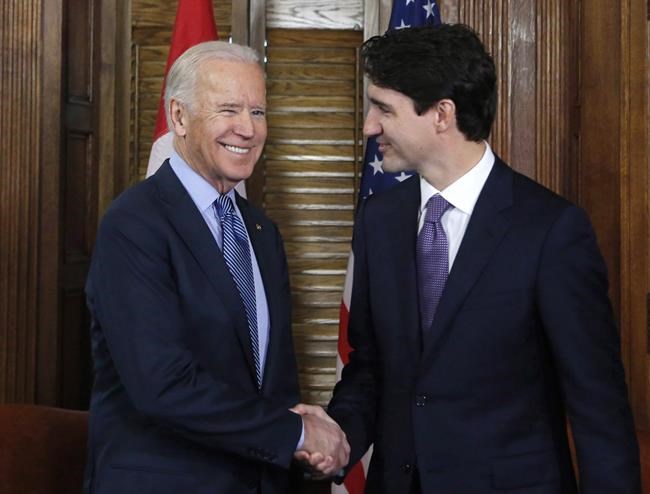
And while the pandemic may ensure it doesn’t register on the same scale as Brian Mulroney’s 1985 Shamrock Summit with Ronald Reagan, the expectations in Canada are still high.
Whether they are met remains anyone’s guess.
“I don’t want people to rest on their laurels and say, ‘Well, we got the first meeting, so good for us,'” said Maryscott Greenwood, CEO of the Canadian American Business Council.
There is plenty of hard work ahead, including on the Canada-U. S. border, navigating Buy American protectionism, a way forward on China and the thorny issue of cross-border pipelines.
To make progress, Greenwood said, the Prime Minister’s Office might do well to pretend Donald Trump is still president.
“Canada embarked on a very, very forward-leaning, activist agenda about engaging the U.S., inside and outside of D.C.” when Trump was in office, she said.
“It’s going to be important to have that level of urgency and that level of effort, and not just assume that everything’s good now that Biden’s here.”
Biden has signalled a hard line on Buy American, his suite of protectionist measures aimed at ensuring domestic contractors and suppliers are the primary beneficiaries of U.S. tax dollars spent on infrastructure projects and procurement efforts.
He may take a similar line with Trudeau, White House press secretary Jen Psaki suggested Monday.
“He signed an executive order; we’re of course evaluating procurement components of that, but no changes anticipated,” Psaki said.
“Of course, the prime minister will bring up whatever he would like to bring up, as is true of any bilateral meeting.”
Psaki offered up familiar bromides — a shared vision on climate change, cross-border economic ties and the “strong and deep partnership” between two “neighbours, friends and NATO allies.”
But she avoided saying whether Biden would further commit to help secure the release of Canadians Michael Kovrig and Michael Spavor, who have been held in China for more than two years.
The two were swept up after Canada arrested Huawei chief financial officer Meng Wanzhou to face extradition to the U.S., where she has been charged with violating sanctions on Iran.
Resolving the three-way diplomatic standoff that ensued will be a top priority for Trudeau, said Eric Miller, a Canada-U. S. expert and president of the D.C.-based Rideau Potomac Strategy Group.
The 2022 Olympics, to be hosted in Beijing, could provide the perfect inflection point, he said — particularly if the Chinese have reason to fear prominent protests during a moment of national pride.
“What are the Chinese going to do if the Canadian team marches into the stadium with armbands that say, ‘Free the Michaels?'” Miller said.
“I do think Biden’s at a phase now where there’s some receptivity to some different ideas. And as is often the case with this stuff, it often falls to Canada to kind of push the needle.”
Speaking of needles: Trudeau is widely expected to press Biden on making more of the U.S. COVID-19 vaccine supply available for export to Canada, where production delays in Europe have been plaguing efforts to get shots in arms.
Politically, however, it will be hard for Biden to sell the idea of providing relief to other countries when the vaccination effort at home still has a long way to go.
“Fundamentally, Trudeau has no choice but to make to make a push on this,” Miller said.
“Trudeau is going to make a big deal of asking, and the Biden people will commit to look into it, and nothing will happen.”

Look for a similar outcome if Trudeau complains about Biden’s decision to cancel the cross-border Keystone XL pipeline expansion, which he did with the stroke of a pen on his first day in the White House.
Canada remains a country heavily dependent on its natural resources, said Bill Reilly, who served as head of the Environmental Protection Agency under former president George Bush, from 1989 to 1993.
“It’s very likely to be raising issues that run counter to some of the environmental aspirations that animate the Biden administration,” Reilly told a panel discussion Monday.
“I don’t think some of these issues are going to lend themselves to easy resolution.”
This report by The Canadian Press was first published Feb. 22, 2021.
Related Articles
Time for neighbours to move forward together
Advertisement Advertise With Us
Advertisement Advertise With Us