Study: Russia’s Sputnik V vaccine appears safe, effective

Advertisement

Advertise with us

MOSCOW - Russian scientists say the country's Sputnik V vaccine appears safe and effective against COVID-19, according to early results of an advanced study published Tuesday in a British medical journal.

Read this article for free:


By clicking the button above, an account will be created and you will begin to receive some of our recommended newsletters. You may opt out of any newsletter by visiting your Email and Communication Preferences page or by clicking "unsubscribe" at the bottom of any email.

or

Already have an account? Log in here »

To continue reading, please subscribe:

Digital Subscription

One year of digital access for only $1.44 a week*

  • Enjoy unlimited reading on winnipegfreepress.com
  • Read the E-Edition, our digital replica newspaper
  • Access News Break, our award-winning app
  • Play interactive puzzles

*Billed as $5.77 plus GST every four weeks. After 52 weeks, price increases to the regular rate of $19.95 plus GST every four weeks. Offer available to new and qualified returning subscribers only. Cancel any time.

To continue reading, please subscribe:

Add Free Press access to your Brandon Sun subscription for only an additional

$1 for the first 4 weeks*

  • Enjoy unlimited reading on winnipegfreepress.com
  • Read the E-Edition, our digital replica newspaper
  • Access News Break, our award-winning app
  • Play interactive puzzles
Start now

*Your next Brandon Sun subscription payment will increase by $1.00 and you will be charged $17.95 plus GST for four weeks. After four weeks, your payment will increase to $24.95 plus GST every four weeks.

Hey there, time traveller!
This article was published 02/02/2021 (2098 days ago), so information in it may no longer be current.

MOSCOW – Russian scientists say the country’s Sputnik V vaccine appears safe and effective against COVID-19, according to early results of an advanced study published Tuesday in a British medical journal.

The news is a boost for the vaccine, which governments around the world increasingly are purchasing in the race to stop the devastation caused by the coronavirus pandemic.

Researchers said that based on a fall trial involving about 20,000 people in Russia, the vaccine is about 91% effective and appears to prevent inoculated individuals from becoming severely ill with COVID-19. But it is unclear if Sputnik V can stop transmission. The study was published online Tuesday in The Lancet.
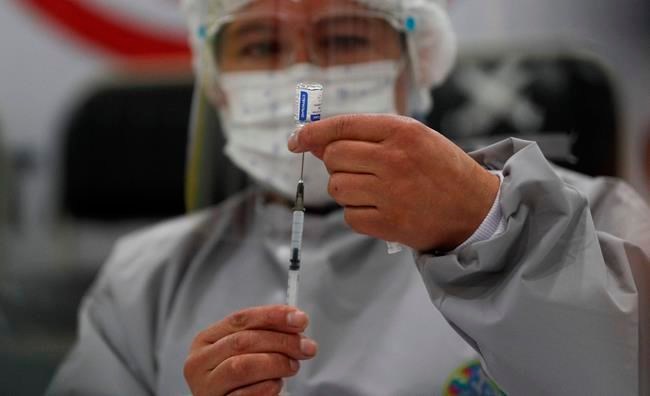
A healthcare worker prepares a dose of Russia's Sputnik V COVID-19 vaccine, at the Del Norte Hospital in El Alto, Bolivia, Saturday, Jan. 30, 2021. (AP Photo/Juan Karita)

Scientists not linked to the research acknowledged that the speed at which the vaccine was made and rolled out had brought criticism of the Russian effort’s “unseemly haste, corner cutting and an absence of transparency.”

“But the outcome reported here is clear,” British scientists Ian Jones and Polly Roy wrote in an accompanying commentary. “Another vaccine can now join the fight to reduce the incidence of COVID-19.”

The vaccine was approved by the Russian government with much fanfare on Aug. 11. President Vladimir Putin personally broke the news on national television and said one of his daughters had already received it. At the time, the vaccine had only been tested in several dozen people, and the move elicited criticism from experts both at home and abroad.

Kirill Dmitriev, CEO of the Russian Direct Investment Fund that bankrolled the development of the shot, called the study in The Lancet “check and mate to the critics of the Russian vaccine.”

“Russia was right from the very beginning,” he said.

Outside Russia, Sputnik V has received authorization in over a dozen countries, according to the fund — including the former Soviet republics of Belarus, Armenia and Turkmenistan; Latin American nations including Argentina, Bolivia and Venezuela; African nations such as Algeria as well as Serbia, Iran, Palestine and UAE.

Batches of the vaccine have already been supplied to six countries. In all, more than 50 countries have submitted applications for 2.4 billion doses, an RDIF spokesman told The Associated Press.

The latest study is based on research involving about 20,000 people over 18 at 25 hospitals in Moscow between September and November, of whom three-quarters got two doses of the Russian vaccine 21 days apart and the remainder got placebo shots.

Serious side effects were reported rare in both groups and four deaths were reported, although none were considered to be the result of the vaccine.

The study included more than 2,100 people over age 60 and the vaccine appeared to be about 92% effective in them. The research is ongoing, but Russia’s Health Ministry said in December it was cutting the size of the study from the planned 40,000 subjects to about 31,000 already enrolled volunteers, with developers citing ethical concerns about using placebo shots.

The Russian vaccine uses a modified version of the common cold-causing adenovirus to carry genes for the spike protein in the coronavirus as a way to prime the body to react if COVID-19 comes along. That’s a similar technology to the vaccine developed by AstraZeneca and Oxford University. But unlike AstraZeneca’s two-dose vaccine, the Russians used a slightly different adenovirus for the second booster shot.
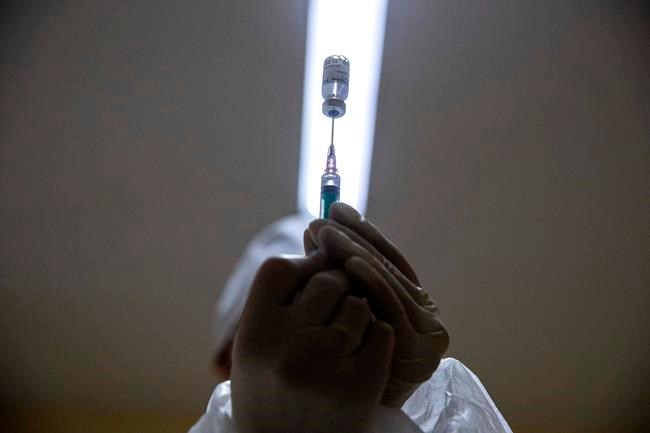
FILE - In this Wednesday, Dec. 30, 2020 file photo, a medical worker prepares a shot of Russia's Sputnik V coronavirus vaccine in Moscow, Russia. Russian scientists say the country's Sputnik V vaccine appears safe and effective against COVID-19, according to early results of an advanced study published on Tuesday Feb. 2, 2021, in a British medical journal. (AP Photo/Pavel Golovkin, File)

“This aims to drive higher immune responses to the target ‘spike’ by using two slightly different jabs,” said Alexander Edwards, an associate professor in biomedical technology at Britain’s University of Reading, who was not connected to the Russian research. He said if you have two identical shots, it’s possible the immune system doesn’t get as big a boost from the second injection.

Roy, a professor of virology at the London School of Hygiene and Tropical Medicine, said there should no longer be any doubts about the Russian vaccine. She said the high level of antibodies produced by Sputnik V suggest that it could also protect against some of the new COVID-19 variants that have been detected recently, but more studies are needed to verify that.

“Initially, I had some concerns about what they were saying and thought they were getting too much publicity, but the data are now very strong,” Roy said.

Sputnik V was rolled out in a large-scale vaccination campaign in Russia in December, with doctors and teachers the first in line. Last month, Putin ordered mass immunizations to start.

In early January, the Russian Direct Investment Fund said over 1 million Russians had already been vaccinated. Some Russian media questioned the number, suggesting that the rollout had been much slower, with many Russian regions reporting small numbers of vaccinations.

The production of Sputnik V will span several countries, including India, South Korea, Brazil, China. “We will also manufacture vaccines in Kazakhstan, develop (production) in Belarus, in Turkey, and possibly even in Iran,” Dmitriev said, adding that the production in China will start at the end of the month.

Algeria will begin producing the Sputnik V vaccine “within the coming weeks,” Kamel Mansouri, the head of Algeria’s national agency for pharmaceuticals, said Tuesday. The first batch of 50,000 doses arrived in Algeria last week.

The European Medicines Agency said the developers of Sputnik V recently asked for advice on what data they needed to submit for the vaccine to be licensed across the 27-nation European Union.

Hungary’s first shipment of Sputnik V — 40,000 doses — arrived on Tuesday, Foreign Minister Peter Szijjarto said on Facebook. Hungary expects to get enough Sputnik V vaccine to treat 1 million people in the next three months.

Hungarian health authorities were the first in the EU to approve the vaccine on Jan. 21, but the National Public Health Center must still give its final approval before shots are distributed to the public.
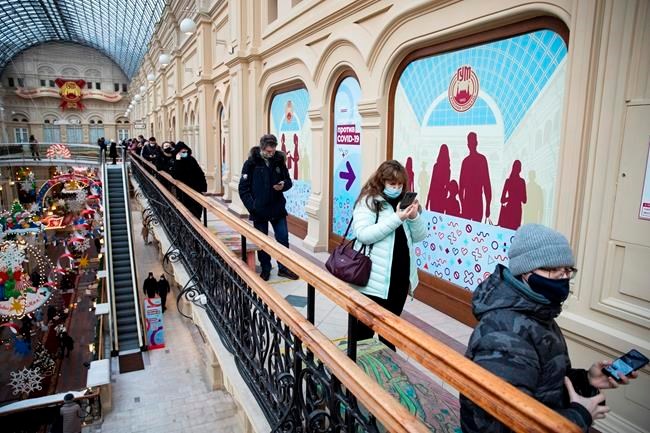
People stand in a queue to get a shot of Russia's Sputnik V coronavirus vaccine in a vaccination center in GUM State Department store in Moscow, Russia, Wednesday, Jan. 20, 2021. Russia started a mass coronavirus vaccination campaign on Monday, Jan. 18. (AP Photo/Pavel Golovkin)

The minister took the opportunity to blast the EU’s own vaccination rollout, which has been much slower than ones in Israel, Britain or the United States.

“Brussels’ centralized vaccine procurement has been a failure, which has risked the lives of Europeans and the swiftest restarting of the European economy,” Szijjarto said.

“We were the first, but we probably won’t be the only ones” in the EU to consider using Russian and Chinese COVID-19 vaccines, he added.

___

Maria Cheng reported from Toronto. Associated Press writers Aomar Ouali in Algiers, Algeria, Lori Hinnant in Paris and Justin Spike in Budapest, Hungary, contributed.

___

Follow all of AP’s pandemic coverage at https://apnews.com/hub/coronavirus-pandemic,https://apnews.com/hub/coronavirus-vaccine and https://apnews.com/UnderstandingtheOutbreak

Report Error Submit a Tip

More Stories

Nobel laureate Toni Morrison dead at 88

Hillel Italie, The Associated Press 18 minute read Preview

Nobel laureate Toni Morrison dead at 88

Hillel Italie, The Associated Press 18 minute read Tuesday, Aug. 6, 2019

NEW YORK - Nobel laureate Toni Morrison, a pioneer and reigning giant of modern literature whose imaginative power in "Beloved," ''Song of Solomon" and other works transformed American letters by dramatizing the pursuit of freedom within the boundaries of race, has died at age 88.

Publisher Alfred A. Knopf announced that Morrison died Monday night at Montefiore Medical Center in New York. Morrison's family issued a statement through Knopf saying she died after a brief illness.

"Toni Morrison passed away peacefully last night surrounded by family and friends," the family announced. "The consummate writer who treasured the written word, whether her own, her students or others, she read voraciously and was most at home when writing."

Few authors rose in such rapid, spectacular style. She was nearly 40 when her first novel, "The Bluest Eye," was published. By her early 60s, after just six novels, she had become the first black woman to receive the Nobel literature prize, praised in 1993 by the Swedish academy for her "visionary force" and for her delving into "language itself, a language she wants to liberate" from categories of black and white. In 2012, Barack Obama awarded her a Presidential Medal of Freedom.

Read
Tuesday, Aug. 6, 2019

Haunted houses aren’t the only places to find jump scares

Jen Zoratti 3 minute read Preview

Haunted houses aren’t the only places to find jump scares

Jen Zoratti 3 minute read 2:01 AM CDT

C’est l’Halloween, to quote the 1981 elementary school French class banger by Matt Maxwell, but you know what’s already plenty scary? Life.

We all have our personal haunted houses, so to speak, hence the popularity of the “a haunted house but it’s just…” meme that pops up every October. Sample: “a haunted house but it’s just a bunch of men telling you you’d be prettier if you smiled.”

In the spirit of the season, I thought I’d offer up a few jump scares of my own.

A haunted house but it’s just Gate E25

Read
2:01 AM CDT

The new normal in Canadian politics

David McLaughlin 5 minute read Preview

The new normal in Canadian politics

David McLaughlin 5 minute read 2:01 AM CDT

“Nothing happening, all at once.”

Welcome to the new normal of Canadian politics, where normality is the new normal. Routine and stable are in; disruptive and excessive are out. Exhibits A and B are the Alberta referendum and the British Columbia election. Voters opted for stability over volatility.

The opposite of being normal is being different from the norm. In politics that means different from where we’ve been and what we’ve come to expect. Two competing trends have dominated our politics for the past decade and a half — progressivism and populism. Think Justin Trudeau and liberal, progressive identity politics in Canada, and Donald Trump and conservative, populist MAGA politics in America. We are now experiencing a swing away from both those trends.

Representing this “new normal” are Prime Minister Mark Carney, for one, and newly elected British Columbia premier, Lorne Doerksen, for another. Both are considered normal because they talk and act like adults in a childish political world. Their political flair is to not have any political flair. They stand out for not standing out.

Read
2:01 AM CDT

Walkout creates chaos at St. James Smitty’s

Morgan Modjeski 3 minute read Preview

Walkout creates chaos at St. James Smitty’s

Morgan Modjeski 3 minute read 2:01 AM CDT

Gordon Sharpe wanted to eat a meal at the St. James Smitty’s Wednesday, but he got a helping of bad news instead.

He saw several workers walk out of the restaurant, at 1017 St. James St.

“(The waiter) came back about 10 minutes later and stood over the table, looking a little distraught and said, ‘I’m quitting right now and so is everybody else,’” Sharpe said. “He said, ‘This is my last time serving you,’ and he was quite choked up.”

“I’ve never seen anything like it,” he said, adding that the managers scrambled to serve patrons.

Read
2:01 AM CDT

Has the political wind changed?

Gwynne Dyer 5 minute read 2:01 AM CDT

It has been quite a week. First we had “Lula” – Luiz Inácio da Silva (as nobody but his mother ever called him) – defying everybody’s expectations. After winding up two million votes behind his challenger, Flávio Bolsonaro, in the first round of the Brazilian presidential election, he made a “miraculous” comeback in the second.

It was like a man going into a revolving door behind you and coming out in front. At the end of the first round, Lula was two million votes behind; at the end of the second round on Oct. 25 he was four million votes ahead. So how did he win a fourth term without cheating?

That’s what Bolsonaro claims he did, having fled to the United States; Trump, Flávio’s mentor, hints at the same. But Lula’s victory was not miraculous. He only learned to read when he was 10, and at 80 he still refused to have a mobile phone. His team finally made him get one and use it.

He wouldn’t do social media videos, so they created a WhatsApp channel called Lula’s Army, and made him appear on it at least daily. The channel went from zero to 10.8 million viewers in two weeks, and Lula won.

Court ruling concludes Canadian Wheat Board saga

Laura Rance-Unger 4 minute read Preview

Court ruling concludes Canadian Wheat Board saga

Laura Rance-Unger 4 minute read 2:01 AM CDT

It remains to be seen whether the recent court ruling in a lawsuit filed after Canadian Wheat Board’s dissolution in 2012 puts the whole debate to rest, as some no doubt hope.

But either way, the dust has settled on the post-CWB world. The sun still rises and a new generation of farmers on the land only knows by name an institution that for generations influenced every aspect of Prairie grain farming.

The first Rural Revival column I wrote for this newspaper more than 30 years ago was about a thousand farmers from Western Canada demonstrating in support of the Wheat Board. It was in the aftermath of the Western Grain Marketing Panel report, one of several efforts that eventually included a plebiscite to help the federal government decide what to do about a vocal minority of farmers who wanted marketing “freedom.”

The polls at the time suggested about two-thirds of farmers were comfortable enough with the single-desk system for food wheat and barley to keep it around. It served as a counterbalance to canola, which they sold on the open market. They essentially had a dual market.

Read
2:01 AM CDT