Advocates share fear of worsening overdose crisis in 2021, want national safe supply

Advertisement

Advertise with us

VANCOUVER - With overdose deaths rising across Canada, advocates for drug users are calling for the implementation of a national safe supply program as part of an effort to save lives.

Read this article for free:


By clicking the button above, an account will be created and you will begin to receive some of our recommended newsletters. You may opt out of any newsletter by visiting your Email and Communication Preferences page or by clicking "unsubscribe" at the bottom of any email.

or

Already have an account? Log in here »

To continue reading, please subscribe:

Digital Subscription

One year of digital access for only $1.44 a week*

  • Enjoy unlimited reading on winnipegfreepress.com
  • Read the E-Edition, our digital replica newspaper
  • Access News Break, our award-winning app
  • Play interactive puzzles

*Billed as $5.77 plus GST every four weeks. After 52 weeks, price increases to the regular rate of $19.95 plus GST every four weeks. Offer available to new and qualified returning subscribers only. Cancel any time.

To continue reading, please subscribe:

Add Free Press access to your Brandon Sun subscription for only an additional

$1 for the first 4 weeks*

  • Enjoy unlimited reading on winnipegfreepress.com
  • Read the E-Edition, our digital replica newspaper
  • Access News Break, our award-winning app
  • Play interactive puzzles
Start now

*Your next Brandon Sun subscription payment will increase by $1.00 and you will be charged $17.95 plus GST for four weeks. After four weeks, your payment will increase to $24.95 plus GST every four weeks.

Hey there, time traveller!
This article was published 17/12/2020 (2144 days ago), so information in it may no longer be current.

VANCOUVER – With overdose deaths rising across Canada, advocates for drug users are calling for the implementation of a national safe supply program as part of an effort to save lives.

Failing to do so, they say, will lead to more deaths from overdoses across the country.

A public health emergency was declared in 2016, a year that saw 991 deaths. More than 1,500 people have died in British Columbia from illicit drug overdoses in 2020.

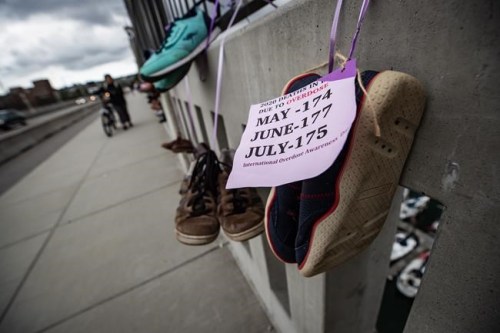
Shoes are hung on the Burrard Bridge in remembrance of victims of illicit drug overdose deaths on International Overdose Awareness Day, in Vancouver, on Monday, August 31, 2020. With overdose deaths rising across Canada, advocates for drug users are calling for the implementation of a national safe supply program as part of an effort to save lives. Failing to do so, they say, will lead to more deaths from overdoses across the country. THE CANADIAN PRESS/Darryl Dyck

Ontario’s chief coroner’s office estimates 50 to 80 people per week are dying of overdoses.

British Columbia’s government created a safe supply program in March, allowing doctors and nurses to prescribe pharmaceutical alternatives to illicit drugs.

Karen Ward, a drug policy and poverty reduction consultant with the City of Vancouver, said the concept of the program needs to be expanded across the country.

“It’s like you’re struggling to tread water in a tsunami,” she said in an interview, referring to the number of overdoses in B.C.

Experts say COVID-19 has exacerbated the situation as the supply of illicit drugs became more toxic when the border was closed and more drugs were made or altered in Canada. The pandemic has also impeded access to key harm reduction services, such as supervised consumption sites.

The federal government issued data on Wednesday showing 17,602 people have died from opioid overdoses between January 2016 and June 2020.

Between January and June of this year, 86 per cent of all opioid overdose deaths occurred in British Columbia, Alberta or Ontario.

“It will get worse. It will, definitely. Unless we stop talking and do some very specific things,” said Ward. “Let’s do safe supply. Nothing is perfect, but let’s find ways to prescribe in your community, in your area, right away. Or it will get worse.”

Along with a national safe supply program, Ward argues decriminalization is something governments should be considering.

It would mean police wouldn’t charge someone caught with a small amount of drugs and they would not seize the substance.

She is also critical of the scope of B.C.’s safe supply program, arguing health professionals need to be more willing to prescribe pharmaceutical alternatives.

“We need a variety of ways to access the health benefits that we have decided are necessary,” Ward said.

The federal government announced $9.5 million in funding for four safe supply pilot projects in Ontario in September, but advocates say that the small size of the project doesn’t do enough.

Last month, Vancouver council voted unanimously to ask the federal government to decriminalize small amounts of illicit drugs for personal use.

Federal Health Minister Patty Hajdu was unavailable for an interview, but her office sent a statement saying it is reviewing Vancouver’s proposal.

“The COVID-19 pandemic has worsened the ongoing opioid crisis. We have lost too many Canadians to overdose and all levels of government must redouble our efforts to save lives,” she said in the statement.

Prime Minister Justin Trudeau said in September that he supported safe supply but maintained his stance against drug decriminalization.

Dr. Mark Tyndall, a professor at the school of population and public health at the University of British Columbia, said more support is needed for safe supply programs and decriminalization efforts.

“Safe supply, to me, is the only real practical thing to do,” he said in an interview.

It’s frustrating to see governments and public health agencies not put as much effort as they could into saving the lives of drug users, said Tyndall, who used to head B.C.’s Centre for Disease Control and worked to launch an opioid vending machine in Vancouver’s Downtown Eastside.

“I’m pretty pessimistic,” he said on what the next year holds for drug users. “The chance of you overdosing from street drugs are probably higher than they were five years ago … we haven’t really made any significant changes that have made people safer.”

Zoe Dodd, a co-organizer with the Toronto Overdose Prevention Society, said governments need to understand the wider impact that overdoses are having.

“If we don’t seriously address the overdose crisis, we will lose a workforce,” she said.

Along with safe supply and decriminalization, more support is needed for people who work and volunteer at overdose prevention sites.

Safe supply, combined with drug decriminalization, is needed to truly make a difference, Dodd said.

This report by The Canadian Press was first published Dec. 17, 2020.

Report Error Submit a Tip

More Stories

Olympics Overnight: Speedskater Blondin wins silver in the mass start, Bowman narrowly misses podium in halfpipe skiing, Jamaica returns to bobsled track

Richie Assaly - Toronto Star, Toronto Star 6 minute read Preview

Olympics Overnight: Speedskater Blondin wins silver in the mass start, Bowman narrowly misses podium in halfpipe skiing, Jamaica returns to bobsled track

Richie Assaly - Toronto Star, Toronto Star 6 minute read Saturday, Feb. 19, 2022

Here’s what you missed overnight at Day 15 of the 2022 Beijing Olympics.

Read
Saturday, Feb. 19, 2022

Teemu Selanne living the good life in southern California

Mike McIntyre 19 minute read Preview

Teemu Selanne living the good life in southern California

Mike McIntyre 19 minute read Friday, Oct. 15, 2021

LAGUNA BEACH — He likes his coffee black. His steak “medium rare plus.” And he’s an extremely generous pour, especially when it comes to a Moscow mule.

His left knee is giving him all sorts of trouble these days, he’s admittedly almost always running behind schedule and his biggest pride and joy are his four children, who keep him and his wife Sirpa hopping with their numerous athletic pursuits.

He is Teemu Selanne, the beloved Winnipeg Jets legend who, you’ll be happy to know, is still living the good life just a stone’s throw from the Pacific Ocean in this little piece of southern California paradise.

Despite being nearly eight years removed from the end of a Hall of Fame hockey career, the Finnish Flash remains a big deal around here. That was clear as we sat down earlier this week for an exclusive chat inside “Selanne’s Steak Tavern” — a high-end eatery he owns that sits along the stunning Pacific Coast Highway.

Read
Friday, Oct. 15, 2021

Haunted houses aren’t the only places to find jump scares

Jen Zoratti 3 minute read Preview

Haunted houses aren’t the only places to find jump scares

Jen Zoratti 3 minute read 2:01 AM CDT

C’est l’Halloween, to quote the 1981 elementary school French class banger by Matt Maxwell, but you know what’s already plenty scary? Life.

We all have our personal haunted houses, so to speak, hence the popularity of the “a haunted house but it’s just…” meme that pops up every October. Sample: “a haunted house but it’s just a bunch of men telling you you’d be prettier if you smiled.”

In the spirit of the season, I thought I’d offer up a few jump scares of my own.

A haunted house but it’s just Gate E25

Read
2:01 AM CDT

Provincial budget fails to chart new course

Editorial 4 minute read Preview

Provincial budget fails to chart new course

Editorial 4 minute read Wednesday, Apr. 13, 2022

If the 2022 Manitoba budget was intended to provide a lifeline for the Progressive Conservative government, it must surely be considered a failure.

Prior to the budget’s release, Premier Heather Stefanson and her government were teetering on the edge of the political abyss. Manitobans are profoundly unhappy with the government’s performance on most issues, including pandemic management. National polls show Ms. Stefanson is Canada’s least popular premier.

That political context made this budget a high-priority project for the Tories. It was, simply put, their best chance to shed the lingering burden left by former premier Brian Pallister, and rebuild the party brand under a new leader.

Unfortunately, Ms. Stefanson’s first budget remains shackled to the deeply flawed fiscal and political logic that defined the Pallister years. And no single budgetary measure embodies that failure more than the premier’s decision to continue cutting education property taxes.

Read
Wednesday, Apr. 13, 2022

The new normal in Canadian politics

David McLaughlin 5 minute read Preview

The new normal in Canadian politics

David McLaughlin 5 minute read 2:01 AM CDT

“Nothing happening, all at once.”

Welcome to the new normal of Canadian politics, where normality is the new normal. Routine and stable are in; disruptive and excessive are out. Exhibits A and B are the Alberta referendum and the British Columbia election. Voters opted for stability over volatility.

The opposite of being normal is being different from the norm. In politics that means different from where we’ve been and what we’ve come to expect. Two competing trends have dominated our politics for the past decade and a half — progressivism and populism. Think Justin Trudeau and liberal, progressive identity politics in Canada, and Donald Trump and conservative, populist MAGA politics in America. We are now experiencing a swing away from both those trends.

Representing this “new normal” are Prime Minister Mark Carney, for one, and newly elected British Columbia premier, Lorne Doerksen, for another. Both are considered normal because they talk and act like adults in a childish political world. Their political flair is to not have any political flair. They stand out for not standing out.

Read
2:01 AM CDT

Drug advocates want national safe supply program

Nick Wells, The Canadian Press 5 minute read Preview

Drug advocates want national safe supply program

Nick Wells, The Canadian Press 5 minute read Thursday, Dec. 17, 2020

VANCOUVER - With overdose deaths rising across Canada, advocates for drug users are calling for the implementation of a national safe supply program as part of an effort to save lives.

Failing to do so, they say, will lead to more deaths from overdoses across the country.

A public health emergency was declared in 2016, a year that saw 991 deaths. More than 1,500 people have died in British Columbia from illicit drug overdoses in 2020.

Ontario's chief coroner's office estimates 50 to 80 people per week are dying of overdoses.

Read
Thursday, Dec. 17, 2020