Saskatchewan could start vaccinating health-care workers next week

Advertisement

Advertise with us

REGINA - The Saskatchewan government has laid out its plan to begin immunizing critical health-care workers against COVID-19 starting next week.

Read this article for free:


By clicking the button above, an account will be created and you will begin to receive some of our recommended newsletters. You may opt out of any newsletter by visiting your Email and Communication Preferences page or by clicking "unsubscribe" at the bottom of any email.

or

Already have an account? Log in here »

To continue reading, please subscribe:

Digital Subscription

One year of digital access for only $1.44 a week*

  • Enjoy unlimited reading on winnipegfreepress.com
  • Read the E-Edition, our digital replica newspaper
  • Access News Break, our award-winning app
  • Play interactive puzzles

*Billed as $5.77 plus GST every four weeks. After 52 weeks, price increases to the regular rate of $19.95 plus GST every four weeks. Offer available to new and qualified returning subscribers only. Cancel any time.

To continue reading, please subscribe:

Add Free Press access to your Brandon Sun subscription for only an additional

$1 for the first 4 weeks*

  • Enjoy unlimited reading on winnipegfreepress.com
  • Read the E-Edition, our digital replica newspaper
  • Access News Break, our award-winning app
  • Play interactive puzzles
Start now

*Your next Brandon Sun subscription payment will increase by $1.00 and you will be charged $17.95 plus GST for four weeks. After four weeks, your payment will increase to $24.95 plus GST every four weeks.

Hey there, time traveller!
This article was published 09/12/2020 (2152 days ago), so information in it may no longer be current.

REGINA – The Saskatchewan government has laid out its plan to begin immunizing critical health-care workers against COVID-19 starting next week.

“Vaccines are the finish line in this very long fight,” Premier Scott Moe said Wednesday minutes after Health Canada approved the Pfizer vaccine.

Moe said Saskatchewan expects to receive 1,950 doses by Tuesday.
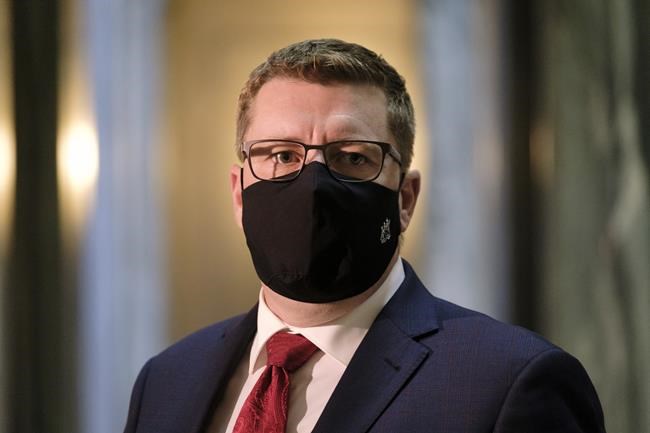
Premier Scott Moe speaks to media at the Legislative Building in Regina, Monday, Nov. 30, 2020. The Saskatchewan government says it's ready to begin immunizing critical health-care workers against COVID-19 starting next week. THE CANADIAN PRESS/Michael Bell

Health Minister Paul Merriman said that it will be a large undertaking, but added the province has put in place human and financial resources to successfully distribute the vaccine.

“When the vaccine will be ready, we will be ready,” he said.

A pilot vaccination program is to take place at the Regina General Hospital for health-care workers in intensive and emergency care, as well as for those on COVID-19 units at Regina General and the Pasqua Hospital in Regina. Staff at testing and assessment centres are also to receive the vaccine.

People who get a shot are to receive a second dose 21 days later.

The province said the first official stage of the program is to begin in late December. Some 202,052 vaccine doses are expected to arrive within the first quarter of next year, and there are to be 10,725 weekly allocations.

More health-care workers, staff and residents in long-term care, seniors over 80 and people living in remote areas such as the far north, who are at least 50, are to get those injections.

The province said allocations of the Moderna vaccine, which is expected to receive Health Canada approval in coming weeks, are still being finalized.

Saskatchewan plans to move from vaccinating some of its most vulnerable residents to the general population beginning in April.

“Once mass immunization has occurred, we will all be able to get closer to our normal routines,” chief medical health officer Dr. Saqib Shahab said in a news release.

In the meantime, people must continue taking precautions and following public health advice, he said.

The province reported 302 new cases Wednesday and five additional COVID-19 deaths — all individuals in their 80s. There were 4,707 active cases and 140 people were in hospital, 27 of them in intensive care.

The government brought in restrictions at the end of November to curb surging infection rates. Shahab said new infections remain too high. The five-day test positivity rate is 8.5 per cent.

Health officials said there are still challenges in how widespread vaccine distribution will work, including to rural and remote communities. The Pfizer vaccine cannot be further transported once it’s delivered to a specific location. And both the Pfizer and Moderna vaccines require specific cold storage.

The province is planning to have the vaccine distributed within care homes and hospitals during the first phase. Scott Livingstone, CEO of the Saskatchewan Health Authority, said the province will rely on pre-existing vaccination structures and pharmacies once inoculations are to be made more widely.

The Saskatchewan Party government has said getting a COVID-19 vaccination will not be mandatory, but it plans to roll out an ad campaign this month talking about immunizations.

Moe said it is people’s job to get the vaccine when it is their turn.

“We all need to get vaccinated to keep ourselves and keep others safe.”

This report by The Canadian Press was first published Dec. 9, 2020

— By Kelly Geraldine Malone in Winnipeg

Report Error Submit a Tip

More Stories

The new normal in Canadian politics

David McLaughlin 5 minute read Preview

The new normal in Canadian politics

David McLaughlin 5 minute read 2:01 AM CDT

“Nothing happening, all at once.”

Welcome to the new normal of Canadian politics, where normality is the new normal. Routine and stable are in; disruptive and excessive are out. Exhibits A and B are the Alberta referendum and the British Columbia election. Voters opted for stability over volatility.

The opposite of being normal is being different from the norm. In politics that means different from where we’ve been and what we’ve come to expect. Two competing trends have dominated our politics for the past decade and a half — progressivism and populism. Think Justin Trudeau and liberal, progressive identity politics in Canada, and Donald Trump and conservative, populist MAGA politics in America. We are now experiencing a swing away from both those trends.

Representing this “new normal” are Prime Minister Mark Carney, for one, and newly elected British Columbia premier, Lorne Doerksen, for another. Both are considered normal because they talk and act like adults in a childish political world. Their political flair is to not have any political flair. They stand out for not standing out.

Read
2:01 AM CDT

Defunding police ‘illogical step’: Pallister

Carol Sanders 5 minute read Preview

Defunding police ‘illogical step’: Pallister

Carol Sanders 5 minute read Tuesday, Jun. 9, 2020

Manitoba Premier Brian Pallister says he’s open to channelling justice funding to preventive programs, but questions whether defunding police is the best approach — warning there will always be criminals taking advantage of vulnerable people.

“I think the motivation that lies in frustrations of the actions of some police services — not necessarily here in Winnipeg exclusively, but elsewhere — is justifiable and understandable, and I get it,” Pallister said Tuesday, when asked to comment on the 30,000 signatures collected for a Justice 4 Black Lives Winnipeg petition calling for the abolition of the city police.

“But then moving to defunding police is, to me, an illogical step from that one. Don’t let your frustration lose your common sense... There’s a lot of people out there in vulnerable communities who depend on the police to protect them and make sure they’re safe from the action of criminals.”

There has been a widespread call to restructure police funding in the wake of George Floyd’s death May 25 in Minneapolis.

Read
Tuesday, Jun. 9, 2020

The long and winding road

Editorial 4 minute read Preview

The long and winding road

Editorial 4 minute read 2:01 AM CDT

As theatre goes, it sent a strong message.

Manitoba Premier Wab Kinew, standing in front of microphones and television cameras, holding up his Indigenous status card and saying that he didn’t feel Canada should have “a race-based form of identification in this country, but that is a reality,” adding that it was time to abolish the Indian Act.

“I think it’s time to abolish the Indian Act, get rid of the Indian Act, move past the Indian Act, and it needs to be done with First Nations people and First Nations governments, of course. I think it’s long overdue that we have a relationship with Indigenous Peoples in Canada that reflects who we are as Canadians today,” he said.

The Indian Act — the name alone suggests how out-dated and out of place the law has become. Originally dating from 1876, the law was put in place to “amend and consolidate the laws respecting Indians” and gave the Minister of the Interior the responsibility to “control and management of the reserves, lands, moneys and property of Indians in Canada.”

Read
2:01 AM CDT

Rural hospital shutdowns continue into fall

Katie May 5 minute read Preview

Rural hospital shutdowns continue into fall

Katie May 5 minute read Monday, Sep. 12, 2022

Summer shutdowns at some rural Manitoba hospitals have quietly extended into fall, and the uncertainty about reopening is frustrating residents.

Read
Monday, Sep. 12, 2022

Submit a news tip

1 minute read Monday, Mar. 16, 2026

Submit a news tip

Walkout creates chaos at St. James Smitty’s

Morgan Modjeski 3 minute read Preview

Walkout creates chaos at St. James Smitty’s

Morgan Modjeski 3 minute read 2:01 AM CDT

Gordon Sharpe wanted to eat a meal at the St. James Smitty’s Wednesday, but he got a helping of bad news instead.

He saw several workers walk out of the restaurant, at 1017 St. James St.

“(The waiter) came back about 10 minutes later and stood over the table, looking a little distraught and said, ‘I’m quitting right now and so is everybody else,’” Sharpe said. “He said, ‘This is my last time serving you,’ and he was quite choked up.”

“I’ve never seen anything like it,” he said, adding that the managers scrambled to serve patrons.

Read
2:01 AM CDT