Saskatchewan’s vaccine plan delayed; health official says COVID growth too high

Advertisement

Advertise with us

REGINA - A senior official with the Saskatchewan Health Authority says the province's health-care system won't be able to cope if the recent growth in COVID-19 cases continues.

Read this article for free:


or

Already have an account? Log in here »

To continue reading, please subscribe:

Subscribe and receive a limited-edition Free Press branded hat or tote.

Digital Subscription

One year of digital access for only $205*

  • Enjoy unlimited reading on winnipegfreepress.com
  • Read the E-Edition, our digital replica newspaper
  • Access News Break, our award-winning app
  • Play interactive puzzles

*First annual payment billed as $205.00 + GST for one year. This annual subscription will automatically renew at $233.00 + GST every 52 weeks (10% off the regular annual price of $259.35). Offer available to new and qualified returning subscribers only. Cancel any time.

To continue reading, please subscribe:

Add Free Press access to your Brandon Sun subscription for only an additional

$1 for the first 4 weeks*

  • Enjoy unlimited reading on winnipegfreepress.com
  • Read the E-Edition, our digital replica newspaper
  • Access News Break, our award-winning app
  • Play interactive puzzles
Start now

*Your next Brandon Sun subscription payment will increase by $1.00 and you will be charged $17.95 plus GST for four weeks. After four weeks, your payment will increase to $24.95 plus GST every four weeks.

Hey there, time traveller!
This article was published 08/12/2020 (2125 days ago), so information in it may no longer be current.

REGINA – A senior official with the Saskatchewan Health Authority says the province’s health-care system won’t be able to cope if the recent growth in COVID-19 cases continues.

Dr. Julie Kryzanowski’s presentation to more than 100 physicians at a virtual town hall last week has been posted online.

She told the town hall that in the last week officials had recorded exponential growth in infections, outbreaks, hospitalizations and deaths.
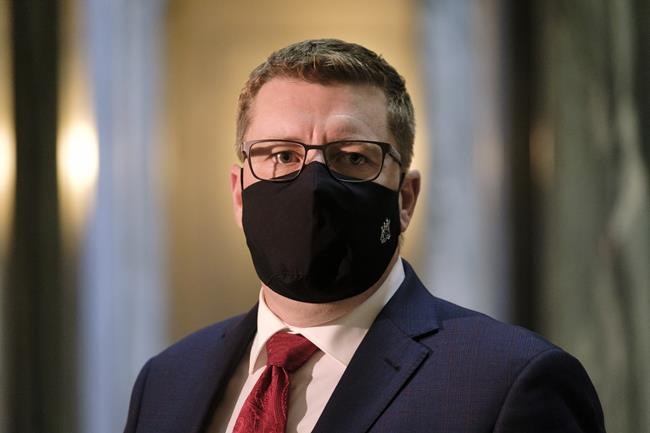
Premier Scott Moe speaks to media after the Throne Speech at the Legislative Building in Regina on Monday Nov. 30, 2020. THE CANADIAN PRESS/Michael Bell

“We do know that with this rate of growth it’s not sustainable for our health system and continues to stress our capacity,” doctors heard, hours after the health authority announced it was diverting up to 600 staff to respond to the surge.

For almost three weeks, masks have been mandatory in indoor public spaces provincewide and no more than five visitors have been allowed to gather inside a home.

Kryzanowski said in her remarks that the public-health orders “are expected to help dampen that rate of growth.”

“But we also know that there’s momentum behind this, so as those measures are introduced, the more restrictive those measures need to be.”

The presentation stated that “the slower measures are implemented the more restrictive the measures will need to be.”

The effect of the latest public-health orders added almost two weeks ago — a 30-person limit for public venues and no team sports — will take several weeks to see any impact, Krysanowski said.

She said the effectiveness of the rules depends on how many people comply.

Doctors were also told to expect a time lag between hospitalizations for COVID-19 and a change in case numbers.

“Hospitalizations, ICU admissions, deaths will continue to rise even as case numbers are maybe flattening because of that lag period.”

Health Minister Paul Merriman said Tuesday that the government and health officials would reveal early next week what public-health rules would apply over the holidays. The current measures expire Dec. 17.

Premier Scott Moe has said he hopes to be able to relax some restrictions to allow people to gather over Christmas, but that will depend on the severity of the virus’s spread.

Tuesday marked the deadliest day of the pandemic yet in Saskatchewan with six additional deaths. Five people who died were in their 80s and one resident was in their 30s.

The province also reported 183 new infections and said 144 people were in hospital, with 27 in intensive care.

Moe was to outline his province’s vaccine delivery plan Tuesday, but a power outage at the legislature in Regina delayed that by a day.

He has said the first in line once a vaccine is approved and delivered will be health workers and some of the province’s most vulnerable, including long-term care residents.

Moe told the legislative assembly on Monday that it appeared the province’s case numbers were stabilizing, but that the seven-day average for daily cases was still too high at 264.

The premier said his Saskatchewan Party government will start vaccinations “as quickly as physically possible.”

Moe said vaccinations will happen in phases determined by health officials as more doses become available in the new year.

The government said getting a COVID-19 vaccine will not be mandatory, but a communications plan will be part of the distribution.

This report by The Canadian Press was first published Dec. 8, 2020.

Note to readers: This is a corrected story. An earlier version said the health authority announced it was diverting up to 60 staff to respond to the surge.

Report Error Submit a Tip

More Stories

Churchill draws scientists from around the world researching impacts of climate change

Sarah Lawrynuik 13 minute read Preview

Churchill draws scientists from around the world researching impacts of climate change

Sarah Lawrynuik 13 minute read Friday, Oct. 23, 2020

CHURCHILL — There is something special about this town.

People who have been here know, though it is challenging to describe. Those who haven’t are told tales of a nearly mystical small community, the unique geography and the magnificent wildlife.

Exactly what makes it such a special place is hard to define, but whatever that intrinsic character is, it acts as a magnetic force for humans and animals alike.

Every summer — as if on cue — the sleek white backs of more than 50,000 beluga whales begin peeking out of the waters of southwestern Hudson Bay as they return to the estuaries of northern Manitoba. Their fidelity to this summer habitat is centuries old, passed on from one generation to the next. This loyalty to the region ensures for as long as this site is safe, these alien-like, curious whales will continue to return.

Read
Friday, Oct. 23, 2020

Who has been invited to the table?

Stephen Borys 6 minute read Preview

Who has been invited to the table?

Stephen Borys 6 minute read Yesterday at 2:01 AM CDT

Last Friday, I spoke at Booth University College’s inaugural Honour and Hope Harvest Dinner in support of Shelter U. I had been asked to speak about the power of art in the community, a subject I have spent much of my professional life thinking about — as a museum director, writer and teacher, and now through my consulting work with Civic Muse.

What continues to interest me is not simply what museums, universities and other public institutions do, but whether their work actually matters — whether they make a difference in the lives of the people and communities around them.

Preparing for the evening brought me back to an even more fundamental question: Who has been invited in?

One of my museum mentors used to remind me that institutions often begin the conversation about public engagement too late. Before engagement comes the welcome, and before the welcome comes the invitation. We can create extraordinary buildings, exhibitions and programs and say that everyone is welcome. But unless people believe that these places are also meant for them, many will never cross the threshold.

Read
Yesterday at 2:01 AM CDT

Twenty-seven new COVID cases in New Brunswick

The Canadian Press 2 minute read Preview

Twenty-seven new COVID cases in New Brunswick

The Canadian Press 2 minute read Thursday, Jan. 28, 2021

FREDERICTON - New Brunswick is reporting 27 new cases of COVID-19 today, including 14 in the hard-hit Edmundston region, which has been under lockdown since Sunday.

Health officials say 11 new cases were identified in the Moncton area and two in the Saint John region.

Moncton remains at the red pandemic-alert level while the rest province — outside Edmundston — is at the lower, orange level.

Indoor and outdoor gatherings are prohibited in Edmundston as is non-essential travel in and out of the region.

Read
Thursday, Jan. 28, 2021

Today’s horoscope

Georgia Nicols 4 minute read Preview

Today’s horoscope

Georgia Nicols 4 minute read Yesterday at 2:01 AM CDT

MOON ALERT: Avoid shopping (except food and gas) and important decisions after 9 p.m. The moon is in Gemini.

ARIES (March 21-April 19)

Your mind is focused, giving you common sense and practical ideas. This is an excellent day to sign up for a course or learn something new. Don’t hesitate to listen to the advice of someone older or more experienced because after all, you don’t have to reinvent the wheel.

TAURUS (April 20-May 20)

Read
Yesterday at 2:01 AM CDT

Cops handcuffed by bail issues, lack of mental-health options, WPS chief tells residents in crime-ridden North End neighbourhood

Nicole Buffie 6 minute read Preview

Cops handcuffed by bail issues, lack of mental-health options, WPS chief tells residents in crime-ridden North End neighbourhood

Nicole Buffie 6 minute read 5:30 PM CDT

Weak bail reform and a lack of mental-health resources and addictions treatment beds are making it more difficult to tackle crime in inner-city neighbourhoods such as William Whyte, where there has been a significant increase in criminal behaviour compared to last year, the city’s top police officer says.

Winnipeg Police Services Chief Gene Bowers made the remarks Thursday night at an event hosted by the William Whyte Neighbourhood Association, where about two dozen residents gathered to share their concerns about crime in the North End community.

“Fentanyl and meth, that’s caused a strain on all our front lines and and all these agencies that are trying to help people,” Bowers told the room of people at Inner City Youth Alive on Aberdeen Avenue Thursday night.

“What really is the problem is there’s no treatment. That’s the gap, because (police and agencies) are all churning the same people through, and we’re all seeing them. We’re all frustrated that there’s no help.”

Read
5:30 PM CDT

Letters, Oct. 2

6 minute read 2:00 AM CDT

Are clinical psychologists next?

Re: Province hires 17 psychiatrists to work in Winnipeg, Selkirk (Sept. 25)

Manitoba’s government has shown that it knows how to solve a specialist staffing crisis in health care. Clinical psychologists are still left to wonder when it will be their turn.

The Manitoba Psychological Society (MPS) welcomes the recent announcement of 17 new psychiatrists in the public system. Any investment in mental health deserves to be celebrated, especially in light of the Canadian Alliance on Mental Illness and Mental Health’s report card that was released in August 2026. Manitoba received overall grades of F and D for mental health and substance use health, respectively. Although disappointing, this is not surprising given that Manitoba spends five to six per cent of its health budget on mental health and addictions, about half the recommended rate of 12 per cent.