WEATHER ALERT

Head of WHO praises Canada’s anti-COVID response; warns vaccine won’t be a panacea

Advertisement

Advertise with us

TORONTO - Canada deserves praise for its efforts to fight COVID-19 both at home and abroad as well as for its commitment to public health, the head of the World Health Organization said on Tuesday.

Read this article for free:


By clicking the button above, an account will be created and you will begin to receive some of our recommended newsletters. You may opt out of any newsletter by visiting your Email and Communication Preferences page or by clicking "unsubscribe" at the bottom of any email.

or

Already have an account? Log in here »

To continue reading, please subscribe:

Digital Subscription

One year of digital access for only $1.44 a week*

  • Enjoy unlimited reading on winnipegfreepress.com
  • Read the E-Edition, our digital replica newspaper
  • Access News Break, our award-winning app
  • Play interactive puzzles

*Billed as $5.77 plus GST every four weeks. After 52 weeks, price increases to the regular rate of $19.95 plus GST every four weeks. Offer available to new and qualified returning subscribers only. Cancel any time.

To continue reading, please subscribe:

Add Free Press access to your Brandon Sun subscription for only an additional

$1 for the first 4 weeks*

  • Enjoy unlimited reading on winnipegfreepress.com
  • Read the E-Edition, our digital replica newspaper
  • Access News Break, our award-winning app
  • Play interactive puzzles
Start now

*Your next Brandon Sun subscription payment will increase by $1.00 and you will be charged $17.95 plus GST for four weeks. After four weeks, your payment will increase to $24.95 plus GST every four weeks.

Hey there, time traveller!
This article was published 17/11/2020 (2176 days ago), so information in it may no longer be current.

TORONTO – Canada deserves praise for its efforts to fight COVID-19 both at home and abroad as well as for its commitment to public health, the head of the World Health Organization said on Tuesday.

In a speech to the Empire Club of Canada, Dr. Tedros Adhanom Ghebreyesus, director-general of the WHO, cited among other things, Ottawa’s $440-million donation to the organization’s anti-pandemic initiative.

“This pandemic has reminded us of the importance of multilateralism, something that Canadians have always embraced,” Tedros said. “Canada has treated this pandemic seriously and adopted an approach that many other countries regard as an example.”

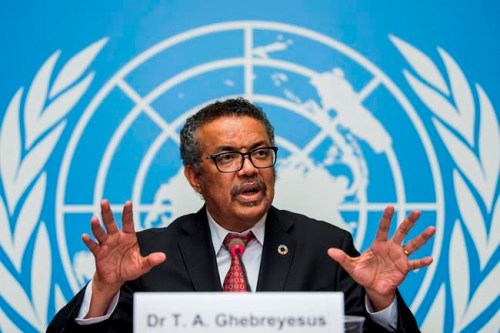
Dr. Tedros Adhanom Ghebreyesus, director general of the World Health Organization (WHO), answers questions at the European headquarters of the United Nations in Geneva, Switzerland on Feb. 7, 2018. Canada deserves praise for its anti-COVID-19 efforts both at home and abroad as well as for its commitment to public health, the head of the World Health Organization said on Wednesday. THE CANADIAN PRESS/AP, Martial Trezzini, Keystone

Tedros warned of the challenges ahead, noting the recent steep spike in cases and deaths both in Canada and around the world. To date, COVID-19 has struck more than 54 million people, 1.3 million fatally. Last week alone saw a record four million new cases and 60,000 deaths reported to the organization.

“We might be tired of COVID-19 but it’s not tired of us,” Tedros said. “The virus has no ideology or beliefs; its only goal is to spread.”

Countries and scientists around the world have been working to develop new diagnostics and treatments for the novel coronavirus. In addition, the race to develop a vaccine has produced promising results.

Tedros said more than $4 billion is still urgently needed to sustain momentum in the international effort. He also warned the global distribution of any vaccine will be among the most daunting logistical efforts the world has seen since the Second World War.

The main issue, he said, will be to ensure limited supplies are distributed fairly.

“The best way to do that is by vaccinating some people in all countries rather than all people in some countries,” he said.

At the same time, Tedros warned that a vaccine in and of itself won’t be a panacea. Public health measures, such as social distancing and avoiding poorly ventilated indoor spaces, will have to continue.

Also, an effective vaccine — about 200 are in the works — won’t fix fundamental issues of inequality, both within and among countries, he said.

“There is no vaccine for poverty, hunger, inequality or climate change.”

In separate comments, the WHO’s Dr. Kate O’Brien said health-care workers must be the first to get a vaccine when it becomes available. They are, she said, at high risk of contracting COVID-19 but essential for maintaining health services.

“We don’t simply want to move from one crisis to another crisis,” said O’Brien, a Canadian and the organization’s director of its department of immunization, vaccines and biologicals.

O’Brien urged people to get their information from credible sources and to avoid the flood of misinformation on social media about the virus, and, more specifically, about a potential vaccine.

It’s particularly important to address safety questions, she said, especially given the lightning speed with which scientists are developing a vaccine to fight COVID-19.

The unprecedented speed is partly the product of the global science community’s focus on vaccine development as well as huge strides made in medical technology. For example, she said, it took years just to identify the virus that can lead to AIDS, never mind sequence its genes.

“That needs to be communicated to people in the community,” O’Brien said.

This report by The Canadian Press was first published Nov. 17, 2020.

Report Error Submit a Tip

More Stories

Oleksiak makes history with seventh Olympic medal

The Canadian Press 8 minute read Preview

Oleksiak makes history with seventh Olympic medal

The Canadian Press 8 minute read Sunday, Aug. 1, 2021

TOKYO - The Canadian women finished their impressive medal haul in the pool – including a record-setting performance from Penny Oleksiak – and Andre De Grasse finally got Canada's men on the board with his second consecutive Olympic bronze in the men's 100 metres.

After finishing third in the medley relay, Maggie Mac Neil draped a bronze medal brimming with significance around Oleksiak's neck as their teammates Kylie Masse and Sydney Pickrem celebrated on the podium.

"Most decorated," they chanted in unison with their arms around each other during post-ceremony interviews with reporters.

On the final day of swimming competition at the Tokyo Olympics, Toronto's Oleksiak took her place at the top among Canada's greatest Olympians. In helping the medley relay team win bronze, she earned her seventh career Olympic medal, and at just 21 became the most decorated Canadian Olympian of all time.

Read
Sunday, Aug. 1, 2021

WRHA moves to cut growing echocardiogram wait list

Larry Kusch 6 minute read Preview

WRHA moves to cut growing echocardiogram wait list

Larry Kusch 6 minute read Tuesday, Aug. 21, 2018

Manitobans are waiting a year or more to receive a key test that detects and tracks heart disease.

As of June 15, there were about 6,500 Manitobans on the wait list for an echocardiogram, and the list is growing at a rate of about 265 per month.

Patients facing heart emergencies are receiving tests immediately, while most of those whose conditions are considered urgent or semi-urgent are getting them within established Canadian benchmark times -- about a week, officials say.

However, thousands of patients who are considered candidates for "elective" tests are waiting anywhere from 10 to 15 months, with a median wait of 12 months, according to the Winnipeg Regional Health Authority.

Read
Tuesday, Aug. 21, 2018

Head of WHO praises Canada's anti-COVID response

Colin Perkel, The Canadian Press 4 minute read Preview

Head of WHO praises Canada's anti-COVID response

Colin Perkel, The Canadian Press 4 minute read Tuesday, Nov. 17, 2020

TORONTO - Canada deserves praise for its efforts to fight COVID-19 both at home and abroad as well as for its commitment to public health, the head of the World Health Organization said on Tuesday.

In a speech to the Empire Club of Canada, Dr. Tedros Adhanom Ghebreyesus, director-general of the WHO, cited among other things, Ottawa’s $440-million donation to the organization's anti-pandemic initiative.

“This pandemic has reminded us of the importance of multilateralism, something that Canadians have always embraced,” Tedros said. "Canada has treated this pandemic seriously and adopted an approach that many other countries regard as an example."

Tedros warned of the challenges ahead, noting the recent steep spike in cases and deaths both in Canada and around the world. To date, COVID-19 has struck more than 54 million people, 1.3 million fatally. Last week alone saw a record four million new cases and 60,000 deaths reported to the organization.

Read
Tuesday, Nov. 17, 2020

Letters, Oct. 31

6 minute read Saturday, Oct. 31, 2026

Civic election a missed opportunity

The outcome of the latest municipal election in Winnipeg is nothing short of baffling. The decline of what was once a proud, beautiful prairie hub is impossible to ignore.

Winnipeg is rapidly sliding into a state of structural and social dilapidation, yet voters have inexplicably chosen to hand incumbent Mayor Scott Gillingham a second term. The decision smells of complacency, and sadly, it represents a massive missed opportunity for real urban renewal.

Walking through downtown Winnipeg today is an exercise in heartbreak. A city centre that should be a bustling economic and cultural core has instead transformed into an absolute eyesore. Encampments and tents are permitted to dot the heart of the city. Streets that used to thrive are now dominated by the tragic, visible reality of severe addiction, with individuals wandering and staggering through public spaces without adequate intervention or care.

Cottage communities constrained by COVID

Cassandra Szklarski, The Canadian Press 6 minute read Preview

Cottage communities constrained by COVID

Cassandra Szklarski, The Canadian Press 6 minute read Friday, May. 1, 2020

TORONTO - A springtime trickle of Manitobans entering Ontario to visit their lakeside cottages alarmed Kenora Mayor Daniel Reynard a month ago.

Now that Manitoba is poised to restart some non-essential services Monday, Reynard fears an even bigger influx — this time sun-seekers expecting amenities that are simply unavailable.

The message in Ontario is still one of restraint: Avoid non-essential travel, and do not visit your cottage. Provincial travel is not prohibited, but vacationers and day-trippers will find little to do.

Restaurants are closed, as are all beaches, golf courses, parks, trails and marinas.

Read
Friday, May. 1, 2020

Killer pleads guilty in three-year-old daughter’s fatal stabbing

Dean Pritchard 4 minute read Preview

Killer pleads guilty in three-year-old daughter’s fatal stabbing

Dean Pritchard 4 minute read Thursday, May. 26, 2022

A Winnipeg man has pleaded guilty to second-degree murder in the shocking stabbing death of his three-year-old daughter.

Frank Nausigimana, 29, entered his plea before Queen’s Bench Justice Joan McKelvey during a brief hearing Thursday morning.

Asked if he understood he was waiving his right to a trial, Nausigimana, through an American Sign Language interpreter, told McKelvey: “ Yes, I accept the punishment and I am following the law of God.”

“I’ve decided that I am going to pray,” Nausigimana said. “I admit I am guilty.”

Read
Thursday, May. 26, 2022