Head of WHO praises Canada’s anti-COVID response; warns vaccine won’t be a panacea

Advertisement

Advertise with us

TORONTO - Canada deserves praise for its efforts to fight COVID-19 both at home and abroad as well as for its commitment to public health, the head of the World Health Organization said on Tuesday.

Read this article for free:


By clicking the button above, an account will be created and you will begin to receive some of our recommended newsletters. You may opt out of any newsletter by visiting your Email and Communication Preferences page or by clicking "unsubscribe" at the bottom of any email.

or

Already have an account? Log in here »

To continue reading, please subscribe:

Digital Subscription

One year of digital access for only $1.44 a week*

  • Enjoy unlimited reading on winnipegfreepress.com
  • Read the E-Edition, our digital replica newspaper
  • Access News Break, our award-winning app
  • Play interactive puzzles

*Billed as $5.77 plus GST every four weeks. After 52 weeks, price increases to the regular rate of $19.95 plus GST every four weeks. Offer available to new and qualified returning subscribers only. Cancel any time.

To continue reading, please subscribe:

Add Free Press access to your Brandon Sun subscription for only an additional

$1 for the first 4 weeks*

  • Enjoy unlimited reading on winnipegfreepress.com
  • Read the E-Edition, our digital replica newspaper
  • Access News Break, our award-winning app
  • Play interactive puzzles
Start now

*Your next Brandon Sun subscription payment will increase by $1.00 and you will be charged $17.95 plus GST for four weeks. After four weeks, your payment will increase to $24.95 plus GST every four weeks.

Hey there, time traveller!
This article was published 17/11/2020 (2173 days ago), so information in it may no longer be current.

TORONTO – Canada deserves praise for its efforts to fight COVID-19 both at home and abroad as well as for its commitment to public health, the head of the World Health Organization said on Tuesday.

In a speech to the Empire Club of Canada, Dr. Tedros Adhanom Ghebreyesus, director-general of the WHO, cited among other things, Ottawa’s $440-million donation to the organization’s anti-pandemic initiative.

“This pandemic has reminded us of the importance of multilateralism, something that Canadians have always embraced,” Tedros said. “Canada has treated this pandemic seriously and adopted an approach that many other countries regard as an example.”
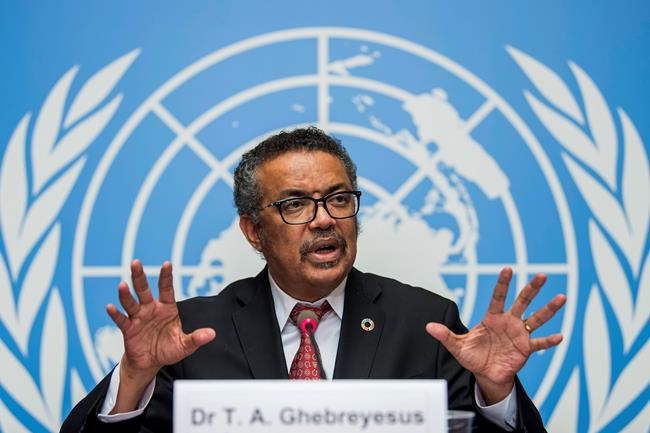
Dr. Tedros Adhanom Ghebreyesus, director general of the World Health Organization (WHO), answers questions at the European headquarters of the United Nations in Geneva, Switzerland on Feb. 7, 2018. Canada deserves praise for its anti-COVID-19 efforts both at home and abroad as well as for its commitment to public health, the head of the World Health Organization said on Wednesday. THE CANADIAN PRESS/AP, Martial Trezzini, Keystone

Tedros warned of the challenges ahead, noting the recent steep spike in cases and deaths both in Canada and around the world. To date, COVID-19 has struck more than 54 million people, 1.3 million fatally. Last week alone saw a record four million new cases and 60,000 deaths reported to the organization.

“We might be tired of COVID-19 but it’s not tired of us,” Tedros said. “The virus has no ideology or beliefs; its only goal is to spread.”

Countries and scientists around the world have been working to develop new diagnostics and treatments for the novel coronavirus. In addition, the race to develop a vaccine has produced promising results.

Tedros said more than $4 billion is still urgently needed to sustain momentum in the international effort. He also warned the global distribution of any vaccine will be among the most daunting logistical efforts the world has seen since the Second World War.

The main issue, he said, will be to ensure limited supplies are distributed fairly.

“The best way to do that is by vaccinating some people in all countries rather than all people in some countries,” he said.

At the same time, Tedros warned that a vaccine in and of itself won’t be a panacea. Public health measures, such as social distancing and avoiding poorly ventilated indoor spaces, will have to continue.

Also, an effective vaccine — about 200 are in the works — won’t fix fundamental issues of inequality, both within and among countries, he said.

“There is no vaccine for poverty, hunger, inequality or climate change.”

In separate comments, the WHO’s Dr. Kate O’Brien said health-care workers must be the first to get a vaccine when it becomes available. They are, she said, at high risk of contracting COVID-19 but essential for maintaining health services.

“We don’t simply want to move from one crisis to another crisis,” said O’Brien, a Canadian and the organization’s director of its department of immunization, vaccines and biologicals.

O’Brien urged people to get their information from credible sources and to avoid the flood of misinformation on social media about the virus, and, more specifically, about a potential vaccine.

It’s particularly important to address safety questions, she said, especially given the lightning speed with which scientists are developing a vaccine to fight COVID-19.

The unprecedented speed is partly the product of the global science community’s focus on vaccine development as well as huge strides made in medical technology. For example, she said, it took years just to identify the virus that can lead to AIDS, never mind sequence its genes.

“That needs to be communicated to people in the community,” O’Brien said.

This report by The Canadian Press was first published Nov. 17, 2020.

Report Error Submit a Tip

More Stories

Science-art collaboration injects dose of emotion into cold, hard truths

Sarah Lawrynuik 5 minute read Preview

Science-art collaboration injects dose of emotion into cold, hard truths

Sarah Lawrynuik 5 minute read Wednesday, Apr. 28, 2021

Looking at spreadsheets and map plots of trees is far beyond Rhian Brynjolson’s typical day as a visual artist, but she became entranced and inspired by data collected by Canadian scientists for a new art project.

Her hope is to try and bring the numbers, map dots and statistics to life in a new way to help the public better connect to climate science.

Falcon Lake’s Brynjolson is one of 12 Canadian artists who participated in an art-science collaboration exhibit, co-ordinated by the Global Water Futures program out of the University of Saskatchewan. The project saw the artists paired with researchers and scientists across the country who then engaged in conversations to try to inspire a new angle to their art.

“The whole idea behind it is: water is life,” says Louise Arnal, the project lead, and a post-doctoral fellow at the Centre for Hydrology and Coldwater Laboratory.

Read
Wednesday, Apr. 28, 2021

Wife’s witchy wonderment won’t spell trouble

Maureen Scurfield 6 minute read 2:00 AM CDT

DEAR MISS LONELYHEARTS: My wife believes in magic potions, which used to make me laugh. But since Halloween season started this year, she’s been acting in a way that frightens me. She seems to think she’s a modern-day “witch.” Give me a break!

Now she has three friends who think they are really casting spells when they get together! And this year on Halloween night she’s being formally accepted into their little witchy group meeting at one of their homes, and is getting a new sorceress name. It’s creepy! How do I cope? I’ve had enough of this.

— Seriously Upset, South St. Vital

Dear Upset: Don’t buy into the hocus pocus by being afraid of it and expressing any trepidation to your wife. She needs you to be strong, so she knows she has a solid anchor and can drop out of this witchy group if it becomes too scary or silly for her.

Security tightens at downtown library

Aldo Santin 5 minute read Preview

Security tightens at downtown library

Aldo Santin 5 minute read Saturday, Feb. 16, 2019

Users of the downtown Millennium Library will be subject to several new security screening measures, more commonly seen at airports and sporting facilities.

City hall announced Friday that effective Feb. 25, all visitors to the Donald Street library will undergo bag checks and be subjected to a hand-held metal detector sweep for alcohol and prohibited weapons. Visitors who refuse to participate will be barred from entering the library.

“The number of incidents (has) increased in the past four to five years, incidences involving violence, threats, alcohol, substance abuse and it was concerning. We met with police and our security contractor. After discussing, we came up with this course of action,” Ed Cuddy, manager of library services, told reporters. “We feel it’s a big change, but we feel it’s justified based on the kind of incidents we’ve been experiencing recently.”

Cuddy wouldn’t elaborate on the nature of the incidents, but did say library workers have not been the victims.

Read
Saturday, Feb. 16, 2019

Brian Bowman wins mayoral battle

Aldo Santin and Mary Agnes Welch 6 minute read Preview

Brian Bowman wins mayoral battle

Aldo Santin and Mary Agnes Welch 6 minute read Thursday, Oct. 23, 2014

In the end, it wasn’t even close.

A mayoral race that was supposed to be a head-to-head battle between privacy lawyer Brian Bowman and former NDP MP and MLA Judy Wasylycia-Leis turned into a rout on election night. Wasylycia-Leis, the experienced politician, had held what looked like an unassailable lead for months, but Bowman, the outsider who promised Winnipeggers a better, prosperous future, chipped doggedly away at it.

“I’m excited to tell you that positive change is coming to city hall,” Bowman told roaring supporters at the Inn At The Forks after making his way into the small ballroom accompanied by his wife and two young sons.

He said he hadn’t expecting such a landslide victory, but had believed that the campaign was building momentum.

Read
Thursday, Oct. 23, 2014

Submit a news tip

1 minute read Monday, Mar. 16, 2026

Submit a news tip

The volatile U.S. midterms

Allan Levine 5 minute read Preview

The volatile U.S. midterms

Allan Levine 5 minute read 2:00 AM CDT

The last time the Democratic Party had 218 or more seats — the number required to control the U.S. House of Representatives — was from 2021 to 2023, following the election of Democrat Joe Biden as president. During that same period, the Democrats also had the edge in the Senate. Despite a 50-50 split with the Republicans, Democrats were able to control the Senate with the help of Vice-President Kamala Harris, who cast the key vote in a tie. From 2023 to 2025, the Democrats had a slim 51 to 49 Senate majority.

If history repeats itself and the latest polls are fairly accurate, on Tuesday, Nov. 3, the Democratic Party will take back the House and (probably) the Senate from the Republicans, who have controlled both legislative bodies since the 2024 election. In the House, the Democrats have to gain at least three more seats. In the Senate, they have to win four more, which is entirely doable, though they almost certainly have to win a seat in Texas, Ohio, Kansas or Alaska, each of which currently has two Republican senators.

The prospect of a Democratic victory has President Donald Trump in a tizzy. For the past two years, he has abused his executive power to impose illegal tariffs on Canada and other countries; started a war with Iran; cozied up to Russian president Vladimir Putin and turned his back on Ukrainian president Volodymyr Zelenskyy; and increased the national debt through questionable tax cuts — to list only a few of his more egregious actions. He has been able to get away with this mainly because Republicans in the Senate and the House refuse to even question his decisions.

With the Democrats in charge, Trump’s brazen actions won’t be completely halted, but he will face significant legislative challenges and obstacles not easily dismissed. His controversial appointees, such as Attorney General Todd Blanche, who perceives himself as Trump’s private lawyer rather than the legal representative of the people, won’t get a free pass in committee hearings.

Read
2:00 AM CDT