Canadian cannabis, psychedelics industries cheer state measures in U.S. election

Advertisement

Advertise with us

TORONTO - Canadian cannabis and psychedelics companies that have been eyeing the U.S. market have a few new reasons to celebrate.

Read this article for free:


or

Already have an account? Log in here »

To continue reading, please subscribe:

Subscribe and receive a limited-edition Free Press branded hat or tote.

Digital Subscription

One year of digital access for only $205*

  • Enjoy unlimited reading on winnipegfreepress.com
  • Read the E-Edition, our digital replica newspaper
  • Access News Break, our award-winning app
  • Play interactive puzzles

*First annual payment billed as $205.00 + GST for one year. This annual subscription will automatically renew at $233.00 + GST every 52 weeks (10% off the regular annual price of $259.35). Offer available to new and qualified returning subscribers only. Cancel any time.

To continue reading, please subscribe:

Add Free Press access to your Brandon Sun subscription for only an additional

$1 for the first 4 weeks*

  • Enjoy unlimited reading on winnipegfreepress.com
  • Read the E-Edition, our digital replica newspaper
  • Access News Break, our award-winning app
  • Play interactive puzzles
Start now

*Your next Brandon Sun subscription payment will increase by $1.00 and you will be charged $17.95 plus GST for four weeks. After four weeks, your payment will increase to $24.95 plus GST every four weeks.

Hey there, time traveller!
This article was published 06/11/2020 (2162 days ago), so information in it may no longer be current.

TORONTO – Canadian cannabis and psychedelics companies that have been eyeing the U.S. market have a few new reasons to celebrate.

Through U.S. election ballot questions, five states — Arizona, New Jersey, South Dakota, Mississippi and Montana — this week voted in favour of legalizing recreational or medical cannabis, while Oregon supported the sale of psilocybin mushrooms and Washington, D.C. decriminalized some psychedelic drugs.

Experts say the growing support for cannabis and psychedelic drugs in the United States could be a boon for its neighbours to the north.
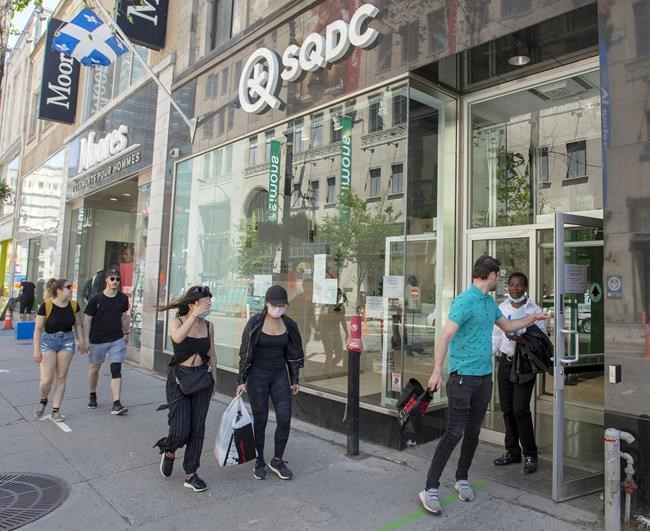
A Quebec cannabis outlet is seen Thursday, June 11, 2020 in Montreal. Canadian cannabis and psychedelics companies that have been eyeing the U.S. market got a few reasons to celebrate this week. THE CANADIAN PRESS/Ryan Remiorz

“The size of the market dwarfs the overall opportunity in Canada,” said Omar Khan, Hill+Knowlton Strategies’ national cannabis sector lead.

“A lot of the players here have gone through ups and downs in the industry, learned what to do and not to do and are now able to perhaps apply some of those learnings to the U.S. market.”

On top of benefits from states that green-lit legalization, Khan said a Joe Biden and Kamala Harris White House could deliver more cannabis wins.

He pointed to the Safe Banking Act, a Democratic bill with some Republican support stalled in the U.S. Senate. It would allow financial institutions to work with cannabis companies without retribution and could pass under a new administration.

“If you’re a Canadian company looking to get into retail down south, that’s potentially a game-changer for you in terms of access to capital,” Khan said.

Biden and Harris could also be good for cannabis companies because they committed to decriminalizing pot and expunging criminal records related to its possession, he said.

“On the flip side, a Donald Trump victory would mean more status quo and I don’t think that’s necessarily a bad thing for cannabis companies because it just gives them that much more time and it allows capital to move back … into Canadian companies,” said Deepak Anand, the chief executive of Materia Ventures, which produces and distributes medical cannabis.

The U.S. election came as the Canadian cannabis sector is facing turmoil. The optimism that circled the industry two years ago, when cannabis was legalized in Canada, has largely dissipated.

Pot companies now are restructuring and laying off thousands of workers. Industry closures, mergers and acquisitions are materializing and many believe more are on their way.

A U.S. toehold could be a step to reversing those trends, said David Culver, Canopy Growth Corp.‘s head of U.S. government relations.

“There’s a lot of eyes in Canada on the U.S. market, and we’re excited about the possibilities there because it will have a very positive impact on my company and many others,” he said.

He believes U.S. election developments signal the growing normalization of cannabis and indicate where policies can be pushed further forward, even during the pandemic.

For example, he said states facing ballooning budget deficits will be “looking under every rock” for tax revenue. Cannabis-friendly policies could create a cash injection while signalling that they are open for businesses in the sector.

When states are ready for cannabis, he said, Canopy has the “crystal ball” advantage because it knows how legalization works from its experience in Canada and can easily deploy strategies it used before.

Aurora Cannabis chief executive Miguel Martin agreed.

“This is the right moment to improve financial systems, address social injustices, and realize the potential benefits of sound, evidence-based cannabis public policy,” he said in an email. “Aurora remains focused on and optimistic for the U.S. CBD market and long-term prospects for federal legalization.”

It’s not just cannabis companies that stand to win through the U.S. election.

Companies working hard to normalize psychedelics and get them seen as potential aids in the fight against mental illness can reap rewards too, said Ronan Levy, Field Trip Health Ltd.’s chief executive.

His Toronto-based company, which has been exploring ketamine-enhanced psychotherapy, believes the psychedelic drug industry will grow and may become more significant than the cannabis sector.

Oregon’s support for the growth, administration and sale of psilocybin mushrooms in licensed facilities is a “bellwether,” Levy said.

“We know for a fact that other states were looking to move forward with a ballot similar to Oregon, but got really sidelined by the pandemic … I think this is really going to drive the industry forward.”

The U.S.’s large population and influence may also change consumer sentiment and hesitation around psychedelics, creating an opportunity for Canadian companies, he said.

“If you see the U.S. start to embrace psychedelic therapies, it’s going to accelerate global acceptance of psychedelic therapies and really drive things forward for us.”

This report by The Canadian Press was first published Nov. 6, 2020.

Companies in this story: (TSX:WEED, TSX:ACB)

Report Error Submit a Tip

More Stories

Michigan governor sues to secure abortion rights, vacate ban

David Eggert, The Associated Press 5 minute read Preview

Michigan governor sues to secure abortion rights, vacate ban

David Eggert, The Associated Press 5 minute read Thursday, Apr. 7, 2022

LANSING, Mich. (AP) — Gov. Gretchen Whitmer filed a lawsuit Thursday asking a Michigan court to recognize the right to get an abortion under the state constitution and to overturn a 176-year-old ban in the state that might take effect again if the U.S. Supreme Court's landmark Roe v. Wade ruling is vacated.

The Democratic governor's preemptive lawsuit, which was filed in Oakland County against prosecutors in 13 counties with an abortion clinic, came as the Supreme Court's conservative majority considers allowing states to ban abortion much earlier in a pregnancy and potentially overturning the right. Planned Parenthood of Michigan and its chief medical officer filed a similar lawsuit in the state Court of Claims to block enforcement of the 1931 law, which dates to an 1846 ban.

Whitmer, who is up for reelection this year, asked the Michigan Supreme Court to quickly take up her case rather than let it wind through lower trial and appellate courts. A favorable decision could enable abortions to continue in Michigan after the federal high court rules.

“It was important for us to take action now, to ensure that women and providers across the state of Michigan know whether abortions will still be available in the state because it impacts their lives and our health care providers' practices. It's crucial that we take this action now to secure and ensure that the Michigan Constitution protects this right that we have had available for 49 years,” Whitmer told The Associated Press, saying nearly 2.2 million women may lose access to a safe, legal medical procedure.

Read
Thursday, Apr. 7, 2022

Booze sales down, gaming and cannabis up in Manitoba

Carol Sanders 5 minute read Preview

Booze sales down, gaming and cannabis up in Manitoba

Carol Sanders 5 minute read 2:01 AM CDT

MANITOBA Liquor and Lotteries delivered $724.1 million in profits to the province in 2025-26, with the lion’s share coming from alcohol, even as booze sales continue to shrink.

The Crown corporation’s contribution to Manitoba’s general revenues decreased by $6 million or 0.8 per cent from last year’s allocation of $730.1 million, its annual report shows.

That indicates stable overall performance “despite a changing operating environment,” the recently-released report said.

Those changes include the order from Premier Wab Kinew last year to remove U.S. alcohol from Liquor Mart store shelves after President Donald Trump launched a trade war against Canada as well as Manitobans’ changing tastes.

Read
2:01 AM CDT

Kelly Taylor

1 minute read Preview

Kelly Taylor

1 minute read Sunday, Aug. 14, 2022

Kelly Taylor is a Winnipeg Free Press copy editor and award-winning automotive journalist. He's been a member of the Automobile Journalists' Association of Canada since 2001.

Read
Sunday, Aug. 14, 2022

Fantastical, moving graphic memoir explores addictions, organ procurement and more

Reviewed by Candida Rifkind 4 minute read Preview

Fantastical, moving graphic memoir explores addictions, organ procurement and more

Reviewed by Candida Rifkind 4 minute read Saturday, May. 30, 2026

At the heart of Mary Shelley’s 1818 classic Frankenstein and its many pop culture adaptations is the scene in the mad scientist’s lab where Victor Frankenstein, helped by a bolt of lightning, animates the grotesque figure made out of human and animal parts lying on his anatomy table.

As much as Shelley’s novel is a philosophical investigation into the desire of modern science to create new life, it is also a gruesome window into the clandestine European trade in graveyard and battlefield body snatching that fuelled early 19th-century anatomy research, medical training and public dissection theatres.

Whose bodies ended up on the slab to advance medical knowledge? As Montreal-based artist Arizona O’Neill explains in her captivating first graphic narrative, it was inevitably poor, racialized and criminalized bodies that were deemed appropriate for the indignities of public display and dissection in earlier periods.

But what about today? This is the central question driving the story of Opioids & Organs, O’Neill’s beautifully drawn story of coming to terms with her father’s untimely death due to a fentanyl overdose as well as the awful truth that Canada’s post-2015 opioid crisis has greatly increased the number of organs available for donation, mostly from otherwise healthy young men like her father.

Read
Saturday, May. 30, 2026

Alzheimer’s has sent my mother back in time

Pam Frampton 5 minute read Preview

Alzheimer’s has sent my mother back in time

Pam Frampton 5 minute read Yesterday at 2:01 AM CDT

My mother does a lot of time-travelling — time-shifting, the Alzheimer’s Society calls it.

I wonder how it feels to be in the present at one moment and then suddenly catapulted deep into the past. Is it a jolting experience or a smooth transition to go back and forth in time?

Mom will never be able to tell me. There is so much she can never tell me now.

She can still recite her children’s names when prompted, but she doesn’t ask us about our lives. Instead, she talks about her younger siblings, their grandfather who was hard of hearing, the isolated place where they used to live whose inhabitants were resettled nearly 60 years ago.

Read
Yesterday at 2:01 AM CDT

War veteran helped build Rivercrest

Bill Redekop 6 minute read Saturday, Mar. 30, 2019

As one of the original homeowners in Rivercrest, a subdivision north of Winnipeg set aside for war veterans in 1946, and the very last of them to leave at age 101, Art Christensen embodied neighbourhood-building.

He volunteered with the construction of the Rivercrest United Church, Rivercrest Community Club, West St. Paul Curling Club, and West St. Paul Fire Hall.

He went on to serve as West St. Paul councillor for 10 years, and then as reeve for 11.

Christensen was even a bit of a social convener.