Coronavirus dims Mexico’s bright Day of the Dead celebration
Advertisement
Read this article for free:
or
Already have an account? Log in here »
To continue reading, please subscribe:

Digital Subscription
One year of digital access for only $205*
- Enjoy unlimited reading on winnipegfreepress.com
- Read the E-Edition, our digital replica newspaper
- Access News Break, our award-winning app
- Play interactive puzzles
*First annual payment billed as $205.00 + GST for one year. This annual subscription will automatically renew at $233.00 + GST every 52 weeks (10% off the regular annual price of $259.35). Offer available to new and qualified returning subscribers only. Cancel any time.
To continue reading, please subscribe:
Add Free Press access to your Brandon Sun subscription for only an additional
$1 for the first 4 weeks*
- Enjoy unlimited reading on winnipegfreepress.com
- Read the E-Edition, our digital replica newspaper
- Access News Break, our award-winning app
- Play interactive puzzles
*Your next Brandon Sun subscription payment will increase by $1.00 and you will be charged $17.95 plus GST for four weeks. After four weeks, your payment will increase to $24.95 plus GST every four weeks.
Read unlimited articles for free today:
or
Already have an account? Log in here »
Hey there, time traveller!
This article was published 29/10/2020 (2158 days ago), so information in it may no longer be current.
MEXICO CITY – Mexico’s Day of the Dead celebration this weekend won’t be the same in a year so marked by death, in a country where more than 90,000 people have died of COVID-19.
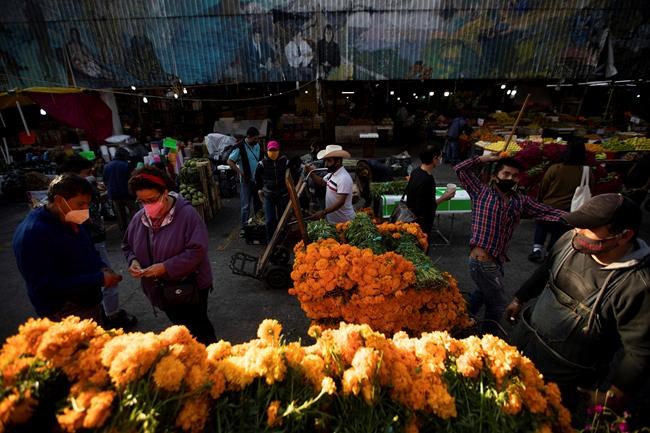
Many of those had to be cremated rather than buried, and even for those with gravesides to visit, the pandemic has forced authorities in most parts of Mexico to close cemeteries to prevent the traditional Nov. 1-2 observances when entire families clean and decorate tombs, cover them with orange marigolds, light candles and chat with their deceased relatives, perhaps over a glass of their favourite beverage.
On Sunday, many residents of the impoverished suburb of Valle de Chalco, east of Mexico City, visited to a recently opened overflow section of the local cemetery to clean the simple graves of their loved ones — many still just marked by dirt mounds — because they had heard the graveyards would be closed on the actual holiday. “A lot of people came to fix up their (relatives’) graves before the Day of the Dead,” said José Juan Rivera Almazán, the cemetery manager.
He noted the new section of the graveyard “is filling up quickly. We do not know if that’s because of the disease,” though it is clear there is a steady trickle of new burials of COVID victims; they are easy to recognize because their coffins come wrapped in plastic.
On a normal Day of the Dead, Rivera Almazán said, “You can’t even walk through here, it is so full, people, visitors, vendors’ stands.”
This year, though, the cemetery will be quiet.
Jacinta Jiménez Viviano lost her husband, retired manual labourer Vicente Domínguez Alejo, to COVID-19 this year. He died in the hospital, after almost no visits; Jacinta was occupied with her son, who also fell ill but recovered. Her husband, a diabetic, was not so lucky.
Knowing she would not be able to come on Nov. 2 — when deceased adults are honoured — she brought flowers Sunday to plant at her husband’s dusty grave. She said the simple act of tending the grave was reassuring.
“I feel this represents hope that we will make it because, thank God, these days of the dead are very important to Mexicans,” Jiménez Viviano said. “We will leave a little offering for him now, and later, when we can, we will return.”
Mexico has long had a different attitude toward death, more social, more accepting than in many parts of the world. Wakes and funerals here are often elaborate, days-long events gathering entire neighbourhoods and extended families for eating, praying and remembering.
But death amid the pandemic has become a very lonely affair; not only were wakes prohibited, many families couldn’t be with their relatives in their final moments or even view the body because of the coronavirus.
But in some ways, this year’s Dia de Muertos has also taken the holiday back to its roots and stripped away many of the cultural overlays and modern innovations that had begun influencing the celebration in recent years.
Gone is the Hollywood-style Day of the Dead parade that Mexico City adopted to mimic a fictitious march in the 2015 James Bond movie “Spectre.” Halloween, with its more risky, group activities — costume parties and trick-or-treating — has retreated in the face of the pandemic.
In many ways, it has boiled down to the way the holiday began: simple altars to invite the dead to come home for a night, featuring candles to guide the spirits back and the favourite food and drink of the dead to lure them home. Held inside homes, this is one of the few safe activities, though there are some attempts at online celebrations too.
“This year, the Day of the Dead must be celebrated virtually,” said Mexico City cultural secretary José Alfonso Suárez del Real, inviting city residents to post photos or videos of their altars on a city website. “It is fundamental that we recover and adopt once again the altars to our dead, which are household altars.”
One of the country’s largest funeral homes, Gayosso, has launched “Lazos,” an online system for sending flowers directly to graves and mausoleums. And, with cemeteries and mausoleums closed due to the risk of infection from COVID-19, the company offers online Masses for the departed.
It’s not the same.
“In one way or another, they are taking away our ancestral tradition … a tradition that has never before been cancelled,” said Ericka Alejandra Alvarez, an ethnohistorian at Mexico’s National Autonomous University. “This is going to cause a shock in society; people are going to be upset, uncomfortable, not happy.”

Born of pre-Hispanic rituals that may have lasted 20 days, and combined with European elements brought by the Spaniards, Day of the Dead is rooted in the idea that the spirits of the dead should know they are loved and have a home; if they don’t, they might wander aimlessly.
This has led to sometimes strange and elaborate preparations. In some towns and neighbourhoods, families tend small fires outside their homes and spread trails of marigold petals to the door to guide the spirits. In some Indigenous towns, the bones of ancestors are annually taken from ossuary niches to be cleaned around the Day of the Dead.
“It is not just going to a tomb to leave an offering or lay some flowers there,” said Alvarez. “Everything that we Mexicans do regarding death is cathartic, because you cry, your soul breaks,” she noted. “All this catharsis you go through with the symbols that make up a funeral, they are important because they give you the sense and the understanding of death, and that isn’t there anymore” because the cemeteries are closed.
“So how are we going to do it? I say that we should do it, not in crowds, or collectively, but in our own homes,” she said. “If we can’t go to the cemeteries, we have to put up our altars.”
Those are often crowded affairs, reflecting all of a family’s deceased. This year Alvarez’s will be dedicated to two brothers who died years ago as children, to her three uncles and grandparents.
Related Articles
Experts divided on COVID-19 Halloween risks
Advertisement Advertise With Us
Advertisement Advertise With Us