Trick or Treat? Experts divided on letting kids go out on Halloween due to COVID risk
Advertisement
Read this article for free:
or
Already have an account? Log in here »
To continue reading, please subscribe:
Digital Subscription
One year of digital access for only $1.44 a week*
- Enjoy unlimited reading on winnipegfreepress.com
- Read the E-Edition, our digital replica newspaper
- Access News Break, our award-winning app
- Play interactive puzzles
*Billed as $5.77 plus GST every four weeks. After 52 weeks, price increases to the regular rate of $19.95 plus GST every four weeks. Offer available to new and qualified returning subscribers only. Cancel any time.
To continue reading, please subscribe:
Add Free Press access to your Brandon Sun subscription for only an additional
$1 for the first 4 weeks*
- Enjoy unlimited reading on winnipegfreepress.com
- Read the E-Edition, our digital replica newspaper
- Access News Break, our award-winning app
- Play interactive puzzles
*Your next Brandon Sun subscription payment will increase by $1.00 and you will be charged $17.95 plus GST for four weeks. After four weeks, your payment will increase to $24.95 plus GST every four weeks.
Read unlimited articles for free today:
or
Already have an account? Log in here »
Hey there, time traveller!
This article was published 30/10/2020 (2192 days ago), so information in it may no longer be current.
As COVID-19 case numbers continue to creep up in much of the country, some parents are feeling spooked about letting their children trick-or-treat on Halloween.
Should they carry on with the door-to-door tradition, or find a different way to celebrate the eerie annual holiday?
While some infectious disease pediatricians say now is not the time for trick-or-treating, especially in COVID hot spots, others contend that the outdoor nature of the activity makes it fairly low-risk.
Dr. Anna Banerji, an associate professor at the University of Toronto’s School of Public Health, says trick-or-treating should “probably be cancelled this year.”
“We’ve … shut down gyms and restaurants (in parts of Ontario and Quebec) to try to control COVID,” she said. “So I just don’t think it’s a good idea.”
Areas with few COVID cases will be safer for trick-or-treaters, Banerji says, but having contact with multiple people, regardless of how brief those interactions are, can carry higher risk in cities with larger concentrations of the virus.
Banerji says it will be tough to keep kids — excited to see their dressed-up counterparts — from congregating on driveways and sidewalks, which will make it harder for parents accompanying them to maintain a safe distance as well.
“In general it’s not high-risk when you’re just walking by someone on the street, but when you’ve got a whole bunch of kids and they’re walking together, the risk might go up,” Banerji said. “And the adults are there too. And they’re being exposed to all these different kids.”
“In general it’s not high-risk when you’re just walking by someone on the street, but when you’ve got a whole bunch of kids and they’re walking together, the risk might go up.”–Dr. Anna Banerji
Dr. Martha Fulford of McMaster Children’s Hospital says the risk of COVID spreading through trick-or-treaters is “very small.”
The outdoor element helps mitigate danger, Fulford says, adding that keeping distance from groups on sidewalks should be easy enough by walking around them.
Still, she suggests safeguards to minimize potential transmission, like getting trick-or-treaters to stick to their own neighbourhoods and making sure kids clean their hands before indulging in their bounty.
Homeowners wary of contracting the virus from costumed kiddos on their porches can find creative ways to hand out candy as well.
Fulford suggests candy handlers sit outside, if weather permits, to avoid having too many fingers pushing doorbells. She doesn’t suggest leaving a bulk, self-serve bowl outside, however, since having “multiple tiny hands” reaching in makes that a high-touch surface.
“We’ve learned COVID generally is not well-transmitted on surfaces. We don’t think there’s a problem when we go grocery shopping or anything like that. So sealed candies is not a problem.”–Dr. Martha Fulford
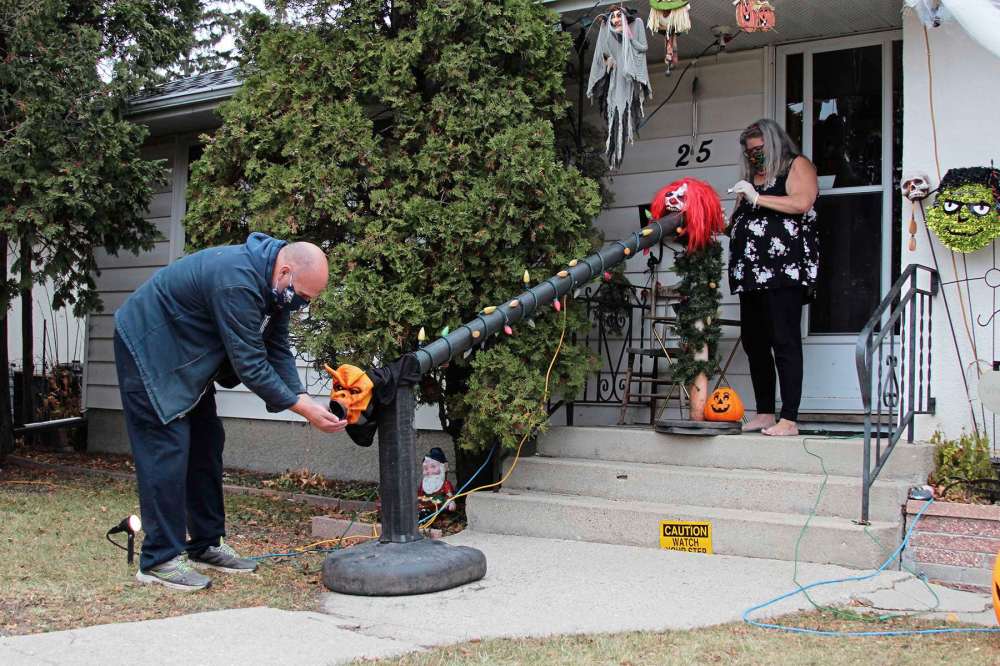
“Use tongs. Get some kind of dispensing thing or build a little slide where you pop the candy in a tube and it pops out the other end for the kids,” Fulford said.
“We’ve learned COVID generally is not well-transmitted on surfaces. We don’t think there’s a problem when we go grocery shopping or anything like that. So sealed candies is not a problem.”
Canada’s chief public health officer, Dr. Theresa Tam, said earlier this month that trick-or-treating could proceed as long as participants follow physical distancing and other safety protocols. She mentioned handing out treats on a hockey stick, or using pool noodles to separate kids from homeowners at their front doors.
The U.S. Centers for Disease Control and Prevention says there’s no need to shelve trick-or-treating completely, recommending children stay two metres apart and wear cloth masks that can be incorporated into their costumes. The organization says a costume mask is not a substitute for a cloth mask, but layering of masks can cause breathing difficulties and isn’t advised.
Fulford says face coverings aren’t necessary for children outdoors, but adults accompanying kids on their candy quest can wear them if they’re struggling to maintain distance from other groups. If homeowners handing out candy feel safer wearing face coverings, they should do that as well, she adds.
“What are we teaching our children (by cancelling Halloween)? We’re teaching them to be scared to have social interactions and we’re not teaching resilience.”–Dr. Martha Fulford
Banerji, meanwhile, says all parties involved in trick-or-treating should be wearing face coverings. But an even better strategy, she said may be to not take part at all.
“For the first Halloween in my life, we’re not going to do it,” she said. “I just don’t think it’s safe.”
Fulford worries too many households will go that route, leaving kids disappointed.
She says kids have “borne the brunt of pandemic restrictions,” from school closures back in March to the subsequenet cancellations of everything from team sports to in-person birthday parties.
“It’s an easy default is to say ‘no Halloween’ but those who suffer the consequences are our kids,” Fulford said. “To the best of our ability, I really do not think we should be canceling childhood.
“What are we teaching our children (by cancelling Halloween)? We’re teaching them to be scared to have social interactions and we’re not teaching resilience. So I worry.”
Dr. Nicole Racine, a child psychology expert with the University of Calgary, says kids are “creatures of habit” who can find routine and meaning in annual traditions like Halloween.

So we have to be careful not to take too many of those shared experiences away from them, she said.
Racine suggests finding ways to replace experiences like trick-or-treating, such as holding a candy scavenger hunt within your own household, rather than canceling them outright.
“It’s about how we can reframe things for kids so that there’s still something to look forward to, still something to enjoy, and still something that can be quite meaningful to them,” Racine said.
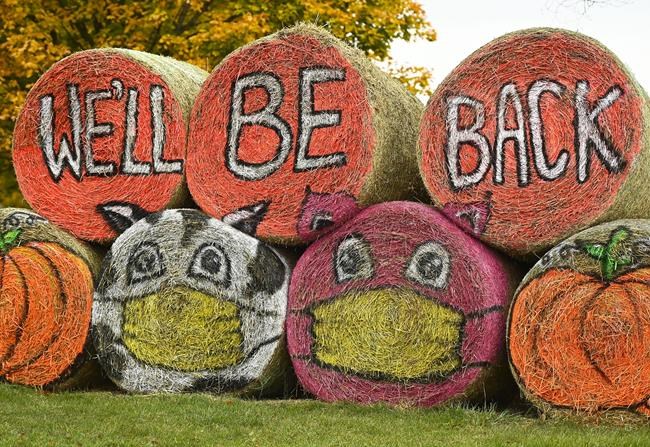
“It’s going to be a balance of thinking about (limiting) risk to keep other members of our society safe while still being able to enjoy some of the social activities involved with being a kid.”
This report by The Canadian Press was first published Oct. 30, 2020.
Related Articles
Halloween goes ahead in frightening times


Advertisement Advertise With Us
Advertisement Advertise With Us