‘Where people say goodbye… ‘

'Crypt Keeper' says needs of families top priority

Advertisement

Advertise with us

Dave Watts comes face-to-face with death every day.

Read this article for free:

or

Already have an account? Log in here »

To continue reading, please subscribe:

Subscribe and receive a limited-edition Free Press branded hat or tote.

Digital Subscription

One year of digital access for only $205*

  • Enjoy unlimited reading on winnipegfreepress.com
  • Read the E-Edition, our digital replica newspaper
  • Access News Break, our award-winning app
  • Play interactive puzzles

*First annual payment billed as $205.00 + GST for one year. This annual subscription will automatically renew at $233.00 + GST every 52 weeks (10% off the regular annual price of $259.35). Offer available to new and qualified returning subscribers only. Cancel any time.

To continue reading, please subscribe:

Add Free Press access to your Brandon Sun subscription for only an additional

$1 for the first 4 weeks*

  • Enjoy unlimited reading on winnipegfreepress.com
  • Read the E-Edition, our digital replica newspaper
  • Access News Break, our award-winning app
  • Play interactive puzzles
Start now

*Your next Brandon Sun subscription payment will increase by $1.00 and you will be charged $17.95 plus GST for four weeks. After four weeks, your payment will increase to $24.95 plus GST every four weeks.

Opinion

Hey there, time traveller!
This article was published 04/09/2009 (6158 days ago), so information in it may no longer be current.

Dave Watts comes face-to-face with death every day.

The lanky 43-year-old is a groundskeeper and maintenance man at the Shaarey Zedek cemetery, a sprawling Jewish cemetery in the North End. In plain terms, he’s a gravedigger.

He enjoys his job. His grandparents used to manage the cemetery. Watts remembers playing hide-and-seek among the tombstones when he was a kid.
WAYNE.GLOWACKI@FREEPRESS.MB.CA
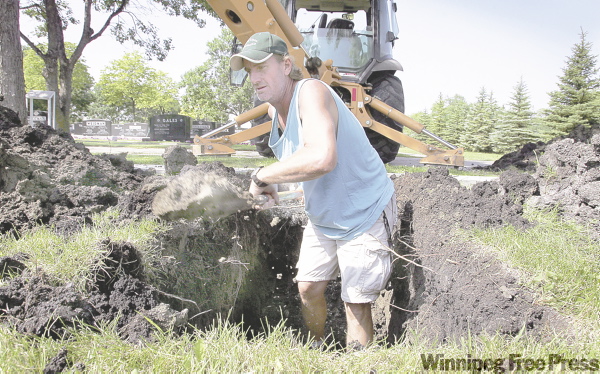
Dave Watts grabs his shovel at the Shaarey Zedek cemetery to tidy up a fresh grave he has roughed out with a backhoe. He admits being moved to tears at some funerals.
WAYNE.GLOWACKI@FREEPRESS.MB.CA Dave Watts grabs his shovel at the Shaarey Zedek cemetery to tidy up a fresh grave he has roughed out with a backhoe. He admits being moved to tears at some funerals.

When he was 14, he was hired to cut the grass at the cemetery.

"Sometimes, when I walk through I smell the flowers and the grass and it reminds me of my childhood," he says, laughing. "Kind of strange, huh?"

He moved on from grass-cutting to a career as a concrete man. He’d pour basements, sidewalks and stairs. It’s physically demanding work that hurts a body. The hours are long. You wear out eventually.

Four years ago, he came back to the cemetery.

"It’s still physical work but it’s a different kind," he says, his soil-caked work boots stretched out. "We have to move stones sometimes. We put a roller in but you have to be really careful. You don’t want to be breaking any stones."

To dig a grave, you start by marking out the plot lines. Watts then shovels a thin outline in the ground. The backhoe digs out most of the dirt.

"A grave is at least six feet by three-and-a-half feet," he explains. "The coffin has to have at least three-and-a-half feet of soil on top. I like to dig down at least six feet."

In warm weather, Watts can dig a grave in under half an hour. When the ground is frozen, it can take two hours of scraping to get below the frost line.

After the machine has done its work, Watts jumps into the grave.

"I finish it by hand. You want to even it out. Make it look nice for the family."

The gravediggers used to line the graves with fake grass. They’ve stopped that practice, although some families want a layer of grass over the coffin.

The needs of the family come up frequently when Watts talks about his job. It’s tough to see the grieving relatives, he says, many of whom he’s seen at other funerals. He does his job with a quiet dignity.

"I don’t start the tractor, putting dirt back over the coffin until the family has left, until the cars are gone," Watts says.

"You have to be careful because you’re burying someone’s family member. If they want to have certain things done, we’ll do them."

Although Watts is not Jewish, he has become aware of Jewish burial traditions through his work.

"I get to know the rabbis," he says. "One thing you have to be very careful of is not to smash the coffins. There’s not supposed to be any metal in them so you can’t just dump soil on top of them."

He admits he has been moved to tears at some funerals.

"There was this one guy, I guess he was about my age. The widow was there with the kids. She was crying so hard. She was laying on the coffin and begging us not to lower it."

He blinks away tears at the memory.

"You can’t forget something like that," he says gruffly.

"There’s one tombstone that says ‘survivor of Auschwitz.’ That kind of things get to you. You wonder who this person was, what they had to go through before they came to Canada."

His hours are regular, eight to 4:30. He sometimes works Sundays. Saturday is the Jewish sabbath and burials are forbidden on that day.

He earns roughly $30,000 a year.

Watts says he gets some teasing about his job.

"A lot of my friends call me the Crypt Keeper," he says with a tight smile. "It’s a job. It’s another day at the office for me. Some people get weirded out about it. Other people say: ‘Oooh, cool!’ It’s not cool. This is where people say goodbye to someone they love."

He still loves wandering through the cemetery. There’s a peacefulness to his workplace.

"If you’re here at night, it’s quiet. It looks so lovely and dark."

His job has convinced him of one thing. He wants to be cremated, not buried.

"I don’t want to be put in the ground like that. Sometimes you’re digging out a grave to bury someone next to their husband or wife. The smell is atrocious. It’s like rotten eggs times 20.

"I’ve gotten sick a few times. You realize what’s actually going on under the soil and the grass."

He doesn’t believe in an afterlife.

"My personal belief is once you’re done, that’s it."

The office phone rings shrilly. A co-worker has locked his keys in his truck and needs rescuing.

"Just another crazy day at the graveyard," Watts says with a smile. "Some days are just like that."

lindor.reynolds@freepress.mb.ca

Report Error Submit a Tip

More Stories

Manitoba MP’s future in the House uncertain over vax status

Dylan Robertson 4 minute read Preview

Manitoba MP’s future in the House uncertain over vax status

Dylan Robertson 4 minute read Thursday, Oct. 21, 2021

OTTAWA — Prime Minister Justin Trudeau says unvaccinated MPs are leaving their constituents in the lurch by pushing back against a COVID-19 immunization mandate on Parliament Hill and virtual sittings.

Meanwhile, the only Manitoba MP to not disclose his vaccination status is headed to Ottawa, amid debates over whether to allow the unvaccinated to take their seats in the House of Commons.

“It is puzzling to me that there are people out there who think, just because they are members of Parliament, they do not need to keep themselves their loved ones, or their constituents safe, when the vast majority of Canadians have done the right thing,” Prime Minister Justin Trudeau told reporters Thursday.

He noted that just outside the parliamentary precinct, people need to show proof of vaccination to enter a restaurant under Ontario rules. Trudeau argued it only makes sense to have the policy for the chamber.

Read
Thursday, Oct. 21, 2021

Canadian AI: What kind, and who will own it

Fred Wilson and Robert Chernomas 5 minute read 2:00 AM CDT

What is it we should fear about AI? That it will take our jobs? Overload our electricity networks and make our own energy needs more expensive? Put scarce freshwater resources at risk? Or is it that it will be unregulated, breach privacy laws and be used for a wide range of perverse purposes?

If Canadians are among the most distrustful of the AI revolution, it isn’t because they are uninformed or technologically regressive. Their reluctance is because there is no plan for Canadian AI guided by an overarching public interest.

To the contrary, the hundreds of AI data centre proposals in Canada are driven by an investor frenzy completely disconnected from Canadian needs or economic and social goals.

A Canadian Press freedom of information request from the federal government revealed that power demands from current proposals total more than 20 GW, a massive capacity comparable to the total power needs of all Canadian households, and 25 times greater than the roughly 850 MW the federal government has projected that known sovereign AI proposals will reach by 2030.

U of M students add malt barley roots to chocolate for nutritious treat

Tiago Resko 4 minute read Preview

U of M students add malt barley roots to chocolate for nutritious treat

Tiago Resko 4 minute read 2:00 AM CDT

The brewing industry isn’t known for being health conscious but, for a team of University of Manitoba students, it was the key to creating a chocolate bar that combines nutrition and indulgence.

Rooties is a proposed product by food sciences students at U of M that upcycles leftover malt barley roots used to brew beer. The malt increases the chocolate bar’s protein and fibre content, making it a more nutritious option for consumers, said Sherwin Santiano, one of four team members who worked on the product.

“It has a chewy sweet layer, and it has malt barley rootlets infused into the chocolate, similar to a Mars Bar,” he said.

Rooties is a finalist in an international food development competition run by Mars Snacking in partnership with the Institute of Food and Technologies Student Association. The annual event, called IFT First, selects groups of students from around the world to develop a product and present it to a panel of judges in Chicago.

Read
2:00 AM CDT

ATV deaths, injuries are call for action

Editorial 4 minute read Preview

ATV deaths, injuries are call for action

Editorial 4 minute read 2:00 AM CDT

The numbers are alarming, and the calls to address them are neither unexpected nor unreasonable. But reducing the rate of injuries and deaths related to the use of all-terrain vehicles will not be easily accomplished.

The death last week of a 59-year-old woman in South Indian Lake, about 770 kilometres north of Winnipeg, was the fifth ATV-related fatality in Manitoba this year — a particularly disturbing statistic in light of the fact 2025 was the deadliest year in more than a decade for ATV riders in this province.

Eleven people lost their lives in ATV accidents last year, according to recently released data, and 227 required hospital care for injuries sustained while operating off-road vehicles. There have been 68 ATV-related deaths in this province since 2017.

All of which has prompted questions about whether it’s time for Manitoba to follow the lead of other provinces that have made ATV safety training mandatory for users of off-road vehicles.

Read
2:00 AM CDT

Cruise control: city mulls move to curb street noise levels

Ben Waldman 4 minute read Preview

Cruise control: city mulls move to curb street noise levels

Ben Waldman 4 minute read Friday, Jan. 17, 2020

Sunday cruise nights on Portage Avenue are a Winnipeg tradition, but cavalcades of convertibles and muscle cars rolling down the street can come with a noisy byproduct.

Next week, the city's executive policy committee will discuss some changes — including noise cameras that capture licence plate data of particularly loud vehicles — aimed at keeping the volume down.

The recommendation, which would require provincial approval, comes on the heels of complaints from area residents about the Sunday night noise levels, says Coun. Cindy Gilroy (Daniel McIntyre).

"Most residents don't mind the cruise nights themselves," she said Thursday. "It's the revving and the screeching" and the modified mufflers.

Read
Friday, Jan. 17, 2020

No parole for 20 years for 2020 torture, murder

Dean Pritchard 6 minute read Preview

No parole for 20 years for 2020 torture, murder

Dean Pritchard 6 minute read Wednesday, Jun. 29, 2022

Born in Bolivia, Gerhard Reimer-Wiebe and his young wife moved to Canada in hopes of building a better life, only to have their dreams dashed in the most horrifying way.

After settling in the Steinbach area, Reimer-Wiebe, struggling with life in a new country and raising a young family, turned to alcohol and drugs.

“I was completely at rock bottom,” Reimer-Wiebe said in a 2018 video recorded for Teen Challenge, a faith-based counselling service he leaned on for help with his addictions.

Reimer-Wiebe rebounded for a time, but relapsed, and by June 2020, the 27-year-old man was staying in a Winnipeg home.

Read
Wednesday, Jun. 29, 2022