Trudeau, Morneau, Telford must resign, or trigger an election: Blanchet

Advertisement

Advertise with us

OTTAWA - Bloc Quebecois Yves-Francois Blanchet said Wednesday his party will force a confidence vote against the Liberal government this fall unless Prime Minister Justin Trudeau, his finance minister and his chief of staff resign.

Read this article for free:


By clicking the button above, an account will be created and you will begin to receive some of our recommended newsletters. You may opt out of any newsletter by visiting your Email and Communication Preferences page or by clicking "unsubscribe" at the bottom of any email.

or

Already have an account? Log in here »

To continue reading, please subscribe:

Digital Subscription

One year of digital access for only $1.44 a week*

  • Enjoy unlimited reading on winnipegfreepress.com
  • Read the E-Edition, our digital replica newspaper
  • Access News Break, our award-winning app
  • Play interactive puzzles

*Billed as $5.77 plus GST every four weeks. After 52 weeks, price increases to the regular rate of $19.95 plus GST every four weeks. Offer available to new and qualified returning subscribers only. Cancel any time.

To continue reading, please subscribe:

Add Free Press access to your Brandon Sun subscription for only an additional

$1 for the first 4 weeks*

  • Enjoy unlimited reading on winnipegfreepress.com
  • Read the E-Edition, our digital replica newspaper
  • Access News Break, our award-winning app
  • Play interactive puzzles
Start now

*Your next Brandon Sun subscription payment will increase by $1.00 and you will be charged $17.95 plus GST for four weeks. After four weeks, your payment will increase to $24.95 plus GST every four weeks.

Hey there, time traveller!
This article was published 12/08/2020 (2271 days ago), so information in it may no longer be current.

OTTAWA – Bloc Quebecois Yves-Francois Blanchet said Wednesday his party will force a confidence vote against the Liberal government this fall unless Prime Minister Justin Trudeau, his finance minister and his chief of staff resign.

But the New Democrats don’t seem ready to back the effort and with 24 MPs, they have enough seats in the House of Commons to be the deciding factor in whether Canada moves toward a fall election in the middle of a pandemic.

Blanchet first made his threat Wednesday morning before a planned sitting of the hybrid House of Commons in Ottawa. He reiterated it later in the Commons, expressing disgust Trudeau hadn’t even bothered to show up.

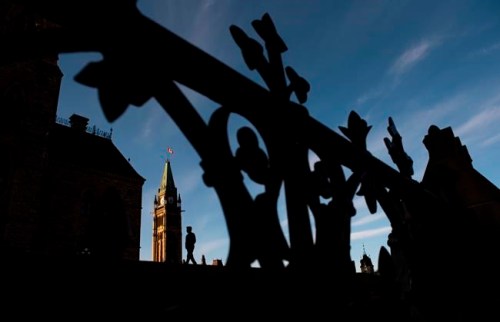
The Peace Tower on Parliament Hill in Ottawa is seen, in the midst of the COVID-19 pandemic, on Saturday, April 18, 2020. Justin Trudeau's ethical conduct will be put under an opposition microscope today during a rare summer sitting of the House of Commons, but the prime minister won't be there. THE CANADIAN PRESS/Justin Tang

Trudeau is on a two-week summer vacation with his family. Blanchet said in French that he had also been on vacation but chose to end it in time to be able to attend, and that Trudeau’s absence sealed the deal on pushing for a fall election.

“We have to ask, is this government still worthy of our confidence and they just gave us the answer,” Blanchet said in French, before storming out of the chamber in a dramatic huff. He later returned for the rest of the question period.

Blanchet earlier told reporters the revelations around the WE Charity controversy — as well as new details about a contract for the commercial rent-relief program that went to a company employing the husband of Katie Telford, who is Trudeau’s chief of staff — prove the Liberal government is no longer trustworthy.

Blanchet said even though the country is still grappling with COVID-19, keeping people in office who are “mismanaging” the government would be more dangerous than sending Canadians to the polls in a pandemic.

Liberal Foreign Affairs Minister Francois-Philippe Champagne shrugged it off as he arrived for Wednesday’s session.

“I’m not concerned about threats,” he said.

Champagne said Canadians are focused on their health and safety and the economic recovery and are not looking to head to the polls during the COVID-19 pandemic.

The Liberals, with 156 seats, are 14 votes shy of a majority in the House of Commons. Blanchet, with 32 MPs, would need the Conservatives’ 121 seats, and either all three Greens and two Independent MPs or at least some of the NDP’s 24 votes to pass a motion of no confidence.

He said he had not yet consulted the other opposition leaders on the matter.

The NDP is not on board at this point.

New Democrat Leader Jagmeet Singh said in a written statement Wednesday that the government can earn confidence by working with the NDP to fix employment insurance and improve child care so people can go back to work.

“Those are the things we will be fighting for and be looking for as we continue to try to make Parliament work,” he said. “Just like we have been throughout the minority Parliament.”

The Conservatives are set to elect a new leader later this month, so a decision on what to do this fall will depend on who wins that race. Alberta Tory MP John Barlow said Wednesday that from his perspective, an election this fall isn’t a good idea.

“Honestly, I don’t think Canadians are ready for an election right now,” he said.

Barlow said the government has a lot to answer for and needs to do a lot to show a strong economic recovery plan this fall, but he said next spring, if the virus is more under control, seems more logical to him for election timing. Having thousands of volunteers going door to door right now does not seem safe, Barlow added.

The Conservatives and Bloc focused much of their time during 95 minutes of questions Wednesday on the government’s various ethical issues. Conservative House Leader Candice Bergen at one point said Trudeau had set the lowest bar for ethical conduct of any prime minister in Canadian history.

The NDP stuck mainly to questions about the pandemic response, including asking when Canadians will get all the details about what will happen when the Canada Emergency Response Benefit ends later this month. Manitoba NDP MP Daniel Blaikie said Canadians need to have information on what they will receive in September, which he noted is a little more than two weeks away.

The government’s plan is to transfer those on CERB to employment insurance, as well as caregiver and sick leave benefits. Employment Minister Carla Qualtrough said the details will be coming very soon.

Trudeau and Morneau are under investigation by the federal ethics watchdog for possible conflicts of interest arising from the government’s decision to hand administration of a student grant program to WE Charity.

Both Trudeau and Morneau have close family connections to the WE organization and have apologized for not recusing themselves from the decision.

Trudeau’s office points out that the prime minister has already testified at length about the controversy before the Commons finance committee, as have Morneau, other ministers and senior bureaucrats.

Morneau attended the House of Commons sitting virtually and responded to a question from Conservative Leader Andrew Scheer about his political future by saying the government will remain focused on the needs of Canadians in the pandemic.

Wednesday marked Scheer’s final day in the House of Commons as his party’s leader. His successor will be named later this month before the next sitting.

The chamber normally does not sit at all during the summer. Under special procedural rules adopted during the COVID-19 pandemic, the government agreed to have the Commons sit twice in July and twice in August. A confidence vote is not possible during this period.

The House of Commons is currently supposed to resume in full on Sept. 21, which would be Blanchet’s first expected opportunity to raise a motion of no confidence.

This report by The Canadian Press was first published Aug. 12, 2020.

— With files from Stephanie Levitz, Teresa Wright and Joan Bryden.

Note to readers: This is a corrected story. A previous version had the incorrect name for Bloc Quebecois Leader Yves-Francois Blanchet. It also said the Bloc Quebecois needs support from at least one other party to successfully trigger an election.

Report Error Submit a Tip

More Stories

Provincial budget fails to chart new course

Editorial 4 minute read Preview

Provincial budget fails to chart new course

Editorial 4 minute read Wednesday, Apr. 13, 2022

If the 2022 Manitoba budget was intended to provide a lifeline for the Progressive Conservative government, it must surely be considered a failure.

Prior to the budget’s release, Premier Heather Stefanson and her government were teetering on the edge of the political abyss. Manitobans are profoundly unhappy with the government’s performance on most issues, including pandemic management. National polls show Ms. Stefanson is Canada’s least popular premier.

That political context made this budget a high-priority project for the Tories. It was, simply put, their best chance to shed the lingering burden left by former premier Brian Pallister, and rebuild the party brand under a new leader.

Unfortunately, Ms. Stefanson’s first budget remains shackled to the deeply flawed fiscal and political logic that defined the Pallister years. And no single budgetary measure embodies that failure more than the premier’s decision to continue cutting education property taxes.

Read
Wednesday, Apr. 13, 2022

Court ruling concludes Canadian Wheat Board saga

Laura Rance-Unger 4 minute read Preview

Court ruling concludes Canadian Wheat Board saga

Laura Rance-Unger 4 minute read 2:01 AM CDT

It remains to be seen whether the recent court ruling in a lawsuit filed after Canadian Wheat Board’s dissolution in 2012 puts the whole debate to rest, as some no doubt hope.

But either way, the dust has settled on the post-CWB world. The sun still rises and a new generation of farmers on the land only knows by name an institution that for generations influenced every aspect of Prairie grain farming.

The first Rural Revival column I wrote for this newspaper more than 30 years ago was about a thousand farmers from Western Canada demonstrating in support of the Wheat Board. It was in the aftermath of the Western Grain Marketing Panel report, one of several efforts that eventually included a plebiscite to help the federal government decide what to do about a vocal minority of farmers who wanted marketing “freedom.”

The polls at the time suggested about two-thirds of farmers were comfortable enough with the single-desk system for food wheat and barley to keep it around. It served as a counterbalance to canola, which they sold on the open market. They essentially had a dual market.

Read
2:01 AM CDT

Bloc renews call for Trudeau, Morneau to resign

Mia Rabson, The Canadian Press 6 minute read Preview

Bloc renews call for Trudeau, Morneau to resign

Mia Rabson, The Canadian Press 6 minute read Wednesday, Aug. 12, 2020

OTTAWA - Bloc Quebecois Yves-Francois Blanchet said Wednesday his party will force a confidence vote against the Liberal government this fall unless Prime Minister Justin Trudeau, his finance minister and his chief of staff resign.

But the New Democrats don't seem ready to back the effort and with 24 MPs, they have enough seats in the House of Commons to be the deciding factor in whether Canada moves toward a fall election in the middle of a pandemic.

Blanchet first made his threat Wednesday morning before a planned sitting of the hybrid House of Commons in Ottawa. He reiterated it later in the Commons, expressing disgust Trudeau hadn't even bothered to show up.

Trudeau is on a two-week summer vacation with his family. Blanchet said in French that he had also been on vacation but chose to end it in time to be able to attend, and that Trudeau's absence sealed the deal on pushing for a fall election.

Read
Wednesday, Aug. 12, 2020

Human rights museum responds to reopening backlash

Julia-Simone Rutgers 4 minute read Preview

Human rights museum responds to reopening backlash

Julia-Simone Rutgers 4 minute read Thursday, Jul. 29, 2021

The Canadian Museum for Human Rights reopened to fully vaccinated members of the public this week, drawing cries of discrimination from those who have chosen not to get vaccinated against COVID-19.

While the some of the backlash has been “disturbing,” museum CEO Isha Khan said the conflict has opened room for a conversation about human rights during the pandemic.

“We made the decision to open in compliance with that law, really because we’re a public institution and we saw it as our responsibility to open as soon as we could to the public — within the restrictions as they currently are,” Khan said Thursday.

“But it’s really important to us, as the Canadian Museum for Human Rights we have a mandate for human rights education, that we’re trying to ground the conversation in human rights principles.”

Read
Thursday, Jul. 29, 2021

Province’s first female dentist took skill, insight wherever needed

David Sanderson    25 minute read Preview

Province’s first female dentist took skill, insight wherever needed

David Sanderson    25 minute read Saturday, Apr. 3, 2021

Some stories take longer to get around to than others.

In the fall of 2011 I hooked up with Fiona Odlum at an Academy Road Starbucks for a lighthearted feature about people who report on traffic for a living. Odlum, currently a contributor at CBC Saskatchewan, was working for 680 CJOB at the time, clueing rush-hour commuters in on stalls, lane closures and fender-benders they’d be wise to avoid.

Odlum turned the tables at one point by asking a few questions of her own including, “So, what’s your main beat?”

I don’t really have one, I told her, but if pressed, I would probably go with human-interest pieces.

Read
Saturday, Apr. 3, 2021

Has the political wind changed?

Gwynne Dyer 5 minute read 2:01 AM CDT

It has been quite a week. First we had “Lula” – Luiz Inácio da Silva (as nobody but his mother ever called him) – defying everybody’s expectations. After winding up two million votes behind his challenger, Flávio Bolsonaro, in the first round of the Brazilian presidential election, he made a “miraculous” comeback in the second.

It was like a man going into a revolving door behind you and coming out in front. At the end of the first round, Lula was two million votes behind; at the end of the second round on Oct. 25 he was four million votes ahead. So how did he win a fourth term without cheating?

That’s what Bolsonaro claims he did, having fled to the United States; Trump, Flávio’s mentor, hints at the same. But Lula’s victory was not miraculous. He only learned to read when he was 10, and at 80 he still refused to have a mobile phone. His team finally made him get one and use it.

He wouldn’t do social media videos, so they created a WhatsApp channel called Lula’s Army, and made him appear on it at least daily. The channel went from zero to 10.8 million viewers in two weeks, and Lula won.