Ontario government defends back-to-school plan despite contradictions

Advertisement

Advertise with us

TORONTO - Ontario's premier stood by the province's back-to-school plans on Tuesday as federal officials offered up COVID-19-prevention guidelines that appeared to contradict those revealed by provincial officials last week.

Read this article for free:


By clicking the button above, an account will be created and you will begin to receive some of our recommended newsletters. You may opt out of any newsletter by visiting your Email and Communication Preferences page or by clicking "unsubscribe" at the bottom of any email.

or

Already have an account? Log in here »

To continue reading, please subscribe:

Digital Subscription

One year of digital access for only $1.44 a week*

  • Enjoy unlimited reading on winnipegfreepress.com
  • Read the E-Edition, our digital replica newspaper
  • Access News Break, our award-winning app
  • Play interactive puzzles

*Billed as $5.77 plus GST every four weeks. After 52 weeks, price increases to the regular rate of $19.95 plus GST every four weeks. Offer available to new and qualified returning subscribers only. Cancel any time.

To continue reading, please subscribe:

Add Free Press access to your Brandon Sun subscription for only an additional

$1 for the first 4 weeks*

  • Enjoy unlimited reading on winnipegfreepress.com
  • Read the E-Edition, our digital replica newspaper
  • Access News Break, our award-winning app
  • Play interactive puzzles
Start now

*Your next Brandon Sun subscription payment will increase by $1.00 and you will be charged $17.95 plus GST for four weeks. After four weeks, your payment will increase to $24.95 plus GST every four weeks.

Hey there, time traveller!
This article was published 04/08/2020 (2278 days ago), so information in it may no longer be current.

TORONTO – Ontario’s premier stood by the province’s back-to-school plans on Tuesday as federal officials offered up COVID-19-prevention guidelines that appeared to contradict those revealed by provincial officials last week.

Doug Ford’s comments came as Ontario’s 72 publicly funded school boards worked on firming up their proposals to welcome students back to class. While most of those plans have yet to be finalized, a draft set of guidelines from the country’s largest school board suggests sports won’t be a part of the upcoming academic year.

The Progressive Conservative government has come under fire since it unveiled its vision for the coming school year last week. The plan will see students in kindergarten through Grade 8 return to school without any reduction in class sizes, though students will spend the day in a single cohort to limit contact with other pupils.

Most high schoolers will also be in class full-time, though students at two dozen boards across the province will take half their courses online in a bid to curb the spread of the novel coronavirus. Masks will be mandatory for those in Grade 4 and up, while those in Grade 3 and below will be encouraged but not required to wear them.

Both federal public health officials and a panel of experts from leading Ontario pediatric hospitals have said physical distancing is a necessary component of any back-to-school plan, but Ford said Tuesday the province’s current approach is grounded in science and well-able to protect students and staff alike.

“It’s not ‘our’ plan — we went with some of the brightest minds in the world,” Ford said during a news conference in Beamsville, Ont. “They’ve come up with a plan. I respect their plan. They’re the experts. But for the parents who are nervous, I understand.”

Ontario parents have not hesitated to voice their concerns in the days since the plan was released last Thursday, saying the crowded classrooms already prevalent across much of the education system will limit the ability to practise physical distancing.

Canada’s chief public health officer, Dr. Theresa Tam, also appeared to highlight the importance of preserving personal space at schools during a Tuesday briefing on the national COVID-19 response.

“Arrange your school environment, physically and otherwise, so that physical distancing can happen,” Tam said. “Ensure that the number of contacts children and teachers have is minimized.”

The expert panel whose advice formed the basis of the Ontario government’s plan has encouraged physical distancing whenever possible, though with some variations on the now-familiar public health advice.

Dr. Chuck Hui of the Ottawa-based Children’s Hospital of Eastern Ontario previously said a distance of one metre instead of two might be enough among elementary-school students, though two metres is still ideal among older kids.

Other measures contained in the government plan, such as the widespread return to full-time, in-person learning and the use of masks, comply with the guidelines released by CHEO and Toronto’s Hospital for Sick Children.

SickKids did not immediately respond to request for comment on the degree of compliance in the province’s back-to-school strategy.

Alexandra Adamo, spokeswoman for Education Minister Stephen Lecce, said Ontario’s plan was developed with input from “the best medical and scientific leaders in Canada,” including SickKids.

“Our single greatest priority is the safety of students, staff, and their families,” Adamo said in a statement.

The Ministry of Education, meanwhile, said it is working with school boards to finalize and approve detailed return-to-class plans, noting that task should be completed by the end of the week.

A preliminary version of one such plan from the Toronto District School Board spells out some of the changes coming in September.

High school classes, for instance, will be delivered via so-called “quad-mesters” — four terms consisting of two courses a piece.

The TDSB is one of the provincially designated boards that will be allowing secondary-school students to take half their classes online, with courses taught in-person one week being delivered virtually the next.

The board’s plan also states that students will have to do without lockers or school-based sports until further notice.

Dr. Barbara Yaffe, Ontario’s associate chief medical officer of health, said the proposal struck her as “reasonable.”

“It’s not a return to normal — we are still in a pandemic,” Yaffe said Tuesday.

This report by The Canadian Press was first published on Aug. 4, 2020.

Report Error Submit a Tip

More Stories

The volatile U.S. midterms

Allan Levine 5 minute read Preview

The volatile U.S. midterms

Allan Levine 5 minute read 2:00 AM CDT

The last time the Democratic Party had 218 or more seats — the number required to control the U.S. House of Representatives — was from 2021 to 2023, following the election of Democrat Joe Biden as president. During that same period, the Democrats also had the edge in the Senate. Despite a 50-50 split with the Republicans, Democrats were able to control the Senate with the help of Vice-President Kamala Harris, who cast the key vote in a tie. From 2023 to 2025, the Democrats had a slim 51 to 49 Senate majority.

If history repeats itself and the latest polls are fairly accurate, on Tuesday, Nov. 3, the Democratic Party will take back the House and (probably) the Senate from the Republicans, who have controlled both legislative bodies since the 2024 election. In the House, the Democrats have to gain at least three more seats. In the Senate, they have to win four more, which is entirely doable, though they almost certainly have to win a seat in Texas, Ohio, Kansas or Alaska, each of which currently has two Republican senators.

The prospect of a Democratic victory has President Donald Trump in a tizzy. For the past two years, he has abused his executive power to impose illegal tariffs on Canada and other countries; started a war with Iran; cozied up to Russian president Vladimir Putin and turned his back on Ukrainian president Volodymyr Zelenskyy; and increased the national debt through questionable tax cuts — to list only a few of his more egregious actions. He has been able to get away with this mainly because Republicans in the Senate and the House refuse to even question his decisions.

With the Democrats in charge, Trump’s brazen actions won’t be completely halted, but he will face significant legislative challenges and obstacles not easily dismissed. His controversial appointees, such as Attorney General Todd Blanche, who perceives himself as Trump’s private lawyer rather than the legal representative of the people, won’t get a free pass in committee hearings.

Read
2:00 AM CDT

Notable quotes from 2020 Tokyo Olympics

The Canadian Press 3 minute read Sunday, Jul. 25, 2021

Correctional Services Canada is reopening prison farms. But in B.C., where it has no such programs, a wife and her late husband, who killed a man in a botched holdup, started Emma’s Acres, a unique prison farm she hopes to see expanded.

Submit a news tip

1 minute read Monday, Mar. 16, 2026

Submit a news tip

Opera singer David Daniels no longer in singers’ union following sexual assault guilty plea

The Associated Press 2 minute read Preview

Opera singer David Daniels no longer in singers’ union following sexual assault guilty plea

The Associated Press 2 minute read Thursday, Dec. 21, 2023

NEW YORK (AP) — Countertenor David Daniels is no longer a member of the union for singers following his guilty plea to a charge of sexual assault.

The 57-year-old and his husband, Scott Walters, pleaded guilty to sexual assault of an adult, a second-degree felony, in Houston's Harris County District Court on Aug. 4. Their accuser was aspiring opera singer Sam Schultz.

They both were sentenced to eight years’ probation and required to register as sex offenders.

American Guild of Musical Artists spokesperson Alicia Cook said Wednesday that Daniels is no longer a member of the union.

Read
Thursday, Dec. 21, 2023

Ontario stands by back-to-school plan

Michelle McQuigge, The Canadian Press 4 minute read Tuesday, Aug. 4, 2020

TORONTO - Ontario's premier stood by the province's back-to-school plans on Tuesday as federal officials offered up COVID-19-prevention guidelines that appeared to contradict those revealed by provincial officials last week.

Doug Ford's comments came as Ontario's 72 publicly funded school boards worked on firming up their proposals to welcome students back to class. While most of those plans have yet to be finalized, a draft set of guidelines from the country's largest school board suggests sports won't be a part of the upcoming academic year.

The Progressive Conservative government has come under fire since it unveiled its vision for the coming school year last week. The plan will see students in kindergarten through Grade 8 return to school without any reduction in class sizes, though students will spend the day in a single cohort to limit contact with other pupils.

Most high schoolers will also be in class full-time, though students at two dozen boards across the province will take half their courses online in a bid to curb the spread of the novel coronavirus. Masks will be mandatory for those in Grade 4 and up, while those in Grade 3 and below will be encouraged but not required to wear them.

A fond farewell to the Hercules

Editorial 4 minute read Preview

A fond farewell to the Hercules

Editorial 4 minute read 2:00 AM CDT

Fans at the NHL’s outdoor Heritage Classic game last weekend were no doubt thrilled by the sight and sound of two CF-18 Hornet fighter jets conducting a flyover at Princess Auto Stadium shortly before the puck was dropped for the much-anticipated Winnipeg Jets/Montreal Canadiens matchup.

Flyovers such as these always create a spectacular scene, as the speed and power of the jets are on full display for the brief moments they’re in view above the stadium bowl. But fans who maintained their skyward gaze for a few seconds after the Hornets’ blink-and-you’ll-miss-it appearance were treated to a much more poignant aeronautical exhibition, as a CC-130H Hercules aircraft passed over the stadium in the fighter jets’ wake.

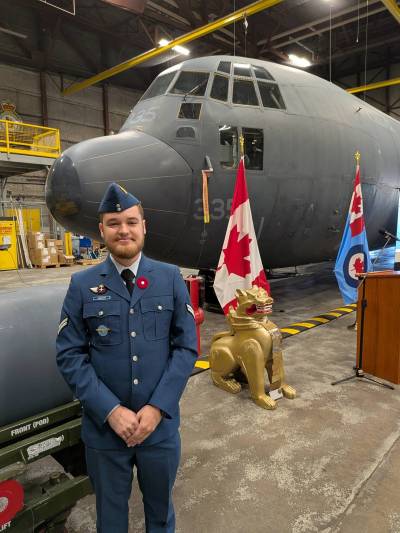
Compared to the supersonic CF-18s, the massive, propeller-driven transport plane probably seemed to be doing more of a “crawl-over”; what most folks at the outdoor game probably didn’t realize, however, was that this was almost certainly the last time they’ll see one of these ubiquitous Canadian Forces aircraft in the sky.

The CC-130H is being retired after more than half a century as the RCAF’s combat, rescue and transport workhorse. The “Herc” will be replaced by more modern aircraft, including the smaller and more nimble CC-295 Kingfisher, which will be used for search-and-rescue missions out of 17 Wing Winnipeg, beginning next month.

Read
2:00 AM CDT