How risky is flying during the coronavirus pandemic?

Advertisement

Advertise with us

How risky is flying during the coronavirus pandemic?

Read this article for free:


By clicking the button above, an account will be created and you will begin to receive some of our recommended newsletters. You may opt out of any newsletter by visiting your Email and Communication Preferences page or by clicking "unsubscribe" at the bottom of any email.

or

Already have an account? Log in here »

To continue reading, please subscribe:

Digital Subscription

One year of digital access for only $1.44 a week*

  • Enjoy unlimited reading on winnipegfreepress.com
  • Read the E-Edition, our digital replica newspaper
  • Access News Break, our award-winning app
  • Play interactive puzzles

*Billed as $5.77 plus GST every four weeks. After 52 weeks, price increases to the regular rate of $19.95 plus GST every four weeks. Offer available to new and qualified returning subscribers only. Cancel any time.

To continue reading, please subscribe:

Add Free Press access to your Brandon Sun subscription for only an additional

$1 for the first 4 weeks*

  • Enjoy unlimited reading on winnipegfreepress.com
  • Read the E-Edition, our digital replica newspaper
  • Access News Break, our award-winning app
  • Play interactive puzzles
Start now

*Your next Brandon Sun subscription payment will increase by $1.00 and you will be charged $17.95 plus GST for four weeks. After four weeks, your payment will increase to $24.95 plus GST every four weeks.

Hey there, time traveller!
This article was published 30/06/2020 (2307 days ago), so information in it may no longer be current.

How risky is flying during the coronavirus pandemic?

Flying can increase your risk of exposure to infection, but airlines are taking some precautions and you can too.

Air travel means spending time in security lines and airport terminals, which puts you into close contact with other people. As travel slowly recovers, planes are becoming more crowded, which means you will likely sit close to other people, often for hours, which raises your risk.
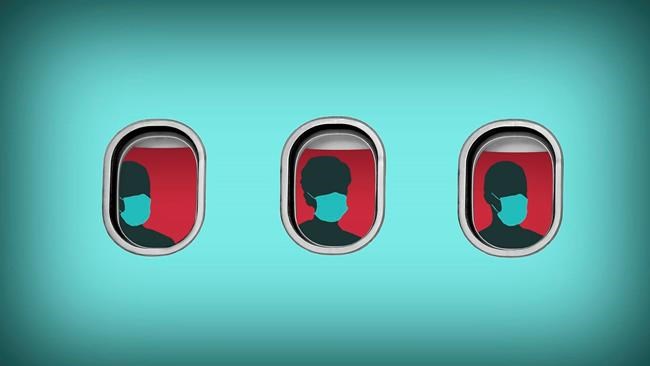
Illustration by Peter Hamlin.;

Once on a plane, most viruses and other germs don’t spread easily because of the way air circulates, according to the U.S. Centers for Disease Control and Prevention. Airlines also say they are focusing on sanitizing the hard surfaces that passengers commonly touch.

Some airlines like Alaska, Delta, JetBlue and Southwest are blocking middle seats or limiting capacity. But even if every middle seat is empty you will likely be closer than the recommended distance of 6 feet to another passenger now that planes are getting fuller.

American, United and Spirit are now booking flights to full capacity when they can. All leading U.S. airlines require passengers to wear masks. Lauren Ancel Meyers, an expert in disease outbreaks at the University of Texas, says that can help limit risk.

For air travel, and all other types of transportation, the CDC recommends washing your hands, maintaining social distancing and wearing face coverings.

Several airlines announced Monday that they will ask passengers about possible COVID-19 symptoms and whether they have been in contact with someone who tested positive for the virus in the previous two weeks.

Still, Meyers said you still might consider whether you need to be on that plane. “We should all be in the mindset of ‘only if necessary’ and always taking the most precautions we can to protect ourselves and others,” she said.

___

The AP is answering your questions about the coronavirus in this series. Submit them at: FactCheck@AP.org.

Read previous Viral Questions:

Who would be the first to get a COVID-19 vaccine?

Is it safe to form a COVID-19 “support bubble” with friends?

Is it safe to stay in hotels as reopenings get underway?

Report Error Submit a Tip

More Stories

MPI must evolve to ‘best-in-class’

Kyle Ross 5 minute read 2:02 AM CDT

As a Manitoban, you pay the lowest auto insurance rates in Canada in 2026. (That’s the analysis shared in the Saskatchewan Auto Fund’s 2026 Rate Proposal, in case having your good fortune envied by your neighbours sweetens the news.)

You deal directly with one insurance company — your own — after your vehicle gets hit, rather than chasing the other driver’s company. When it comes to fair and transparent customer service, your insurer has a higher bar to jump than in many other provinces. A private insurance company could just hike your rates; before making rate changes, Manitoba Public Insurance must go through an open and transparent public hearing at the Public Utilities Board, a neutral third party.

It’s worth remembering these points as MPI is slammed in opinion columns, social media posts and water-cooler talk. We have rates and an ease of navigating claims that other Canadians envy. We have a crown corporation that is a crown jewel — or could be.

But the criticism is warranted.

Alberta: More federalist than you thought

David McLaughlin 5 minute read Preview

Alberta: More federalist than you thought

David McLaughlin 5 minute read 2:02 AM CDT

Avert your eyes if you don’t like hard-core. This is a hard-core column about the hard-core Alberta separatists who hijacked a party, corrupted a process and failed in their fevered fervour to break up Canada.

First, be of good cheer. Canada won Monday night’s referendum in Alberta. Decisively. Three-quarters of the votes cast were for Option 1: “Alberta should remain a province of Canada.” Only one in four Alberta voters opted for a referendum on separation.

Alberta won, too. That strong vote against separation means the province can look ahead, confident the independence fever dream is boxed. A true win-win and a sad rarity in politics these days.

Be warned, though. Those hard-core separatists are hard dogs to keep on the porch, as the expression goes. They are already agitating to be taken more seriously than the votes warrant. They intend to flex whatever muscle memory remains to depose Premier Danielle Smith from her leadership of the United Conservative Party. Dis-united Conservative Party, anyone?

Read
2:02 AM CDT

Federal carbon tax unconstitutional: Alberta court

Bob Weber, The Canadian Press 5 minute read Preview

Federal carbon tax unconstitutional: Alberta court

Bob Weber, The Canadian Press 5 minute read Monday, Feb. 24, 2020

EDMONTON - The Alberta Court of Appeal gave opponents of the federal carbon tax their first win on Monday when it ruled that the levy is unconstitutional.

In a 4-1 decision, the Appeal Court said the legislation that brought in the tax erodes provincial jurisdiction.

"The act is a constitutional Trojan Horse," said a portion of the decision written by three of the four majority justices.

"Almost every aspect of the provinces' development and management of their natural resources ... would be subject to federal regulation."

Read
Monday, Feb. 24, 2020

Cup parade? How about a funeral procession instead?

Mike McIntyre 7 minute read Preview

Cup parade? How about a funeral procession instead?

Mike McIntyre 7 minute read Thursday, Feb. 21, 2019

The first step, it's been said, is admitting you have a problem.

And what had been bubbling near the surface for the Winnipeg Jets came to a full-blown boil Wednesday night in Colorado. Embarrassing. Pathetic. Inept. Those were just a few of the words that came to mind after watching the debacle in Denver.

Turns out I was being kind in my assessment of a 7-1 loss to the Avalanche, which included getting lit up for five goals in the final period. That prompted goalie Connor Hellebuyck — completely thrown to the wolves by his teammates — to smash his stick in half after Colorado converted the touchdown with 34 seconds left in the game. It wasn't a good look for anyone, even if it perfectly summed up the current state of affairs.

"It looked like we kind of gave up," said Blake Wheeler in a damning indictment of the team he captains.

Read
Thursday, Feb. 21, 2019

Piece of magic history disappears

Kelly-Anne Riess 5 minute read Preview

Piece of magic history disappears

Kelly-Anne Riess 5 minute read Monday, Oct. 12, 2026

A piece of Winnipeg’s magic history has vanished, and internationally renowned escape artist Dean Gunnarson is offering a $500 reward to anyone who can make it reappear.

The plaque marked the birthplace of what has become the world’s largest organization of professional and amateur magicians, the International Brotherhood of Magicians, which was founded in Winnipeg more than a century ago.

Gunnarson said fellow magician and local magic historian Bruce Thompson discovered the disappearance Tuesday while on his way to work.

Thompson returned to inspect the site and found what appeared to be evidence it had been forcibly removed.

Read
Monday, Oct. 12, 2026

Winnipeg ER nurse shares her account of the fight against COVID-19

Dan Lett 9 minute read Preview

Winnipeg ER nurse shares her account of the fight against COVID-19

Dan Lett 9 minute read Monday, Apr. 6, 2020

She's a veteran nurse at a Winnipeg hospital who has seen her fair share of medical emergencies. But nothing in her past could have prepared her for what's unfolding on health care's front lines amid the coronavirus crisis.

There are stringent new safety protocols. There's an omnipresent fear of the unknown. It's all become part of the new, frightening reality for Manitoba health-care employees — the foot soldiers in this pandemic fight.

The nurse worked back-to-back shifts last weekend at a Winnipeg ER. The woman, who has requested anonymity, shared her first-person account with columnist Dan Lett.

Heightened anxiety:I was very anxious going into this weekend. I felt like I was going into my first job. I was physically terrified about going into the hospital because of what I was reading and what was going on, and what I perceived was going on. I felt sick, like I was going to pass out. I’m sure my heart rate must have been 140. I don’t think I’ve ever been physically scared in my job and I have seen some violent patients in the emergency over the years.

Read
Monday, Apr. 6, 2020