Health experts urge caution as big business demands loosening of travel rules

Advertisement

Advertise with us

Health experts are urging caution after business leaders called on Prime Minister Justin Trudeau and provincial premiers to ease air travel restrictions amid the COVID-19 pandemic.

Read this article for free:


By clicking the button above, an account will be created and you will begin to receive some of our recommended newsletters. You may opt out of any newsletter by visiting your Email and Communication Preferences page or by clicking "unsubscribe" at the bottom of any email.

or

Already have an account? Log in here »

To continue reading, please subscribe:

Digital Subscription

One year of digital access for only $1.44 a week*

  • Enjoy unlimited reading on winnipegfreepress.com
  • Read the E-Edition, our digital replica newspaper
  • Access News Break, our award-winning app
  • Play interactive puzzles

*Billed as $5.77 plus GST every four weeks. After 52 weeks, price increases to the regular rate of $19.95 plus GST every four weeks. Offer available to new and qualified returning subscribers only. Cancel any time.

To continue reading, please subscribe:

Add Free Press access to your Brandon Sun subscription for only an additional

$1 for the first 4 weeks*

  • Enjoy unlimited reading on winnipegfreepress.com
  • Read the E-Edition, our digital replica newspaper
  • Access News Break, our award-winning app
  • Play interactive puzzles
Start now

*Your next Brandon Sun subscription payment will increase by $1.00 and you will be charged $17.95 plus GST for four weeks. After four weeks, your payment will increase to $24.95 plus GST every four weeks.

Hey there, time traveller!
This article was published 19/06/2020 (2326 days ago), so information in it may no longer be current.

Health experts are urging caution after business leaders called on Prime Minister Justin Trudeau and provincial premiers to ease air travel restrictions amid the COVID-19 pandemic.

Paul Pottinger, professor of infectious diseases at the University of Washington’s School of Medicine, says big business should follow the lead of Health Canada and the World Health Organization, which has highlighted a surge of infections in parts of the U.S. and China due to more relaxed lockdown rules.

“The virus does not care whether people are upset, taking a hit to their bottom line,” Pottinger said.
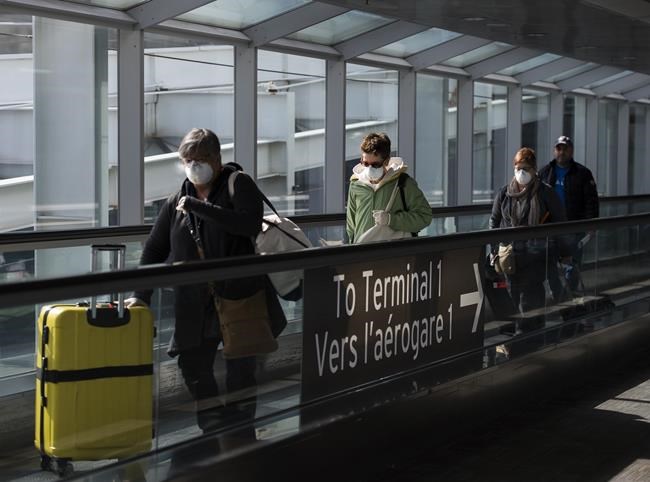
People leave the terminal after arriving at Pearson International Airport in Toronto on Monday, March 16, 2020. Health experts are urging caution after business leaders called on Prime Minister Justin Trudeau and provincial premiers to ease air travel restrictions. Passengers on international flights must self-isolate for 14 days upon arrival in Canada and interprovincial travel is banned in five provinces. THE CANADIAN PRESS/Nathan Denette

“The virus does not care what country you’re from, what time zone you cross, it’s just there as a threat.”

CEOs from 27 major Canadian companies wrote an open letter Thursday asking for a “measured” reopening of the skies that would see travel resume across all provinces and between select countries, though none were identified.

Passengers on international flights must self-isolate for 14 days on arrival in Canada and interprovincial travel is banned in Manitoba and the Maritimes and discouraged elsewhere.

The demand by the business community comes as provinces begin to ease confinement measures, reopening stores, restaurants and schools and allowing larger social gatherings.

Lower travel barriers may be reasonable, but as communities open up they become more vulnerable, Pottinger said, particularly as students return to the classroom in September.

While Canada has extended its U.S. border shutdown until July 21, many European countries including France and Germany are reopening their borders to fellow European travellers.

The risk of air travel lies in both the packed confines of the plane and the potential for spreading the disease to new communities after touchdown.

“Once it’s in the cabin, it’s difficult to stop air moving around,” said Tim Sly, an epidemiologist and professor emeritus at Ryerson University’s School of Public Health.

Transport Canada requires passengers to wear masks on all flights, and temperature checks will soon be obligatory for all international passengers as well as those flying within the country, with screening stations to be set up at 15 airports by September.

Though face coverings and frequent cabin cleaning go a long way to cut down on risk, hygiene protocols are not foolproof and studies have shown the temperature screenings fail to detect a high percentage of those carrying the virus.

Sly and Pottinger say they support a gradual easing of air travel restrictions on countries with low infection rates, but note that the epidemic can flare up quickly and only a small fraction of Canadians have immunity.

Unexpected surges have occurred in remote communities such as La Loche, Sask., and the Campbellton region of New Brunswick. A fresh outbreak in Beijing has prompted a second set of partial lockdowns as schools were closed and hundreds of thousands of residents deemed at risk were barred from leaving the city.

“Imagine that psychological setback, having been released into the world, blinking in the sunshine, and suddenly they blow a whistle and say, ‘No, back into your basement hole and we’ll nail the lid shut,'” Sly said.

He added that he would be willing to fly, but would avoid washrooms and select a window seat for minimal contact.

“And I would wear a baseball cap to protect from droplets falling down to your eyes,” where receptors can potentially pick up the virus, he said.

Some passengers will “inevitably” touch shared armrests or lower their mask to eat, making physical distancing on board all the more important, Pottinger said.

For now, Air Canada and WestJet block the sale of middle or adjacent seats in economy class and throughout the entire plane, respectively. Ultra-low-cost carrier Flair Airlines charges $49 to guarantee an empty adjacent seat.

“It’s going to drive the price up something incredible,” said John McKenna, who heads the Air Transport Association of Canada, which counts 30 regional carriers as members.

“There is a recovery plan underway. But all of that is fruitless unless they do away with the 14-day period. Because no one’s going to travel if they have to be isolated for 14 days.”

Airlines are scrambling to claw back a piece of domestic and transatlantic travel before the summer tourism season fades. Italy, France and Germany, where infection rates are declining, are on the list of countries that should be dropped from Canada’s quarantine list, McKenna said.

“No one knows if it will be a second wave or if we are really looking at a sustained, long crest,” Pottinger said. “But air travel is going to remain one of those activities that will be at increased risk.”

This report by The Canadian Press was first published June 19, 2020.

Companies in this story: (TSX:AC)

Report Error Submit a Tip

More Stories

Today’s horoscope

Georgia Nicols 4 minute read Preview

Today’s horoscope

Georgia Nicols 4 minute read 2:00 AM EST

MOON ALERT: There are no restrictions to shopping or important decisions today. The moon is in Leo.

ARIES (March 21-April 19)

Avoid disputes about shared property, inheritances, taxes, debt and insurance issues. This might also include shared expenses. Just coast. Parents should be vigilant about their kids. Social plans might suddenly change. It’s a good day to make art.

TAURUS (April 20-May 20)

Read
2:00 AM EST

Haunted houses aren’t the only places to find jump scares

Jen Zoratti 3 minute read Preview

Haunted houses aren’t the only places to find jump scares

Jen Zoratti 3 minute read Yesterday at 2:01 AM CDT

C’est l’Halloween, to quote the 1981 elementary school French class banger by Matt Maxwell, but you know what’s already plenty scary? Life.

We all have our personal haunted houses, so to speak, hence the popularity of the “a haunted house but it’s just…” meme that pops up every October. Sample: “a haunted house but it’s just a bunch of men telling you you’d be prettier if you smiled.”

In the spirit of the season, I thought I’d offer up a few jump scares of my own.

A haunted house but it’s just Gate E25

Read
Yesterday at 2:01 AM CDT

The long and winding road

Editorial 4 minute read Preview

The long and winding road

Editorial 4 minute read Yesterday at 2:01 AM CDT

As theatre goes, it sent a strong message.

Manitoba Premier Wab Kinew, standing in front of microphones and television cameras, holding up his Indigenous status card and saying that he didn’t feel Canada should have “a race-based form of identification in this country, but that is a reality,” adding that it was time to abolish the Indian Act.

“I think it’s time to abolish the Indian Act, get rid of the Indian Act, move past the Indian Act, and it needs to be done with First Nations people and First Nations governments, of course. I think it’s long overdue that we have a relationship with Indigenous Peoples in Canada that reflects who we are as Canadians today,” he said.

The Indian Act — the name alone suggests how out-dated and out of place the law has become. Originally dating from 1876, the law was put in place to “amend and consolidate the laws respecting Indians” and gave the Minister of the Interior the responsibility to “control and management of the reserves, lands, moneys and property of Indians in Canada.”

Read
Yesterday at 2:01 AM CDT

Say What?! Sports guys travel to new destination

Steve Lyons and Paul Wiecek 16 minute read Preview

Say What?! Sports guys travel to new destination

Steve Lyons and Paul Wiecek 16 minute read Thursday, Jan. 30, 2020

Say What?! is an email conversation between sports editor Steve Lyons and sports columnist Paul Wiecek. Look for us regularly but intermittently on the Free Press website.


Steve Lyons: Heya. How you doing? How’s 2020 treating you so far?

Few things to get us started:

Read
Thursday, Jan. 30, 2020

Go with the snow

Eva Wasney 6 minute read Preview

Go with the snow

Eva Wasney 6 minute read Tuesday, Feb. 8, 2022

Wearing a dusty pink snowsuit and a face mask emblazoned with colourful Dala horses, Sonja Lundstrom is excited.

“This is going to be my 80th birthday present to myself,” she says, pointing to a nearby wooden kicksled poised for takeoff. “My grandma had one of these and my dad made me one out of hockey sticks for all my children… but these are the new modern ones and I haven’t had one of those.”

But today’s frosty jaunt is less of a test drive and more of a diplomatic adventure. Lundstrom is the president of the Swedish Cultural Association of Manitoba and is at The Forks to give Urban Ahlin, the Swedish Ambassador to Canada, a little taste of home.

“In my part of Sweden we use the (kicksleds) when we go out on the ice for ice fishing,” says Ahlin, who was in town recently with several other Nordic ambassadors to meet with the premier. “This is a very climate-friendly means of transportation and you can use it for lots of different reasons… it’s actually pretty fun to ride as well.”

Read
Tuesday, Feb. 8, 2022

Has the political wind changed?

Gwynne Dyer 5 minute read Yesterday at 2:01 AM CDT

It has been quite a week. First we had “Lula” – Luiz Inácio da Silva (as nobody but his mother ever called him) – defying everybody’s expectations. After winding up two million votes behind his challenger, Flávio Bolsonaro, in the first round of the Brazilian presidential election, he made a “miraculous” comeback in the second.

It was like a man going into a revolving door behind you and coming out in front. At the end of the first round, Lula was two million votes behind; at the end of the second round on Oct. 25 he was four million votes ahead. So how did he win a fourth term without cheating?

That’s what Bolsonaro claims he did, having fled to the United States; Trump, Flávio’s mentor, hints at the same. But Lula’s victory was not miraculous. He only learned to read when he was 10, and at 80 he still refused to have a mobile phone. His team finally made him get one and use it.

He wouldn’t do social media videos, so they created a WhatsApp channel called Lula’s Army, and made him appear on it at least daily. The channel went from zero to 10.8 million viewers in two weeks, and Lula won.