Air travellers to be checked for fevers at Canadian airports

Advertisement

Advertise with us

OTTAWA - Air travellers will need to have their temperatures checked before they're allowed to board planes but the system will take months to set up, Transport Minister Marc Garneau said Friday.

Read this article for free:


By clicking the button above, an account will be created and you will begin to receive some of our recommended newsletters. You may opt out of any newsletter by visiting your Email and Communication Preferences page or by clicking "unsubscribe" at the bottom of any email.

or

Already have an account? Log in here »

To continue reading, please subscribe:

Digital Subscription

One year of digital access for only $1.44 a week*

  • Enjoy unlimited reading on winnipegfreepress.com
  • Read the E-Edition, our digital replica newspaper
  • Access News Break, our award-winning app
  • Play interactive puzzles

*Billed as $5.77 plus GST every four weeks. After 52 weeks, price increases to the regular rate of $19.95 plus GST every four weeks. Offer available to new and qualified returning subscribers only. Cancel any time.

To continue reading, please subscribe:

Add Free Press access to your Brandon Sun subscription for only an additional

$1 for the first 4 weeks*

  • Enjoy unlimited reading on winnipegfreepress.com
  • Read the E-Edition, our digital replica newspaper
  • Access News Break, our award-winning app
  • Play interactive puzzles
Start now

*Your next Brandon Sun subscription payment will increase by $1.00 and you will be charged $17.95 plus GST for four weeks. After four weeks, your payment will increase to $24.95 plus GST every four weeks.

Hey there, time traveller!
This article was published 12/06/2020 (2333 days ago), so information in it may no longer be current.

OTTAWA – Air travellers will need to have their temperatures checked before they’re allowed to board planes but the system will take months to set up, Transport Minister Marc Garneau said Friday.

The measure is meant to keep COVID-19 from spreading as more people start flying again.

Garneau said the requirement will be phased in, starting with people boarding planes bound for Canada at the end of June. It will expand to the country’s four largest airports (in Toronto, Montreal, Vancouver and Calgary) by the end of July, and then 11 more airports serving mostly domestic travellers at the end of September.

Prime Minister Justin Trudeau holds a press conference at Rideau Cottage amid the COVID-19 pandemic in Ottawa on Friday, June 12, 2020. THE CANADIAN PRESS/Sean Kilpatrick

The order for travellers heading into Canada from abroad is easy for the government to impose: airlines, many of which are already conducting such checks, are responsible for them. Within Canada, the checks will be done by the Canadian Air Transport Security Authority.

“It will take us a little longer to purchase the equipment, set up the procedures, so we can screen people when they are departing on domestic flights,” Garneau said.

He said if a first check finds a would-be traveller has a fever, his or her temperature will be taken again in 10 minutes. Anyone found with a fever in both checks will not be allowed to fly and will be told to try again in 14 days.

“That’s an arbitrary but prudent amount of time,” Garneau said.

“We’re working with the airlines, the intention is that the rebooking would not be more expensive but just be a rebooking to a different date.”

Other costs associated with delaying a flight by two weeks will be up to travellers, however.

Canada has rules against allowing people on planes who have obvious symptoms of the novel coronavirus and screening forms meant to get travellers to self-report the possibility they are sick. But it has not been actively checking flyers for fevers, as many other countries have.

Not everyone with COVID-19 has a fever and not everyone with a fever has COVID-19 but Garneau said the fever checks add an extra layer of safety for others on planes and for people at travellers’ destinations.

This report by The Canadian Press was first published June 12, 2020.

Report Error Submit a Tip

More Stories

Say What?! Sports guys travel to new destination

Steve Lyons and Paul Wiecek 16 minute read Preview

Say What?! Sports guys travel to new destination

Steve Lyons and Paul Wiecek 16 minute read Thursday, Jan. 30, 2020

Say What?! is an email conversation between sports editor Steve Lyons and sports columnist Paul Wiecek. Look for us regularly but intermittently on the Free Press website.


Steve Lyons: Heya. How you doing? How’s 2020 treating you so far?

Few things to get us started:

Read
Thursday, Jan. 30, 2020

RRC Polytech program cuts take bite out of hospitality, tourism sector

Maggie Macintosh 4 minute read Preview

RRC Polytech program cuts take bite out of hospitality, tourism sector

Maggie Macintosh 4 minute read Saturday, May. 2, 2026

Manitoba’s tourism industry is bracing for the disappearance of hospitality training programs — once-popular courses among international students.

Citing budgetary challenges related to a shift in federal immigration policy, Red River College Polytechnic is scrapping 11 programs and scaling back three others in 2026-27. Its hospitality business management diploma is one of seven permanent casualties.

The announcement, while unsurprising, is but the latest blow to a sector trying to “build back the workforce” in the wake of the COVID-19 pandemic, said Michael Juce, president of the Manitoba Hotel Association.

“Are people going to go outside of Manitoba for training? And if they leave, are they going to come back?” Juce said, adding that rural hotels in particular are already grappling with staffing shortages.

Read
Saturday, May. 2, 2026

Taxi and ride-hailing services receive 58 complaints since March

Jessica Botelho-Urbanski 5 minute read Preview

Taxi and ride-hailing services receive 58 complaints since March

Jessica Botelho-Urbanski 5 minute read Friday, Aug. 17, 2018

The City of Winnipeg has fielded 58 formal complaints about vehicle-for-hire operations since taking over industry oversight from the province in March.

According to freedom of information request results, the city mostly received complaints about taxi operations, and the two largest companies – Duffy’s Taxi and Unicity Taxi – were the main culprits.

From March 1, 2018 to July 13, 2018, the Winnipeg Parking Authority received 20 complaints about Duffy’s, mostly to do with driver road habits (five complaints), driver conduct (three), service refusal (three) or poor service (three), among other issues.

During the same period, Unicity had 19 complaints, five of them related to poor service and three about driver conduct, plus other misdeeds.

Read
Friday, Aug. 17, 2018

Haunted houses aren’t the only places to find jump scares

Jen Zoratti 3 minute read Preview

Haunted houses aren’t the only places to find jump scares

Jen Zoratti 3 minute read Yesterday at 2:01 AM CDT

C’est l’Halloween, to quote the 1981 elementary school French class banger by Matt Maxwell, but you know what’s already plenty scary? Life.

We all have our personal haunted houses, so to speak, hence the popularity of the “a haunted house but it’s just…” meme that pops up every October. Sample: “a haunted house but it’s just a bunch of men telling you you’d be prettier if you smiled.”

In the spirit of the season, I thought I’d offer up a few jump scares of my own.

A haunted house but it’s just Gate E25

Read
Yesterday at 2:01 AM CDT

Go with the snow

Eva Wasney 6 minute read Preview

Go with the snow

Eva Wasney 6 minute read Tuesday, Feb. 8, 2022

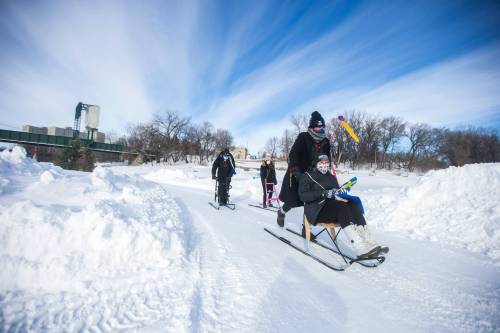
Wearing a dusty pink snowsuit and a face mask emblazoned with colourful Dala horses, Sonja Lundstrom is excited.

“This is going to be my 80th birthday present to myself,” she says, pointing to a nearby wooden kicksled poised for takeoff. “My grandma had one of these and my dad made me one out of hockey sticks for all my children… but these are the new modern ones and I haven’t had one of those.”

But today’s frosty jaunt is less of a test drive and more of a diplomatic adventure. Lundstrom is the president of the Swedish Cultural Association of Manitoba and is at The Forks to give Urban Ahlin, the Swedish Ambassador to Canada, a little taste of home.

“In my part of Sweden we use the (kicksleds) when we go out on the ice for ice fishing,” says Ahlin, who was in town recently with several other Nordic ambassadors to meet with the premier. “This is a very climate-friendly means of transportation and you can use it for lots of different reasons… it’s actually pretty fun to ride as well.”

Read
Tuesday, Feb. 8, 2022

Has the political wind changed?

Gwynne Dyer 5 minute read Yesterday at 2:01 AM CDT

It has been quite a week. First we had “Lula” – Luiz Inácio da Silva (as nobody but his mother ever called him) – defying everybody’s expectations. After winding up two million votes behind his challenger, Flávio Bolsonaro, in the first round of the Brazilian presidential election, he made a “miraculous” comeback in the second.

It was like a man going into a revolving door behind you and coming out in front. At the end of the first round, Lula was two million votes behind; at the end of the second round on Oct. 25 he was four million votes ahead. So how did he win a fourth term without cheating?

That’s what Bolsonaro claims he did, having fled to the United States; Trump, Flávio’s mentor, hints at the same. But Lula’s victory was not miraculous. He only learned to read when he was 10, and at 80 he still refused to have a mobile phone. His team finally made him get one and use it.

He wouldn’t do social media videos, so they created a WhatsApp channel called Lula’s Army, and made him appear on it at least daily. The channel went from zero to 10.8 million viewers in two weeks, and Lula won.