Parents, educators, experts talk to kids on race amid unrest

Advertisement

Advertise with us

NEW YORK - As an African American parent, Cassandre Dunbar in Charlotte, North Carolina, always knew she and her husband would have “the talk” with their son, the one preparing him for interactions with law enforcement.

Read this article for free:


By clicking the button above, an account will be created and you will begin to receive some of our recommended newsletters. You may opt out of any newsletter by visiting your Email and Communication Preferences page or by clicking "unsubscribe" at the bottom of any email.

or

Already have an account? Log in here »

To continue reading, please subscribe:

Digital Subscription

One year of digital access for only $1.44 a week*

  • Enjoy unlimited reading on winnipegfreepress.com
  • Read the E-Edition, our digital replica newspaper
  • Access News Break, our award-winning app
  • Play interactive puzzles

*Billed as $5.77 plus GST every four weeks. After 52 weeks, price increases to the regular rate of $19.95 plus GST every four weeks. Offer available to new and qualified returning subscribers only. Cancel any time.

To continue reading, please subscribe:

Add Free Press access to your Brandon Sun subscription for only an additional

$1 for the first 4 weeks*

  • Enjoy unlimited reading on winnipegfreepress.com
  • Read the E-Edition, our digital replica newspaper
  • Access News Break, our award-winning app
  • Play interactive puzzles
Start now

*Your next Brandon Sun subscription payment will increase by $1.00 and you will be charged $17.95 plus GST for four weeks. After four weeks, your payment will increase to $24.95 plus GST every four weeks.

Hey there, time traveller!
This article was published 03/06/2020 (2342 days ago), so information in it may no longer be current.

NEW YORK – As an African American parent, Cassandre Dunbar in Charlotte, North Carolina, always knew she and her husband would have “the talk” with their son, the one preparing him for interactions with law enforcement.

But she never dreamed it would be necessary at 5 years old.

“I thought the cops were supposed to help us? Are they only helpful to white people?” he asked after taking in TV coverage of protests and overhearing his parents discuss the deaths of George Floyd, Ahmaud Arbery and Breonna Taylor.
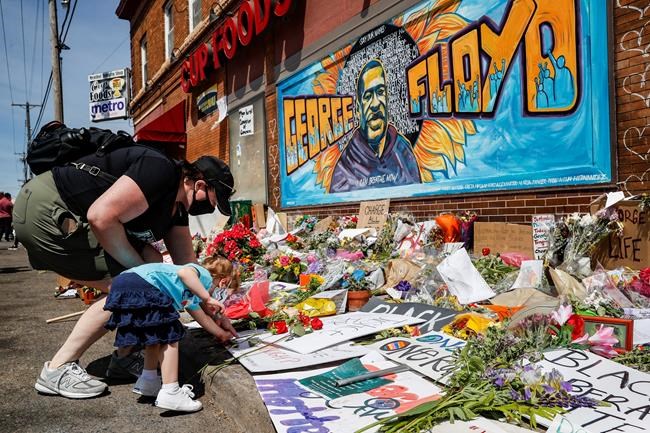
FILE - In this May 31, 2020 file photo, Jessica Knutson and her daughter Abigail, 3, place flowers at a memorial to George Floyd in Minneapolis. After a week of riots and looting over the loss of George Floyd, the Minneapolis black man who died after a police officer pressed his knee into his neck for more than eight minutes as he pleaded for air, parents are struggling to have the talk in this volatile moment, along with many others around race and racism. (AP Photo/John Minchillo, File)

Dunbar explained to her eldest child: “Some people have a hard time understanding that skin colour doesn’t have anything to do with what kind of person you are. I said that, yes, cops are meant to help us all, but some cops aren’t good cops and the bad ones really aren’t helpful to people who look like us.”

Many parents of all races are struggling with similar conversations after a week of outrage and sadness that spilled into streets worldwide after video of Floyd’s death emerged. It came after months of family togetherness in coronavirus lockdown, a time when kids have been cut off from schools and peers.

Floyd, a handcuffed black man, died after a Minneapolis police officer pressed his knee into his neck as he pleaded for air.

To help her kids going forward, Dunbar has been reaching out for guidance from child therapists, early childhood educators and seasoned parents.

How conversations with kids about race and racism play out can be intensely personal for parents. Many white parents in particular believe children are too young for such discussions at age 10 or 11, said Andrew Grant-Thomas, co-founder of Embrace Race, a non-profit that provides resources for parents and educators.

“They think that kids are too naive and fragile and will crumple the moment you even mention the word,” he said. ”By not engaging kids explicitly, essentially you’re leaving them to flounder in this tidal wave of communication about race that they are receiving from a very early age, but without you there to deliberately mediate how they make sense of what they get.”

Howard Stevenson, a clinical psychologist in the Graduate School of Education at the University of Pennsylvania, works with educators and families to understand the trauma and stress of race-based hate. Insights that he offered online in 2016 have been shared by school districts around the country in the past week with parents.

“Both verbal and non-verbal approaches influence what children not only know about race but whether they should speak to it or how they should manage the stress of it,” Stevenson told The Associated Press. “Children watch what their parents don’t do during racial moments as much as what they actually purposely teach.”

He said research shows that the more parents talk to children about race, the more those children “tend to be less overwhelmed by the politics.”

For African American mom Sonya Horton in Brooklyn, New York, that means putting it all on the line for her 11-year-old daughter, Samirah, a budding DJ and anti-bullying activist who attends a predominantly white private school.

The sixth-grader belongs to a school club for black and brown students where they feel free to discuss slights from classmates over things like how they wear their hair, certain foods they particularly like and family traditions.

Of her white classmates, Samirah said: “I feel like they know what racism is but not to the full extent of the meaning of it. I feel like they might think making an inappropriate joke could be racist, but racist could be imitating someone or saying a comment that’s not particularly nice.”

Horton, whose husband is a retired police officer, said they have never “sugar-coated things” for their child.

“I never feel that she’s too young to know or to understand,” Horton said. “We live in a world where it’s out there, and if you’re not open and you’re not talking about it then they may come away with misinformation and miseducation.”

For parents, the first step is checking their own feelings, Stevenson and other experts said. A good second step is listening to the experiences of parents and children of colour without judgment, and accept that racism does exist.

Val Whiting, who is African American and lives in suburban Seattle, said her 19-year-old son, the eldest of two teen boys, has had plenty of practice handling racism in their predominantly white neighbourhood, from racial slurs on the soccer field to a car full of young people shouting the “N-word” before speeding off.

“I wanted to pull out a bazooka and blow up that car full of cowards,” she said. “But we’ve taught him how to make connections and nurture relationships with other people of colour, so he immediately contacted a Facebook group he belongs to in order to share what happened, and get support and guidance. I’m OK with that.”

This artwork released by Kokila Books, an imprint of Penguin Young Readers, shows an illustration from
This artwork released by Kokila Books, an imprint of Penguin Young Readers, shows an illustration from "Antiracist Baby" by Ibram X. Kendi with illustrations by Ashley Lukashevsky. After a week of riots and looting over the loss of George Floyd, the Minneapolis black man who died after a police officer pressed his knee into his neck for more than eight minutes as he pleaded for air, parents are struggling to have the talk in this volatile moment, along with many others around race and racism. (Kokila Books, an imprint of Penguin Young Readers via AP)

In Myrtle Beach, South Carolina, Traci Sumter wouldn’t allow her black 15-year-old son to participate in protests.

“I’ve read threats and horrible comments online by neighbours, teachers and people I had considered friends,” she said. “I cried when I saw the George Floyd video. I cried again when I watched my son watch it. The look of disappointment on his face let me know that he felt the world had failed him. Again.”

Ibram X. Kendi is a National Book Award winner, activist, history professor and founding director of the Antiracist Research and Policy Center at American University.

He’s also dad to 4-year-old Imani.

When his daughter was born, Kendi found few books on race and racism for the very young. He wrote his own, a board book in rhyme out this month from the Penguin Young Readers imprint Kokila Books.

Titled “Antiracist Baby,” it’s one of a surge of titles on racism making their way up the Amazon bestseller list.

“The data points to the fact that children as young as 5 or 6 months begin recognizing race, and children as young as 2 to 3 years old start recognizing or even believing in racist ideas,” Kendi said. “Typically parents don’t even know how to begin to have these conversations with these very, very young people, let alone recognizing the importance of having these conversations.”

Through illustrations by Ashley Lukashevsky, Kendi shows that the first step toward making racial equity a reality is opening your eyes to all skin colours.

“Antiracist Baby learns all the colours, not because race is true,” he writes. “If you claim to be colour-blind, you deny what’s right in front of you.”

At Manhattan’s Little Red School House and Elisabeth Irwin High School, Alisa Soriano is an assistant principal who filled in this week as a first-grade teacher. At the school’s regular classroom morning meetings, the recent protests and deaths were discussed via Zoom.

The progressive school is committed to diversity, equity and inclusion work year-round, so even the youngest children weren’t taken aback, Soriano said.

“When you speak to young children with passion and with respect, and with information that is valid to their lives, they listen,” she said.

___

This story corrects the spelling of Traci Sumter.

Report Error Submit a Tip

More Stories

Has the political wind changed?

Gwynne Dyer 5 minute read Yesterday at 2:01 AM CDT

It has been quite a week. First we had “Lula” – Luiz Inácio da Silva (as nobody but his mother ever called him) – defying everybody’s expectations. After winding up two million votes behind his challenger, Flávio Bolsonaro, in the first round of the Brazilian presidential election, he made a “miraculous” comeback in the second.

It was like a man going into a revolving door behind you and coming out in front. At the end of the first round, Lula was two million votes behind; at the end of the second round on Oct. 25 he was four million votes ahead. So how did he win a fourth term without cheating?

That’s what Bolsonaro claims he did, having fled to the United States; Trump, Flávio’s mentor, hints at the same. But Lula’s victory was not miraculous. He only learned to read when he was 10, and at 80 he still refused to have a mobile phone. His team finally made him get one and use it.

He wouldn’t do social media videos, so they created a WhatsApp channel called Lula’s Army, and made him appear on it at least daily. The channel went from zero to 10.8 million viewers in two weeks, and Lula won.

Teemu Selanne living the good life in southern California

Mike McIntyre 19 minute read Preview

Teemu Selanne living the good life in southern California

Mike McIntyre 19 minute read Friday, Oct. 15, 2021

LAGUNA BEACH — He likes his coffee black. His steak “medium rare plus.” And he’s an extremely generous pour, especially when it comes to a Moscow mule.

His left knee is giving him all sorts of trouble these days, he’s admittedly almost always running behind schedule and his biggest pride and joy are his four children, who keep him and his wife Sirpa hopping with their numerous athletic pursuits.

He is Teemu Selanne, the beloved Winnipeg Jets legend who, you’ll be happy to know, is still living the good life just a stone’s throw from the Pacific Ocean in this little piece of southern California paradise.

Despite being nearly eight years removed from the end of a Hall of Fame hockey career, the Finnish Flash remains a big deal around here. That was clear as we sat down earlier this week for an exclusive chat inside “Selanne’s Steak Tavern” — a high-end eatery he owns that sits along the stunning Pacific Coast Highway.

Read
Friday, Oct. 15, 2021

Today’s horoscope

Georgia Nicols 4 minute read Preview

Today’s horoscope

Georgia Nicols 4 minute read 2:00 AM EST

MOON ALERT: There are no restrictions to shopping or important decisions today. The moon is in Leo.

ARIES (March 21-April 19)

Avoid disputes about shared property, inheritances, taxes, debt and insurance issues. This might also include shared expenses. Just coast. Parents should be vigilant about their kids. Social plans might suddenly change. It’s a good day to make art.

TAURUS (April 20-May 20)

Read
2:00 AM EST

‘We’re just all thankful to have some baseball’

Mike McIntyre 6 minute read Preview

‘We’re just all thankful to have some baseball’

Mike McIntyre 6 minute read Wednesday, Jun. 24, 2020

Driving more than 2,000 kilometres in less than a day might seem like the equivalent of getting a root canal to many. But it's a journey Winnipeg Goldeyes manager Rick Forney was happy to make this week, one that started from his residence in Maryland and ended in his most unusual temporary baseball home of Fargo, N.D.

Unable to play games at Shaw Park this summer owing to COVID-19 restrictions banning large gatherings for sporting events until at least September, the Fish will instead fly in enemy territory. An abbreviated spring training gets underway Thursday followed by an abbreviated 60-game American Association baseball season starting July 3.

Forney's 24th season with the Goldeyes, including the past 15 as skipper, is going to be unlike any other.

"It's not ideal, but it's not a reason to not work. If the Goldeyes are going to operate in any fashion, then I want to be a part of it," Forney said by telephone as he passed the midway point of his solo trek just outside Chicago.

Read
Wednesday, Jun. 24, 2020

SNC planned U.S. move if no deal: documents

Jordan Press and Christopher Reynolds, The Canadian Press 5 minute read Preview

SNC planned U.S. move if no deal: documents

Jordan Press and Christopher Reynolds, The Canadian Press 5 minute read Thursday, Mar. 28, 2019

OTTAWA - SNC-Lavalin warned federal prosecutors last fall about a possible plan to split the company in two, move its offices to the United States and eliminate its Canadian workforce if it didn't get a deal to avoid criminal prosecution, newly obtained documents show.

The documents, part of a PowerPoint presentation obtained by The Canadian Press, describe something called "Plan B" — what Montreal-based SNC might have to do if it can't convince the government to grant a so-called remediation agreement to avoid criminal proceedings in a fraud and corruption case related to projects in Libya.

Under that plan, SNC would move its Montreal headquarters and corporate offices in Ontario and Quebec to the U.S. within a year, cutting its workforce to just 3,500 from 8,717, before eventually winding up its Canadian operations.

“The government of Canada needs to weigh the public interest impact of the prosecution of SNC-Lavalin," the presentation reads.

Read
Thursday, Mar. 28, 2019

Winnipeg novelist's latest offering a riveting fictional account of missionaries' plight

Reviewed by Julienne Isaacs 5 minute read Preview

Winnipeg novelist's latest offering a riveting fictional account of missionaries' plight

Reviewed by Julienne Isaacs 5 minute read Saturday, Sep. 7, 2019

In 1955, five American missionary couples set out to evangelize the Waorani, an Indigenous people group of the Ecuadorian rainforest that had never had contact with the outside world. They dubbed their mission “Operation Auca.”

After a few months of airdropping gifts, the five men — Jim Elliot, Peter Fleming, Nate Saint, Ed McCully and Roger Youderian — opted to set up camp on a beach near a Waorani settlement. Just a few days later, they were all speared to death. Thanks to the swift arrival of a Life magazine photographer, the brutal conclusion to Operation Auca became global news.

In her new novel, Five Wives, Winnipeg writer Joan Thomas tells this story again.

“In the missionaries’ memoirs, ‘God’s leading’ explains almost every impulse,” Thomas writes in a postscript. “I set out to peer behind that, to explore in human terms actions that astonished me.”

Read
Saturday, Sep. 7, 2019