‘Discomfort is part of change’: How to be an ally in fighting anti-black racism

Advertisement

Advertise with us

As protests over the deaths of black people during encounters with police have roiled the United States and Canada, many supporters are eager to take a stand, but run the risk of crowding out black voices on the front lines of the movement.

Read this article for free:


By clicking the button above, an account will be created and you will begin to receive some of our recommended newsletters. You may opt out of any newsletter by visiting your Email and Communication Preferences page or by clicking "unsubscribe" at the bottom of any email.

or

Already have an account? Log in here »

To continue reading, please subscribe:

Digital Subscription

One year of digital access for only $1.44 a week*

  • Enjoy unlimited reading on winnipegfreepress.com
  • Read the E-Edition, our digital replica newspaper
  • Access News Break, our award-winning app
  • Play interactive puzzles

*Billed as $5.77 plus GST every four weeks. After 52 weeks, price increases to the regular rate of $19.95 plus GST every four weeks. Offer available to new and qualified returning subscribers only. Cancel any time.

To continue reading, please subscribe:

Add Free Press access to your Brandon Sun subscription for only an additional

$1 for the first 4 weeks*

  • Enjoy unlimited reading on winnipegfreepress.com
  • Read the E-Edition, our digital replica newspaper
  • Access News Break, our award-winning app
  • Play interactive puzzles
Start now

*Your next Brandon Sun subscription payment will increase by $1.00 and you will be charged $17.95 plus GST for four weeks. After four weeks, your payment will increase to $24.95 plus GST every four weeks.

Hey there, time traveller!
This article was published 03/06/2020 (2343 days ago), so information in it may no longer be current.

As protests over the deaths of black people during encounters with police have roiled the United States and Canada, many supporters are eager to take a stand, but run the risk of crowding out black voices on the front lines of the movement.

Advocates and academics say being an ally extends far beyond sharing hashtags on social media. It’s an ongoing commitment to educating yourself about anti-black racism and your role within it, listening to and amplifying black voices and speaking up when they go unheard.

To understand what it takes to be an ally, The Canadian Press spoke to Kathy Hogarth, associate professor at University of Waterloo’s school of social work; Aklil Noza, health and society student at McMaster University in Hamilton and Dexter Voisin, dean of the University of Toronto’s faculty of social work. Here’s what they had to say:
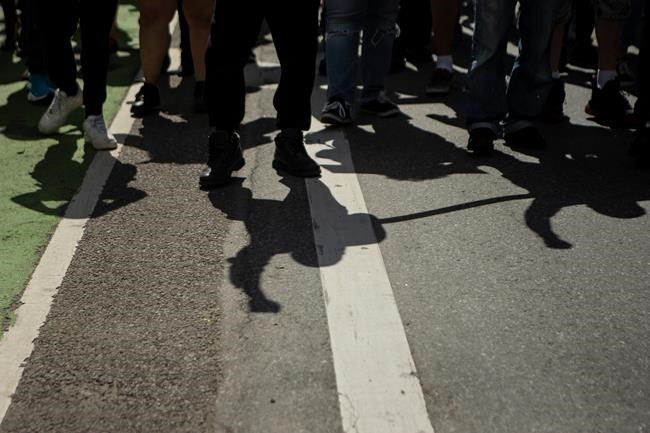
As protests over the deaths of black people during encounters with police have roiled the U.S. and Canada, many supporters are eager to take a stand, but run the risk of crowding out black activists on the front lines of the movement. Demonstrators take part in a rally protesting the death of Regis Korchinski-Paquet in downtown Toronto, Saturday May 30, 2020. Thousands of protesters took to the streets to rally in the aftermath of high-profile, police-involved deaths in both Canada and the United States. THE CANADIAN PRESS/Chris Young

An ally is not a hashtag

Hogarth: An ally is a verb, not a noun. It’s not a tag that we wear. It’s borne out in our actions. I think in our current climate, what is most important is for us to see is that we are standing together in solidarity. That we understand what’s happening in our world not as a black problem, but as all of our problems. So we stand together, because it is only together we will defeat this.

Don’t ask to be taught, take it upon yourself to learn

Hogarth: Half of your work as an ally is doing your homework, doing your own work and not asking those who are victimized to educate you on top of it.

Noza: A quick Google search can save yourself a conversation that may disrupt the grieving process for many black individuals who are in collective mourning at this time and aren’t obligated to be teachers at any point in time.

Don’t take centre stage

Hogarth: Being an ally has limitations. Because you can go home at night and you wear allyship like a pair of jeans, and you can take it off. For those whose bodies are constantly under attack, they don’t have those options of taking it off. So when you wear your allyship badge, I ask that you wear it responsibly. Being an ally does not mean taking the stage. It’s not about you. It’s about dismantling the system.

Listen with compassion

Voisin: What you don’t want to happen is that folks have intellectual curiosity or they look into somebody else’s experience from a voyeuristic standpoint. It’s what some folks call the “pornography of pain” — when you look into someone else’s pain without compassion or empathy…

Don’t patronize by saying, ‘I understand what you mean.’ … Maybe because of the identities and the intersecting identities that a person might hold, they may have experiences that you will never understand or feel or experience. And that’s not really your job.

Amplify black voices

Hogarth: Sometimes as an ally, you just need to pass the mic. Then sometimes as an ally, maybe you’re just a water carrier. And that has to be OK, too. Black bodies have been undergoing centuries of violence. (And that’s) where our allies come in, if you can picture buttressing, pushing from behind, supporting those weary hands as they are risen, and holding your hand up as you hold theirs up.

Use your privilege to speak up for justice

Hogarth: Understand your privilege. It is not about shaming you. The only time you should feel shame about your privilege is when you don’t use it to advance justice…. Understand that when you speak, you are heard in ways that when racialized folks speak, they are not heard. So use your privilege of voice.

Noza: I can be seen as an angry black woman when I speak up to defend myself. I ask that if a non-black person sees something, they say something, ultimately, because white outrage is unfortunately valued more than mine.

Being an ally is a hard, ongoing process — but it’s necessary for change

Hogarth: Privilege blinds you from seeing certain realities. Being an ally is oftentimes an uncomfortable position. A knee in the neck is even more uncomfortable, I guarantee it… To the ones who dare challenge themselves, I say don’t run from the discomfort. The discomfort is part of change.

This report by The Canadian Press was first published June 3, 2020.

Report Error Submit a Tip

More Stories

Deluxe apartment tower taking shape in Tuxedo

Ben Waldman 4 minute read Preview

Deluxe apartment tower taking shape in Tuxedo

Ben Waldman 4 minute read Monday, Aug. 22, 2022

The owners of a shopping strip in the city’s wealthiest neighbourhood have identified the site of a longtime gas station on Corydon Avenue as an untapped residential resource.

Read
Monday, Aug. 22, 2022

Performance (ice-cream) art

Maggie Macintosh 5 minute read Preview

Performance (ice-cream) art

Maggie Macintosh 5 minute read Thursday, Jan. 2, 2020

As 2020 resolutions counter temptation, Teri-Lynn Friesen and Élise Page will be waiting to console those who slip — and they’ll have ice-cream scoops at the ready.

Late last year, the creative duo opened Fête — Winnipeg’s newest coffee and ice-cream parlour, offering an ever-changing menu of 16 made-in-house ice-cream flavours, affogato and, if it’s Sunday morning, pancakes.

There’s also no pressure to pick a flavour at first sight; the shop offers unlimited samples.

“If you gave up coffee, we’re here for you when you need to come back. If you gave up sweets, we’re also here for you,” said Friesen, co-owner of the shop at 300 Assiniboine Ave.

Read
Thursday, Jan. 2, 2020

Comfort, kindness, acceptance and grandpa’s store

Deborah Schnitzer 5 minute read 2:00 AM EST

My grandfather, Ben W. Kert, had a women’s dress shop along Queen Street in Sault Ste. Marie where a number of Jewish men, many of them “Greenies” from the old country, owned and operated women’s haberdasheries with variable success.

Ben had come from Quebec via Northern Manitoba and Fort Frances, a singular man whose French was as good as his English and whose great heart filled my childhood with glory.

Unlike the other Jewish store owners, Ben W. was born in Trois-Rivières, the only male child who survived with five or six sisters born ahead of him.

Legend has it that my grandfather’s arrival and survival were celebrated with the nickname Sonny. When he left home at 15 (rumour claims his stepmother threw him out) and arrived in Montreal, his first employer would not accept the nickname, so my grandfather invented Ben W. on the spot. The W. never stood for anything. When he died, my mother discovered that his first name was actually Harry.

The ‘Gang of Nine’ and business as usual at city hall

Editorial 4 minute read Preview

The ‘Gang of Nine’ and business as usual at city hall

Editorial 4 minute read 2:00 AM EST

In the early 1990s, after the province reduced the number of municipal wards in Winnipeg to 15, critics spoke at length of how a theoretical “Gang of Eight” could control all decision making at city hall. In subsequent years, there were various incarnations of a Gang of Eight, although it was never conclusively shown that eight members of city council could consistently stay on the same page long enough to dominate civic affairs.

That is an apt tale to consider now, as Winnipeg city hall welcomes nine rookie councillors, the largest number of non-incumbents elected in more than 30 years.

Theoretically, this new group of councillors could band together and push through various reforms. It’s a highly intriguing scenario for anyone who has watched the city, on occasion, shun riskier strategies in favor of status quo politics.

However, as was the case in the early 1990s, the chances of that happening begin to fall apart once you consider the work of building and sustaining a coalition of rookie councillors who come from a broad array of backgrounds.

Read
2:00 AM EST

Oleksiak makes history with seventh Olympic medal

The Canadian Press 8 minute read Preview

Oleksiak makes history with seventh Olympic medal

The Canadian Press 8 minute read Sunday, Aug. 1, 2021

TOKYO - The Canadian women finished their impressive medal haul in the pool – including a record-setting performance from Penny Oleksiak – and Andre De Grasse finally got Canada's men on the board with his second consecutive Olympic bronze in the men's 100 metres.

After finishing third in the medley relay, Maggie Mac Neil draped a bronze medal brimming with significance around Oleksiak's neck as their teammates Kylie Masse and Sydney Pickrem celebrated on the podium.

"Most decorated," they chanted in unison with their arms around each other during post-ceremony interviews with reporters.

On the final day of swimming competition at the Tokyo Olympics, Toronto's Oleksiak took her place at the top among Canada's greatest Olympians. In helping the medley relay team win bronze, she earned her seventh career Olympic medal, and at just 21 became the most decorated Canadian Olympian of all time.

Read
Sunday, Aug. 1, 2021

Manitoba’s First Nations and the Indian Act

Hersh Seth 6 minute read 2:00 AM EST

On Monday in Ottawa, Manitoba Premier Wab Kinew called for the Indian Act to be abolished. Prime Minister Mark Carney said he was open to working with First Nations to reform or repeal this law, calling it racist.

The act was created in 1876 and still controls Indian status, reserve lands and band governance. It’s understandable why many people want a better relationship.

But repealing a law and building a new relationship are not the same. What would replace the act’s protections? Who decides? How do governments ensure removing federal authority gives First Nations power while the Crown keeps its promises?

Manitoba has faced these questions before. In 1971, First Nations created a document called Wahbung: Our Tomorrows, in response to then-prime minister Pierre Trudeau’s white paper on assimilation. More than 45 years later, elders and knowledge keepers met at Turtle Lodge, north of Winnipeg, to continue the conversation. Manitobans Dave Courchene Sr. and his son, Dave Courchene Jr., are generational links to the broader movement, and their story should be part of this discussion.