IATA calls for end to in-flight distancing measures but no bathroom queues
Advertisement
Read this article for free:
or
Already have an account? Log in here »
To continue reading, please subscribe:

Digital Subscription
One year of digital access for only $205*
- Enjoy unlimited reading on winnipegfreepress.com
- Read the E-Edition, our digital replica newspaper
- Access News Break, our award-winning app
- Play interactive puzzles
*First annual payment billed as $205.00 + GST for one year. This annual subscription will automatically renew at $233.00 + GST every 52 weeks (10% off the regular annual price of $259.35). Offer available to new and qualified returning subscribers only. Cancel any time.
To continue reading, please subscribe:
Add Free Press access to your Brandon Sun subscription for only an additional
$1 for the first 4 weeks*
- Enjoy unlimited reading on winnipegfreepress.com
- Read the E-Edition, our digital replica newspaper
- Access News Break, our award-winning app
- Play interactive puzzles
*Your next Brandon Sun subscription payment will increase by $1.00 and you will be charged $17.95 plus GST for four weeks. After four weeks, your payment will increase to $24.95 plus GST every four weeks.
Read unlimited articles for free today:
or
Already have an account? Log in here »
Hey there, time traveller!
This article was published 19/05/2020 (2302 days ago), so information in it may no longer be current.
The trade association for the world’s major airlines is proposing a range of measures aimed at relaunching the global air travel industry — including an end to in-flight physical distancing rules — that run counter to the established policies of Canadian carriers and the federal government.
The International Air Transport Association’s roadmap to restarting commercial flights — which have dropped off by more than 95 per cent among Canadian airlines due to the COVID-19 pandemic — suggests that passenger face coverings have “obviated” the need for physical distancing on board, that aircraft seats provide a further barrier to viral transmission and that air filtration systems are equivalent to those at hospital operating theatres.
Nonetheless, the trade group backs a ban on washroom lineups to reduce “congregation of passengers” in the cabin.
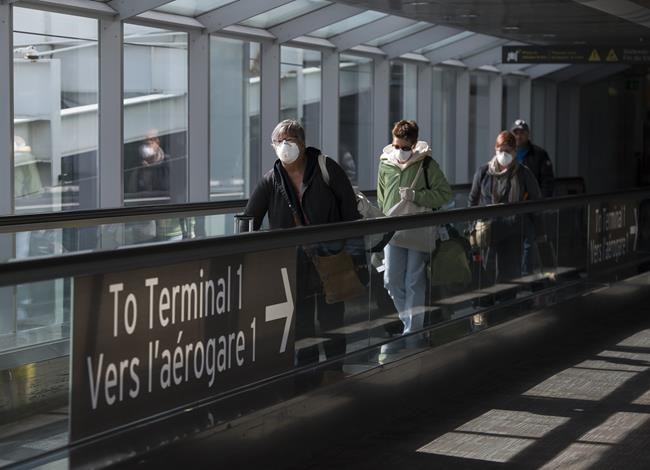
“If we don’t take these first steps in a harmonized way, we will spend many painful years recovering ground that should not have been lost,” said IATA director general Alexandre de Juniac.
IATA’s other proposed in-flight measures include pre-packaged meals to reduce interaction between passengers and crew and frequent “deep cleaning” of the cabin. But even with those precautions — already in place at most airlines — packing travellers into a plane is “really inviting disaster,” said Tim Sly, epidemiologist and professor emeritus at Ryerson University’s School of Public Health.
“That’s bad enough, putting 250 people in an aluminium cigar tube, all elbow to elbow breathing the same air for two, three, four, five, 10 hours,” Sly said in a phone interview.
He conceded modern airplanes have “a heck of a filter system built in,” but said masks alone cannot prevent the on-board spread of COVID-19.
“I think we have to be very, very careful,” he said, “unless the people sit there with almost a hazmat kind of set-up…connected directly to the air supply above.”
Safety and health authorities have stressed physical distancing on land and in the skies since the outbreak began.
Transport Canada listed “social” distancing among the “key points” in preventing the spread of the virus as part of a guide issued to the aviation industry last month.
“Operators should develop guidance for spacing passengers aboard aircraft when possible to optimize social distancing,” the document states.
Air Canada and WestJet Airlines Ltd. — both of which the association counts among its 290-odd members — say their pandemic policies block the sale of adjacent seats in economy class or throughout the entire plane.
“The middle seat on our Boeing 737s and 787 aircraft and every other seat on our Bombardier Q400 has been made unavailable to book to ensure our guests and crew can continue to fly safely and have more space to adhere to social distancing guidelines,” WestJet spokeswoman Morgan Bell said in an email.
The policy is in place until June 30, “and we will re-evaluate this initiative as required,” she said.
An Air Canada spokesman said that “it is not possible to speculate on the future possibilities.”
In its proposal — titled Biosecurity for Air Transport: A Roadmap for Restarting Aviation — IATA recommended temperature screening by government staff at airport points of entry before departure and, if required by authorities, upon arrival.
Temperature checks’ effectiveness remains disputed as the virus may still be in an incubation period or manifest only mild or no symptoms when an individual is scanned.
“The more you actually understand this virus, the more you begin to know that temperature-taking is not effective at all,” Dr. Theresa Tam, Canada’s top public health official, said earlier this month.
“Even if you are infected, we know that the likelihood of picking up someone who is symptomatic is relatively inefficient,” she said.
Pre-flight measures should aim to reduce contact points and lines — the defining traits of many passengers’ airport experience — through measures such as “redesigned gate areas” and unassisted bag drops with home-printed luggage tags, IATA said.
On arrival, travellers should expect health declarations and automated customs processes that rely on apps and biometric technologies, it added.
Dr. Paul Pottinger, professor of infectious diseases at the University of Washington’s School of Medicine, said face coverings do “the great majority of work” to reduce transmission risk. But “inevitably” some passengers will touch shared armrests or lower their mask to eat, making physical distancing all the more important.

“The proverbial two-metre personal space, that is based on science,” Pottinger said. “It is a layer of protection that I envision for all of us regardless of whether you are squeezed into an aluminum tube or walking down the street — the virus doesn’t care.
“The question, I think, is not one of viruses and infection, it’s one of economics,” he said. “Is that risk small enough that people would be willing to pay a price for in terms of the premium on their ticket?”
IATA estimates that revenues generated by airlines in the Canadian market will fall by $14.6 billion or 43 per cent this year as travel remains at a virtual standstill amid border shutdowns and plummeting demand.
This report by The Canadian Press was first published May 19, 2020.
Companies in this story: (TSX:AC)
Related Articles
Airline customers recoup money via chargebacks

Advertisement Advertise With Us
Advertisement Advertise With Us