Companies gear up for return to work with new policies to stop COVID-19 spread

Advertisement

Advertise with us

TORONTO - When employees at boot manufacturer Royer headed back to work last week, their days started with a temperature check as they filed in to the Quebec-based company's facilities while remaining at least six feet apart.

Read this article for free:


By clicking the button above, an account will be created and you will begin to receive some of our recommended newsletters. You may opt out of any newsletter by visiting your Email and Communication Preferences page or by clicking "unsubscribe" at the bottom of any email.

or

Already have an account? Log in here »

To continue reading, please subscribe:

Digital Subscription

One year of digital access for only $1.44 a week*

  • Enjoy unlimited reading on winnipegfreepress.com
  • Read the E-Edition, our digital replica newspaper
  • Access News Break, our award-winning app
  • Play interactive puzzles

*Billed as $5.77 plus GST every four weeks. After 52 weeks, price increases to the regular rate of $19.95 plus GST every four weeks. Offer available to new and qualified returning subscribers only. Cancel any time.

To continue reading, please subscribe:

Add Free Press access to your Brandon Sun subscription for only an additional

$1 for the first 4 weeks*

  • Enjoy unlimited reading on winnipegfreepress.com
  • Read the E-Edition, our digital replica newspaper
  • Access News Break, our award-winning app
  • Play interactive puzzles
Start now

*Your next Brandon Sun subscription payment will increase by $1.00 and you will be charged $17.95 plus GST for four weeks. After four weeks, your payment will increase to $24.95 plus GST every four weeks.

Hey there, time traveller!
This article was published 01/05/2020 (2374 days ago), so information in it may no longer be current.

TORONTO – When employees at boot manufacturer Royer headed back to work last week, their days started with a temperature check as they filed in to the Quebec-based company’s facilities while remaining at least six feet apart.

They were asked whether they had a runny nose, cough, cold or trouble breathing. Reminders to wash their hands regularly were handed out along with face masks and visors before anyone made it to a work station. At lunch time, workers noticed microwaves had been removed to keep them from spreading germs.

“The first day was complicated, with patience needed for everybody,” said Claude O’Reilly, Royer’s executive manager of Canadian operations. “Then after that — it’s been two weeks now — there’s no complaints, no questions, no nothing.”
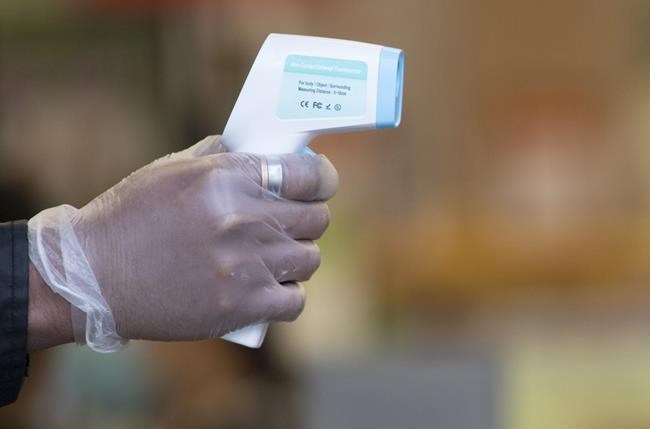
A grocery store security guard takes peoples temperatures prior to allowing them into the store in downtown Vancouver on Wednesday, April 29, 2020. When employees at heavy-duty boot manufacturer Royer headed back to work last week, their day started by having their temperature checked as they filed in to the Quebec-based company's facilities while making sure they were at least six feet apart from each other. THE CANADIAN PRESS/Jonathan Hayward

Royer was among the first wave of businesses that reopened in the midst of COVID-19, helping create a blueprint for the scores of companies that will soon follow suit in Quebec, Saskatchewan and Prince Edward Island.

Those provinces are the first to attempt a gradual return to work — a time-consuming and sometimes costly process that will come with plenty of changes to facilities, policies and interactions on the job.

Before they returned to work, O’Reilly said Royer pored over government and public health guidance and liaised with its union to come up with precautionary measures. Gallons of hand sanitizer and alcohol disinfectant were purchased.

Those who sew some of the boot parts already have distance between their machines and don’t face each other, which made the return to work easy for them, said O’Reilly.

In Regina, chief executive Greg Dukart is preparing to restart golfing at the Wascana Country Club, where Brooke Henderson won the CP Women’s Open in 2018.

“There is great excitement, because at one time there was a thought that there would be no golf or golf in the fall and that really petrified a lot of people,” he said.

On May 15, when the private club opens, golfers will be met by an attendant outdoors, who will answer questions and explain the changes.

The clubhouse will remain closed and there will be no ball washers or course furniture. Members will have access to items stored in their lockers and their clubs through a delivery service and the club will continue using its online lottery system to set up tee times and minimize contact.

Dukart said members who have heard about the changes have been understanding.

“It is what it is. It could be a heck of a lot worse with no golf,” he said.

Ontario has yet to begin the reopening of its economy, but this week unveiled industry-specific guidelines for when companies get the go-ahead.

Businesses, it said, should discourage sharing of telephones, keyboards, desks or workstations, reposition furniture to increase physical distances or install barriers and partitions, and stagger start times and breaks.

In the construction, agriculture and trucking industries, businesses are being told to plan for enough tools to be on site so workers don’t have to share, limit the number of people who use elevators and hoists at one time and disinfect trucks and equipment upon returning them.

Auto companies are being advised to limit services and open on an appointment-only basis. If companies have service bays with little distance in between, the government recommends using every other one.

Even once up and running, it won’t necessarily be smooth sailing.

At Royer, O’Reilly said workers are concerned about warmer weather, worrying that wearing a mask is going to be hot.

“We’ll see how things pan out,” he said. “Maybe we will decide to work on the half days because it won’t be too hot for them.”

This report by The Canadian Press was first published May 1, 2020.

Report Error Submit a Tip

More Stories

One-on-one Journalism Training

0 minute read Wednesday, Jun. 18, 2025

The new normal in Canadian politics

David McLaughlin 5 minute read Preview

The new normal in Canadian politics

David McLaughlin 5 minute read 2:01 AM CDT

“Nothing happening, all at once.”

Welcome to the new normal of Canadian politics, where normality is the new normal. Routine and stable are in; disruptive and excessive are out. Exhibits A and B are the Alberta referendum and the British Columbia election. Voters opted for stability over volatility.

The opposite of being normal is being different from the norm. In politics that means different from where we’ve been and what we’ve come to expect. Two competing trends have dominated our politics for the past decade and a half — progressivism and populism. Think Justin Trudeau and liberal, progressive identity politics in Canada, and Donald Trump and conservative, populist MAGA politics in America. We are now experiencing a swing away from both those trends.

Representing this “new normal” are Prime Minister Mark Carney, for one, and newly elected British Columbia premier, Lorne Doerksen, for another. Both are considered normal because they talk and act like adults in a childish political world. Their political flair is to not have any political flair. They stand out for not standing out.

Read
2:01 AM CDT

Doctor’s departure stressful for teen

Kevin Rollason 6 minute read Preview

Doctor’s departure stressful for teen

Kevin Rollason 6 minute read Sunday, Oct. 24, 2021

Morgan Walker is a typical teen — but only because a piece of his brain the size of a deck of cards was removed four years ago.

Walker, who had seizures multiple times a day before his surgery, fears other people might not be so lucky.

That’s because his surgeon, Dr. Demitre Serletis, is leaving the province and Health Sciences Centre. Serletis will start practising at the Cleveland Clinic in the new year.

“I was kind of shocked, but I understood why,” Walker said from his home in Brandon. “The government really hasn’t been respecting doctors.”

Read
Sunday, Oct. 24, 2021

Fact Check

1 minute read Thursday, Nov. 30, 2023

Fact Check

Having problems with the form?Contact Us Directly |

Human rights museum responds to reopening backlash

Julia-Simone Rutgers 4 minute read Preview

Human rights museum responds to reopening backlash

Julia-Simone Rutgers 4 minute read Thursday, Jul. 29, 2021

The Canadian Museum for Human Rights reopened to fully vaccinated members of the public this week, drawing cries of discrimination from those who have chosen not to get vaccinated against COVID-19.

While the some of the backlash has been “disturbing,” museum CEO Isha Khan said the conflict has opened room for a conversation about human rights during the pandemic.

“We made the decision to open in compliance with that law, really because we’re a public institution and we saw it as our responsibility to open as soon as we could to the public — within the restrictions as they currently are,” Khan said Thursday.

“But it’s really important to us, as the Canadian Museum for Human Rights we have a mandate for human rights education, that we’re trying to ground the conversation in human rights principles.”

Read
Thursday, Jul. 29, 2021

Brandon manufacturer says Canadian steel in demand, but high costs, long delivery times hit hard

Gabrielle Piché 6 minute read Preview

Brandon manufacturer says Canadian steel in demand, but high costs, long delivery times hit hard

Gabrielle Piché 6 minute read 2:01 AM CDT

Something’s different in a Brandon plant.

Building envelope panels — or shells for homes and commercial buildings — keep being produced at Greenstone Building Products.

But the galvanized steel used by workers has been arriving later and the price is constantly increasing, according to company leadership.

“It’s just a little bit nerve-wracking for us to hear the opposite narrative,” said Tilda Fortier, Greenstone Building Products’ business manager.

Read
2:01 AM CDT