Parliament to sit again to approve more COVID-19 relief as spending climbs

Advertisement

Advertise with us

OTTAWA - Parliamentarians will soon find themselves voting anew on spending measures to help the country to combat the financial fallout from COVID-19 — help that is going to cost the federal treasury at least $95 billion — as the result of changes the Liberals have promised in recent days.

Read this article for free:


or

Already have an account? Log in here »

To continue reading, please subscribe:

Subscribe and receive a limited-edition Free Press branded hat or tote.

Digital Subscription

One year of digital access for only $205*

  • Enjoy unlimited reading on winnipegfreepress.com
  • Read the E-Edition, our digital replica newspaper
  • Access News Break, our award-winning app
  • Play interactive puzzles

*First annual payment billed as $205.00 + GST for one year. This annual subscription will automatically renew at $233.00 + GST every 52 weeks (10% off the regular annual price of $259.35). Offer available to new and qualified returning subscribers only. Cancel any time.

To continue reading, please subscribe:

Add Free Press access to your Brandon Sun subscription for only an additional

$1 for the first 4 weeks*

  • Enjoy unlimited reading on winnipegfreepress.com
  • Read the E-Edition, our digital replica newspaper
  • Access News Break, our award-winning app
  • Play interactive puzzles
Start now

*Your next Brandon Sun subscription payment will increase by $1.00 and you will be charged $17.95 plus GST for four weeks. After four weeks, your payment will increase to $24.95 plus GST every four weeks.

Hey there, time traveller!
This article was published 01/04/2020 (2374 days ago), so information in it may no longer be current.

OTTAWA – Parliamentarians will soon find themselves voting anew on spending measures to help the country to combat the financial fallout from COVID-19 — help that is going to cost the federal treasury at least $95 billion — as the result of changes the Liberals have promised in recent days.

Conservatives criticized the Liberals for not getting their plans right the first time; the Bloc Quebecois criticized them for bowing to Conservative demands and limiting their own freedom to deal with changing circumstances.

It was just last week that Parliament hastily passed a suite of spending and lending to help businesses and workers affected by the pandemic, in a special sitting with only a handful of MPs.
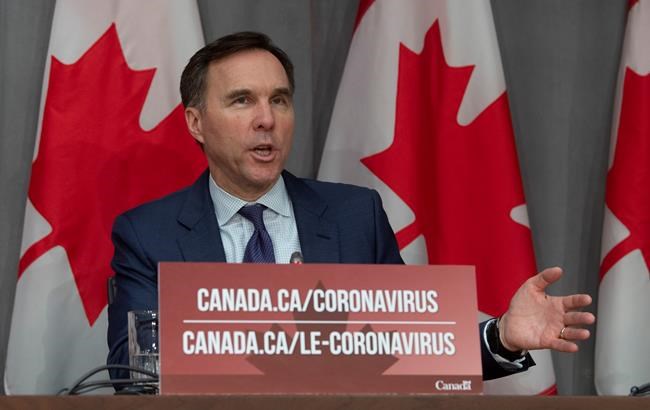
Minister of Finance Bill Morneau responds to a question during a news conference in Ottawa, Friday, March 27, 2020. THE CANADIAN PRESS/Adrian Wyld

On Wednesday, Prime Minister Justin Trudeau said he’s planning to have MPs and senators come back for another sitting to pass additional items in what he described as perhaps the biggest economic bailout and social program this country has ever seen.

The legislation created a 10 per cent wage subsidy for small businesses, but officials briefing reporters about a new 75 per cent subsidy program said the bailout bill didn’t include the expanded program.

The Liberals didn’t put a timeline on when Parliament will be recalled — a process that, under the practice used last time, will require picking a small group of parliamentarians to review and vote on measures.

“The magnitude of the measures that we know are necessary means that it would be a good idea to bring Parliament back to work on them,” Deputy Prime Minister Chrystia Freeland said during a midday press conference.

Opposition parties will have a chance to hear more from Finance Minister Bill Morneau when he appears Thursday afternoon in a teleconference meeting of the House of Commons finance committee.

Conservative Leader Andrew Scheer said his party is ready to amend the law, but argued the problem shouldn’t have happened in the first place.

The Tories objected to a clause that would have given the Liberals the power to spend and tax without parliamentary approval through to December 2021, which the Liberals ultimately backed down on.

“Instead of focusing on legislation to help businesses get through this crisis, they spent their time focusing on a massive power grab to give themselves new and unprecedented powers,” Scheer said during a press conference in his home city of Regina.

In a statement, Bloc Quebecois Leader Yves-Francois Blanchet said the wage subsidy would have been part of the original bill if not for Tories who asked for its removal.

He asked the government to provide the wording of the new bill to all parliamentarians and that the parties agree on the final text before anyone travels to Ottawa.

The new subsidy will cost $71 billion while a direct benefit to out-of-work Canadians will cost about $24 billion, Morneau said in his own news conference Wednesday. The combined measures bring direct financial aid for the economic crisis to more than $105 billion, he said. On top of that is $85 billion in tax deferrals for individuals and businesses, and $65 billion in loans.

Companies that qualify for the larger wage subsidy will need to show at least a 30 per cent drop in revenues due to COVID-19 compared to the same month last year — or a more recent month for a reasonable comparison for a business that is less than a year old, like a startup.

For charities and non-profits, some eligibility details are still being worked out, officials said.

Employers receiving the benefit can be of any size, but can’t be publicly funded, and recipients will be expected do whatever they can to pay the remaining 25 per cent of their employees’ wages.

Officials said it will take between three and six weeks to flow funding that will be capped at $847 per employee, per week.

The Canadian Federation of Independent Business said several design features and unanswered questions may prevent the program from meeting its goal of reducing layoffs.

“If employers are not able to know with certainty whether they will qualify for the subsidy, many will be forced to lay off workers,” CFIB president Dan Kelly said in a statement.

Any worker who receives the wage subsidy can’t also receive a $2,000-a-month emergency benefit that requires an eligible recipient to not be earning any money.

Kevin Milligan, a University of British Columbia economics professor, wrote this week that the government will have to consider how to use the benefit to help those with a severe drop in earnings, as well as students.

His report for the C.D. Howe Institute said “more policy work is needed to fortify” the benefit so it can fully help “bridge our economy across the crisis.”

Applications open April 6 for those born in the first quarter of the calendar year, between January and the end of March. Workers with birthdays in the second quarter can apply April 7, those born in the third quarter on April 8 and those born in the final three months of the year on April 9.

The schedule was designed to avoid overwhelming already taxed systems.

In the last two weeks, some 2.1 million people have applied for employment insurance benefits, Employment Minister Carla Qualtrough said —a number dramatically higher than what the program normally sees. Federal workers have processed more than 430,000 claims, and a new system being implemented Wednesday will help quickly address the backlog, Qualtrough said.

Those approved for EI will be automatically moved over to the new benefit.

This report by The Canadian Press was first published April 1, 2020.

Report Error Submit a Tip

More Stories

Jets rookies look to make an impression in tournament

Mike McIntyre 1 minute read Preview

Jets rookies look to make an impression in tournament

Mike McIntyre 1 minute read Thursday, Sep. 5, 2019

His resumé certainly stands out amongst his peers. Now the challenge is for Kristian Vesalainen to make a similar impression on the ice.

Vesalainen, 20, is Winnipeg's most notable prospect to have travelled to Belleville, Ont., for the Rookie Showcase tournament. The Jets hopefuls will play three games against future Montreal Canadiens and Ottawa Senators beginning tonight, with additional games on Sunday and Monday.

“Great to be back. I’m excited to start a new season," Vesalainen, the 24th-overall pick in the 2017 NHL draft, said Thursday after his team skated at Bell MTS Iceplex prior to getting on a plane. “Just get a good feeling, playing with the guys. Just get touches on the ice and obviously show what I can do.”

There's no question Vesalainen has the tools, and there should be plenty of opportunity for him to translate that into a bigger role with the Jets this season. The big, skilled winger made the team out of camp last year, recording one assist in five games before being relegated to the press box as a healthy scratch, then sent to the Manitoba Moose of the AHL for further seasoning.

Read
Thursday, Sep. 5, 2019

Use it twice: a data centre we could support

Hersh Seth 5 minute read Preview

Use it twice: a data centre we could support

Hersh Seth 5 minute read Thursday, Jul. 30, 2026

In June, Premier Wab Kinew rejected a massive AI data centre planned near Île-des-Chênes. The project would have used 500 megawatts of power, which is about the same as the Grand Rapids generating station, and would have run on six natural gas turbines. Kinew said the environmental cost was too high and the long-term benefit for Manitobans was too low.

He made the right call. But simply saying no to data centres is not enough.

Winnipeg is a cold city. Data centres are basically huge electric heaters with computers inside. Almost every watt they use turns into heat, and most facilities pay to release it into the air. In a city that spends half the year paying to stay warm, that’s not just waste; it’s an opportunity. The idea is simple: use the energy twice. First for computing, then for heating our buildings.

The stakes are real. Manitoba Hydro’s new resource plan says peak demand will exceed our capacity as early as 2029 or 2030, and that the province will need about 1,760 additional megawatts of dependable capacity by 2035.

Read
Thursday, Jul. 30, 2026

Expert urges food, drink makers to look to foreign markets

Gabrielle Piché 5 minute read Preview

Expert urges food, drink makers to look to foreign markets

Gabrielle Piché 5 minute read Yesterday at 5:04 PM CDT

Canada’s slowing population growth could restrict business expansion, a top economist for Farm Credit Canada warned Manitoba manufacturers.

Craig Johnston, the federal Crown corporation’s chief economist, addressed Prairie businesses at Farm Credit Canada’s Food and Beverage Summit Tuesday.

“There could be some modest growth in Canadian consumption of food and beverage,” Johnston said, relaying population numbers inside a Victoria Inn Hotel conference room.

Still, per-person spending on food is “stagnant, if not somewhat rising,” Johnson later told reporters.

Read
Yesterday at 5:04 PM CDT

Billions of dollars spent on health, but scattershot financial reporting leaves decision-makers, Manitobans in the dark, auditor general says

Nicole Buffie 3 minute read Preview

Billions of dollars spent on health, but scattershot financial reporting leaves decision-makers, Manitobans in the dark, auditor general says

Nicole Buffie 3 minute read Yesterday at 5:20 PM CDT

Manitoba’s auditor general says significant gaps in health-sector financial reporting make it difficult to understand how billions of dollars in public funds are spent.

Auditor General Tyson Shtykalo is calling for clearer, more transparent reporting in his latest report, titled Observations on Health Sector Financial Reporting and Accountability in Manitoba.

“Manitoba spends nearly $10 billion annually on health care, but current financial reporting does not provide a clear picture of how that money is spent, what services cost, or the financial pressures facing the system,” Shtykalo said in a news release.

While some financial information is available, the reports do not provide a “complete, consistent, or easily understood” picture of how health-care funds are spent, the report said.

Read
Yesterday at 5:20 PM CDT

Winnipeg Rifles can still secure post-season berth despite starting season 0-4

Joshua Frey-Sam 5 minute read Preview

Winnipeg Rifles can still secure post-season berth despite starting season 0-4

Joshua Frey-Sam 5 minute read 12:47 PM CDT

The Winnipeg Rifles have a seat at the table, something they would’ve certainly taken a few weeks ago.

A solid three-phase performance in a 25-13 win over the Edmonton Huskies on Sunday kept the junior football club’s playoff hopes alive as the team heads into the final week of the regular season in the Prairie Football Conference.

The path to punching their ticket isn’t easy, however. The Rifles must travel to a perennially difficult environment in Saskatoon to face the Hilltops (4-3) on Sunday (1 p.m.), a contest that only matters if the Huskies beat the Edmonton Wildcats on Saturday.

But after starting the season 0-4, it’s a deal that the Rifles will happily take.

Read
12:47 PM CDT

‘In Normandy, we remember’

Aaron Epp 4 minute read Preview

‘In Normandy, we remember’

Aaron Epp 4 minute read Saturday, Sep. 26, 2026

Travelling nearly 7,000 km from his home in France to Winnipeg gave Gabriel Zaranski a new perspective on warfare.

“It’s very different to speak about war in school (than) to speak with real people who (have fought) in a war,” he said. “We can feel the emotion when they speak … The testimony has more impact when it’s real soldiers.”

Zaranski is one of 14 Grade 12 students from Bayeux, a town in France’s Normandy region, in Winnipeg this week for a learning tour.

The students, who attend Lycée Arcisse de Caumont high school, met on Saturday with veterans from the Queen’s Own Cameron Highlanders of Canada, a local military regiment, to discuss their studies and the regiment’s role in the Second World War.

Read
Saturday, Sep. 26, 2026