Why the feds aren’t closing the door on non-essential businesses

Advertisement

Advertise with us

OTTAWA - While Canada's response to the COVID-19 outbreak has taken off drastically in the last week, some have found it lopsided across the country.

Read this article for free:


By clicking the button above, an account will be created and you will begin to receive some of our recommended newsletters. You may opt out of any newsletter by visiting your Email and Communication Preferences page or by clicking "unsubscribe" at the bottom of any email.

or

Already have an account? Log in here »

To continue reading, please subscribe:

Digital Subscription

One year of digital access for only $1.44 a week*

  • Enjoy unlimited reading on winnipegfreepress.com
  • Read the E-Edition, our digital replica newspaper
  • Access News Break, our award-winning app
  • Play interactive puzzles

*Billed as $5.77 plus GST every four weeks. After 52 weeks, price increases to the regular rate of $19.95 plus GST every four weeks. Offer available to new and qualified returning subscribers only. Cancel any time.

To continue reading, please subscribe:

Add Free Press access to your Brandon Sun subscription for only an additional

$1 for the first 4 weeks*

  • Enjoy unlimited reading on winnipegfreepress.com
  • Read the E-Edition, our digital replica newspaper
  • Access News Break, our award-winning app
  • Play interactive puzzles
Start now

*Your next Brandon Sun subscription payment will increase by $1.00 and you will be charged $17.95 plus GST for four weeks. After four weeks, your payment will increase to $24.95 plus GST every four weeks.

Hey there, time traveller!
This article was published 18/03/2020 (2418 days ago), so information in it may no longer be current.

OTTAWA – While Canada’s response to the COVID-19 outbreak has taken off drastically in the last week, some have found it lopsided across the country.

In Ontario and Alberta, dine-in restaurants and bars are closed by provincial decree, while Quebec has shut down bars but ordered restaurants to limit the number of customers.

Other provinces have made no such order.
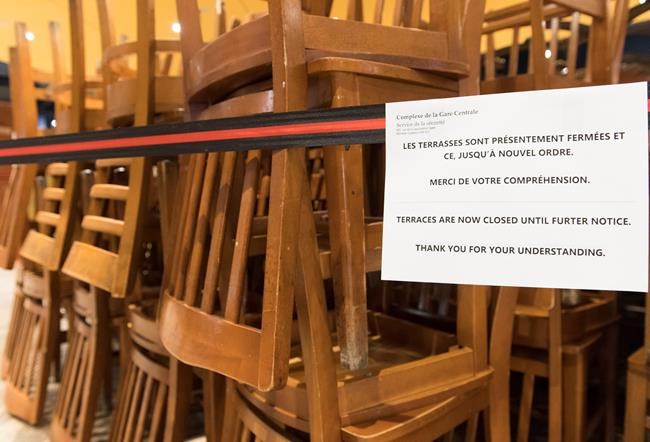
A sign notifying customers of a closed terrace is shown at food court in Montreal, Wednesday, March 18, 2020, as COVID-19 cases rise in Canada and around the world. THE CANADIAN PRESS/Graham Hughes

Even in a single city like Ottawa, there’s variation between which businesses have stayed open and which have shuttered to the public.

Businesses need more federal direction to avoid confusion, the Canadian Chamber of Commerce said Wednesday.

“One of the things businesses are looking for is more coherence,” said Perrin Beatty, president of the Canadian Chamber of Commerce.

Right now in Canada, the Public Health Agency of Canada and federal health minister provide advice to the provinces, but each province and territory is ultimately responsible for making its own decisions.

Beatty said the situation can be particularly vexing for companies that operate across jurisdictions.

“As rate of infection is growing, the same rules increasingly should apply across the board,” he said.

For some, without specific advice from the federal government, it can be a difficult financial proposition to voluntarily shut their doors, he said.

Federal authorities say that have been co-ordinating with provincial counterparts, but that local context is important.

“We very much recognize … that there are specific conditions in specific cities, specific provinces,” said Deputy Prime Minister Chrystia Freeland.

“That’s why we have public health officers also at the provincial and the city level.”

The provinces’ decisions about whether to close non-essential businesses comes down to the reality on the ground, including the number of cases of COVID-19 in the region and whether the area is seeing community transmission.

Chief public health officer Dr. Theresa Tam said it may also come down to a particular health system’s ability to deal with an outbreak. A weaker health system may take a more cautious approach, for example, she said.

Beatty suggested a national message might still be more helpful, even if it leaves room for exceptions. At least then the information would be coming from one source, he explained.

He did complement the federal government though on its open lines of communication with the business community.

And to some extent, he said it will be up to businesses to do the right thing for their customers and employees.

This report by The Canadian Press was first published March 18, 2020.

Report Error Submit a Tip

More Stories

Fact Check

1 minute read Thursday, Nov. 30, 2023

Fact Check

Having problems with the form?Contact Us Directly |

Rural hospital shutdowns continue into fall

Katie May 5 minute read Preview

Rural hospital shutdowns continue into fall

Katie May 5 minute read Monday, Sep. 12, 2022

Summer shutdowns at some rural Manitoba hospitals have quietly extended into fall, and the uncertainty about reopening is frustrating residents.

Read
Monday, Sep. 12, 2022

Olympics Overnight: Speedskater Blondin wins silver in the mass start, Bowman narrowly misses podium in halfpipe skiing, Jamaica returns to bobsled track

Richie Assaly - Toronto Star, Toronto Star 6 minute read Preview

Olympics Overnight: Speedskater Blondin wins silver in the mass start, Bowman narrowly misses podium in halfpipe skiing, Jamaica returns to bobsled track

Richie Assaly - Toronto Star, Toronto Star 6 minute read Saturday, Feb. 19, 2022

Here’s what you missed overnight at Day 15 of the 2022 Beijing Olympics.

Read
Saturday, Feb. 19, 2022

Human rights museum responds to reopening backlash

Julia-Simone Rutgers 4 minute read Preview

Human rights museum responds to reopening backlash

Julia-Simone Rutgers 4 minute read Thursday, Jul. 29, 2021

The Canadian Museum for Human Rights reopened to fully vaccinated members of the public this week, drawing cries of discrimination from those who have chosen not to get vaccinated against COVID-19.

While the some of the backlash has been “disturbing,” museum CEO Isha Khan said the conflict has opened room for a conversation about human rights during the pandemic.

“We made the decision to open in compliance with that law, really because we’re a public institution and we saw it as our responsibility to open as soon as we could to the public — within the restrictions as they currently are,” Khan said Thursday.

“But it’s really important to us, as the Canadian Museum for Human Rights we have a mandate for human rights education, that we’re trying to ground the conversation in human rights principles.”

Read
Thursday, Jul. 29, 2021

State of Manchester United goes beyond ‘favourite soap opera’ status

Jerrad Peters 7 minute read Preview

State of Manchester United goes beyond ‘favourite soap opera’ status

Jerrad Peters 7 minute read Yesterday at 1:17 PM CDT

Last Sunday, during Manchester United’s embarrassing 3-0 loss at home to Bournemouth, supporters in the Stretford End of Old Trafford unveiled a giant banner in protest of their club’s decline.

Beneath depictions of three iconic captains — Eric Cantona, Roy Keane and Bryan Robson — it presented a single word: “STANDARDS.” It wasn’t lost on anyone, as the Red Devils slumped to their meek defeat, that the banner represented the only “standards” in the stadium that afternoon.

The players were booed off the field, and the rest of the week was spent rehashing the inquiry of what, this time, might be wrong with England’s biggest club — an ongoing conversation the BBC has described as “one of the nation’s favourite soap operas.”

Inevitably, the public looked to the trio of greats whose likenesses looked down on the Bournemouth debacle to help make sense of the performance, of the ever-lowering bar of expectations and of the club’s more deep-rooted problems.

Read
Yesterday at 1:17 PM CDT

Herd charge out of the gate

Joshua Frey-Sam 5 minute read Preview

Herd charge out of the gate

Joshua Frey-Sam 5 minute read Yesterday at 10:38 PM CDT

The Manitoba Bisons have designs on finding some sustained success this season.

A solid first step was taken Friday night, as the Bisons earned a hard-fought 83-70 season-opening victory against the cross-town rival Winnipeg Wesmen in Canada West women’s hoops action at the Duckworth Centre.

Fourth-year forward Anna Miko propelled the Bisons on the strength of an 18-point, 10-rebound double-double, while Samantha Onyebuchi also supplied an 11-point, 10-rebound double-double.

“We’ve all basically played against each other for the last, what, six-ish years? So I mean it’s nice to come compete in university, but especially in their gym, it’s sweeter to get the win,” Miko said.

Read
Yesterday at 10:38 PM CDT